How Brew Ratio Actually Works (And Why It's the First Number Worth Tracking)
Understanding the relationship between coffee dose and water weight gives home brewers a single adjustable lever that changes every cup in a predictable direction.
Most home brewing advice hands you a recipe and asks you to follow it. Use this many grams of coffee, this many milliliters of water, brew for this long. That works fine until something tastes off and you have no idea which part to move. Brew ratio is the concept that turns a rigid recipe into a flexible tool you actually understand.
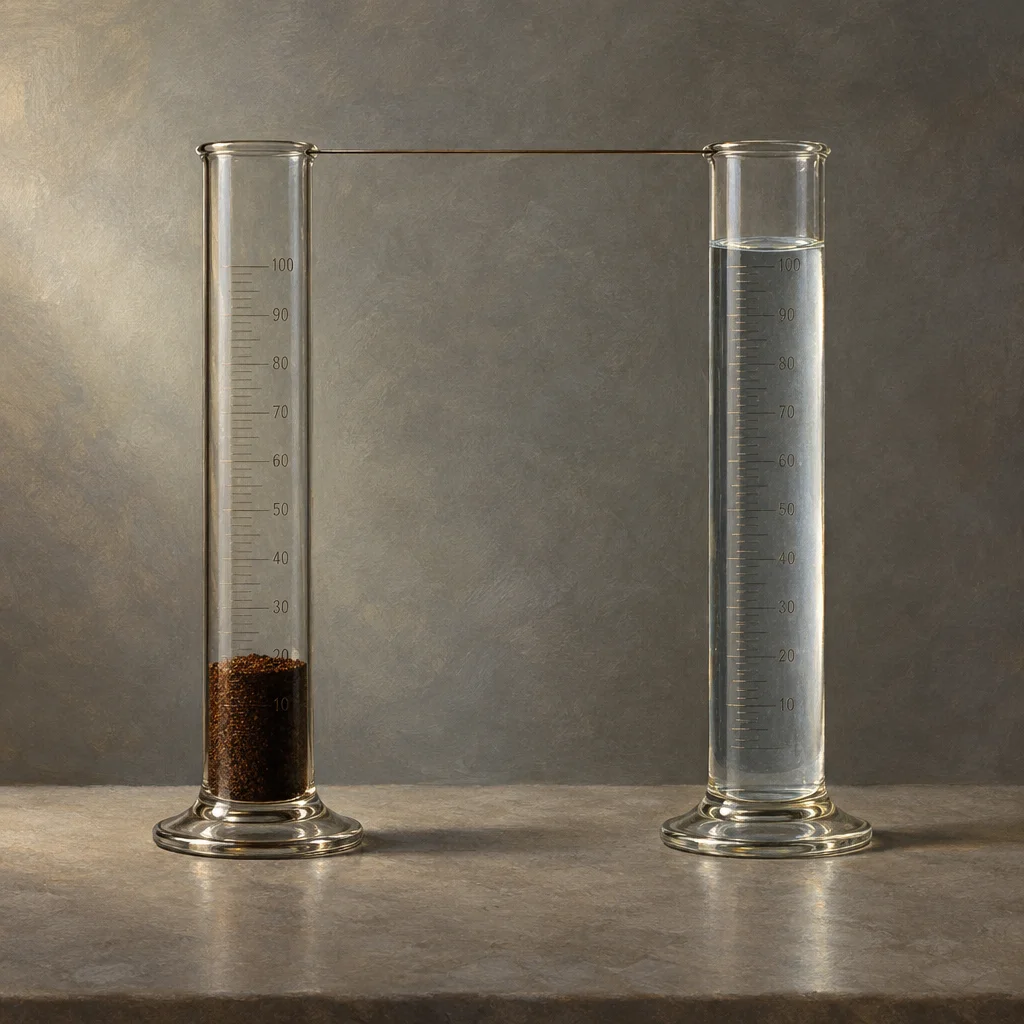
The short version: brew ratio is the relationship between how much dry coffee you use and how much water you brew with. It's usually written as a ratio like 1:15 or 1:17, where the first number is always 1 (representing your coffee dose) and the second number tells you how many parts water go with it. So a 1:15 ratio means 15 grams of water for every 1 gram of coffee. A 1:17 ratio means 17 grams of water per gram of coffee.
This might sound like an abstract way to describe something you could just measure with a scoop, but it becomes genuinely useful the moment you want to make a bigger batch, scale down to a single cup, or understand why one cup tastes thicker or thinner than another.
Why the ratio number matters more than the individual amounts
Imagine you normally brew 20 grams of coffee with 320 grams of water. That's a 1:16 ratio. Now say you want to brew two cups instead of one. If you just double the water to 640 grams but forget to double the coffee, your ratio changes to 1:32 and the result will taste thin and hollow. If you track the ratio instead of just the water volume, scaling becomes straightforward: 40 grams of coffee, 640 grams of water, same 1:16, same cup.
The ratio is also the clearest way to describe what you're going for before you brew. Telling someone you use a 1:15 ratio communicates something real about the strength and extraction target you're aiming at. Telling someone you use 18 grams of coffee without mentioning the water doesn't tell them much at all.
What different ratios actually produce in the cup
Generally speaking, lower second numbers (like 1:13 or 1:14) produce a stronger, more concentrated cup because you're using more coffee relative to the water. Higher second numbers (like 1:17 or 1:18) produce a lighter, more delicate cup because the same amount of coffee is being diluted across more water.
The useful range for most home pour-over and drip brewing sits somewhere between 1:14 and 1:18. Espresso uses much lower ratios around 1:2, which is why it's so concentrated and why you drink it in small volumes. French press and full-immersion methods often land around 1:15 to 1:17. These aren't rules, they're starting points.
If your coffee consistently tastes too intense or heavy, try moving your ratio up by one or two points. Brewing at 1:15 and finding it too strong? Try 1:16 or 1:17 before changing anything else. If it tastes watery or flat, move the ratio down. This is a cleaner first adjustment than changing your grind or your dose in isolation, because it changes the concentration without necessarily changing extraction.
How to use ratio to separate two different problems
This is where ratio thinking becomes a real diagnostic tool. There are two distinct things that can make a coffee taste weak: low extraction and low strength. They feel similar in the cup but have different causes and different fixes.
Low strength means the coffee is under-concentrated. There's simply not enough dissolved coffee relative to the water volume. The fix is a lower ratio number, meaning more coffee per unit of water.
Low extraction means the coffee's solubles weren't fully pulled out during brewing, often because the grind was too coarse, the water too cool, or the brew time too short. The fix isn't adding more coffee, it's adjusting one of those extraction variables.
If you increase your dose (and keep the same water volume, tightening your ratio) and the cup improves noticeably, strength was likely your problem. If you tighten the ratio and the cup still tastes thin, hollow, or sour, extraction is probably the issue and the ratio alone won't solve it.
Using ratio as a deliberate test helps you isolate the problem instead of adjusting multiple variables at once and never knowing which one helped.
Measuring in weight versus volume
Ratio is most useful when you're measuring by weight in grams rather than by volume in tablespoons or scoops. Volume measurements for ground coffee are inconsistent because different coffees have different densities. A tablespoon of a light, airy natural-process coffee weighs less than a tablespoon of a denser, washed bean, so the same scoop produces a different ratio every time you switch bags.
A simple kitchen scale that measures to the gram is the one tool that makes ratio tracking practical. You don't need anything fancy. Once you're measuring both your coffee and your water by weight, you can calculate and repeat your ratio reliably across any bag of coffee.
Finding your personal starting ratio
If you're not sure where to begin, 1:16 is a reasonable neutral starting point for most pour-over and drip methods. Brew a cup at that ratio, taste it without adjusting anything, and then decide whether you want it stronger or lighter. Move the ratio by one point in either direction and brew again. Most people find a ratio they like within three or four attempts, and once you know your number, you have a foundation that travels with you to every new bag of coffee.
You don't have to memorize ratios or think in fractions while you're brewing. In practice, it's just a simple multiplication. If your ratio is 1:15 and you want to use 22 grams of coffee, multiply 22 by 15 and aim for 330 grams of water. That's the whole calculation.
Ratio won't fix every problem in your cup. Grind consistency, water quality, and brew time all still matter. But as a first concept to understand and track, it gives you more useful information per minute of attention than almost anything else in the home brewing toolkit.