How Rest Time After Roasting Changes What Your Coffee Actually Tastes Like
The days between roasting and brewing matter more than most home brewers realize, and understanding the window helps you time your first cup deliberately.
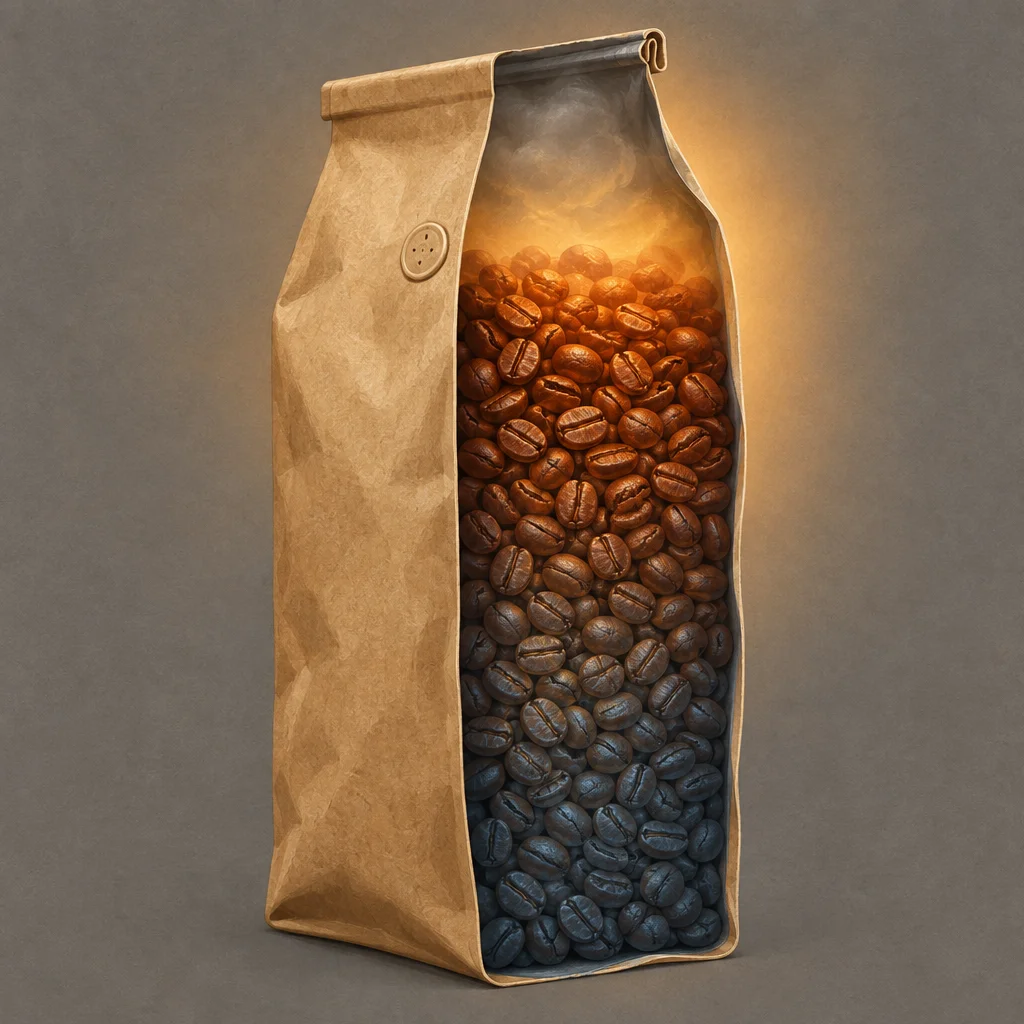
Most coffee bags have a roast date printed on them. A lot of home brewers glance at it, maybe feel good that the number is recent, and then brew immediately. That instinct makes sense. Fresh feels right. But with coffee, freshness is a range, not a single point, and brewing too soon after roast can produce a cup that tastes just as off as one brewed too late.
Here is what is actually happening inside the bag, and how to use that knowledge to time your brews better.
What degassing is, in plain terms
When coffee beans are roasted, heat drives chemical reactions that produce carbon dioxide as a byproduct. That CO2 gets trapped inside the bean's cellular structure. After roasting ends, the beans start releasing it slowly. This process is called degassing, and it continues for days to weeks depending on the bean, the roast level, and how the coffee is stored.
CO2 is not harmful. But when a significant amount of it is still escaping from the grounds during brewing, it creates a physical barrier between the water and the coffee particles. The gas is leaving so aggressively that it disrupts even contact between water and grounds. The result is uneven extraction, and the flavor that comes through tends to be sharp, sour, or thin in a way that does not improve with grind adjustments.
This is also why a very fresh bag blooms dramatically. That big, domed puff of grounds you see during your first pour is mostly CO2 escaping all at once. A generous bloom is not automatically a good sign. It tells you the beans are releasing a lot of gas, which can mean they are not ready yet.
The window looks different for different roasts
Light roasts and dark roasts degas at different rates, and this is worth knowing if you tend to buy one style consistently.
Light roasts are denser because they have been subjected to less heat for less time. They hold onto CO2 longer and degas more slowly. A light roast brewed at two days off roast is likely to taste underdeveloped, hollow, and acidic in an unpleasant way. Many roasters who specialize in light-roasted coffee suggest waiting anywhere from one to two weeks before opening the bag, sometimes longer for certain origins or processing styles.
Dark roasts are more porous because extended heat exposure opens up the bean's cell walls. Gas escapes faster. A dark roast that would be too fresh at day three is often ready by day five or six. The tradeoff is that dark roasts also lose their best flavors more quickly once that degassing period ends, since the same open cell structure lets oxygen in.
Medium roasts sit somewhere in the middle, which is part of why they are forgiving for home brewers. The sweet spot for a medium roast tends to fall somewhere between five days and two weeks off roast, depending on the specific coffee.
None of these ranges are exact rules. They are starting points for paying attention.
How to use your roast date practically
If you buy beans locally or from a roaster who prints a roast date, try to plan a few days of rest before your first brew. If the bag arrives via mail and was roasted a week ago, you are probably in a good position to start brewing right away.
A simple habit that works well for many home brewers: open the bag, sniff the grounds dry before you brew. Coffee at peak rest tends to smell round and complex, with distinct top notes. Coffee that is too fresh often smells sharply gassy or grassy in a way that does not match how you would want your cup to taste. Coffee that is past its window starts to smell flat or papery. Your nose is not a calibrated instrument, but it gives you a useful first read.
You can also pay attention to how the bloom behaves over the first few brews from a new bag. A violently active bloom that spills over the sides of your dripper, or pushes grounds up in a way that is hard to control, suggests a lot of outgassing is still happening. As the days pass and you work through the bag, the bloom will calm down. When it settles into a gentle, dome-shaped puff that holds its shape, the coffee is usually in its best range.
What happens on the other end of the window
Resting coffee is not the same as aging it indefinitely. CO2 acts as a mild preservative inside the bean. As it escapes, oxygen starts to interact with the oils and aromatic compounds in the coffee, and those compounds gradually break down. The result is coffee that tastes flat, stale, or one-dimensional, without any of the sourness or sharpness of under-rested beans.
For whole bean coffee stored in a sealed bag or airtight container at room temperature, most specialty coffees are at their best somewhere between one week and four weeks off roast. After that, the cup still works, but you will likely notice that the interesting characteristics of the bean are fading.
Grinding accelerates this. Once you grind, the surface area exposed to air multiplies dramatically, and the coffee loses its best flavors within hours to a day. This is the strongest argument for grinding immediately before brewing rather than pre-grinding your whole bag.
A small shift in habit
You do not need to track dates obsessively or treat this like a science experiment. The practical change is small: look at the roast date when you buy a bag, give a light roast a few extra days before you start, and notice how the bloom changes as you work through the bag over the following week. That awareness alone will help you recognize when a disappointing cup is a timing issue rather than a recipe issue, which means you can stop adjusting your grind or your water temperature looking for a fix that will not come from either of those places.
Rest is not a step you have to do anything for. It just requires not opening the bag quite yet. That is one of the easier things to get right in home brewing once you know it matters.