How to Adjust Your Brew When You're Working With a New Bag of the Same Coffee
When a new bag of a familiar coffee arrives, three specific physical differences from the previous bag reliably shift your extraction before you change anything.
There's a particular kind of frustration that comes from doing everything right and still getting a bad cup. You're using the same beans you always order, the same grinder setting, the same pour, the same timer. But something tastes off. It's a little flat, or unexpectedly bitter, or thinner than you remember from last week.
A new bag is almost certainly involved. And it's not a coincidence.
Every bag of the same coffee you open is not actually the same coffee. It sounds strange, but it's true in a practical, physical sense. Even when the roaster, origin, and roast profile are identical on paper, the beans you pour into your grinder on bag two are different from the beans that finished bag one. Understanding the three most common reasons why gives you a clear, low-effort path to getting your cup back on track quickly.
The roast date gap changes how the coffee extracts
If you ordered the next bag before finishing the first, there's a good chance the new bag has a different roast date. That gap matters because coffee releases carbon dioxide steadily after roasting, and the rate of that release affects how water moves through the grounds during brewing.
A bag roasted three weeks ago extracts very differently from one roasted five days ago. Fresher beans bloom more aggressively, resist water penetration slightly at first, and can produce a faster drain on a pour-over or a shorter contact time in immersion brewing. Beans that have had more time to degas extract more readily, meaning the same grind setting and brew time can pull more from them before they tip into bitterness.
When you open a new bag, check the roast date and compare it to where the previous bag was in its timeline when you finished it. If your new bag is significantly fresher, you may want to coarsen your grind slightly or extend your brew time to compensate. If it's older, a slightly finer grind or shorter brew time might bring it back in line. Neither adjustment needs to be large. A single step on your grinder and a fifteen-second change in brew time are good starting points.
Density varies even within the same origin and roast level
Coffee bean density is not fixed from harvest to harvest or even lot to lot within the same farm. Growing conditions, rainfall, and processing methods all shift how dense the final bean is. Denser beans are harder, hold their structure longer in the grinder, and tend to produce a more uniform particle distribution at a given setting. Less dense beans grind a little faster and can produce a slightly wider range of particle sizes, which affects how evenly your cup extracts.
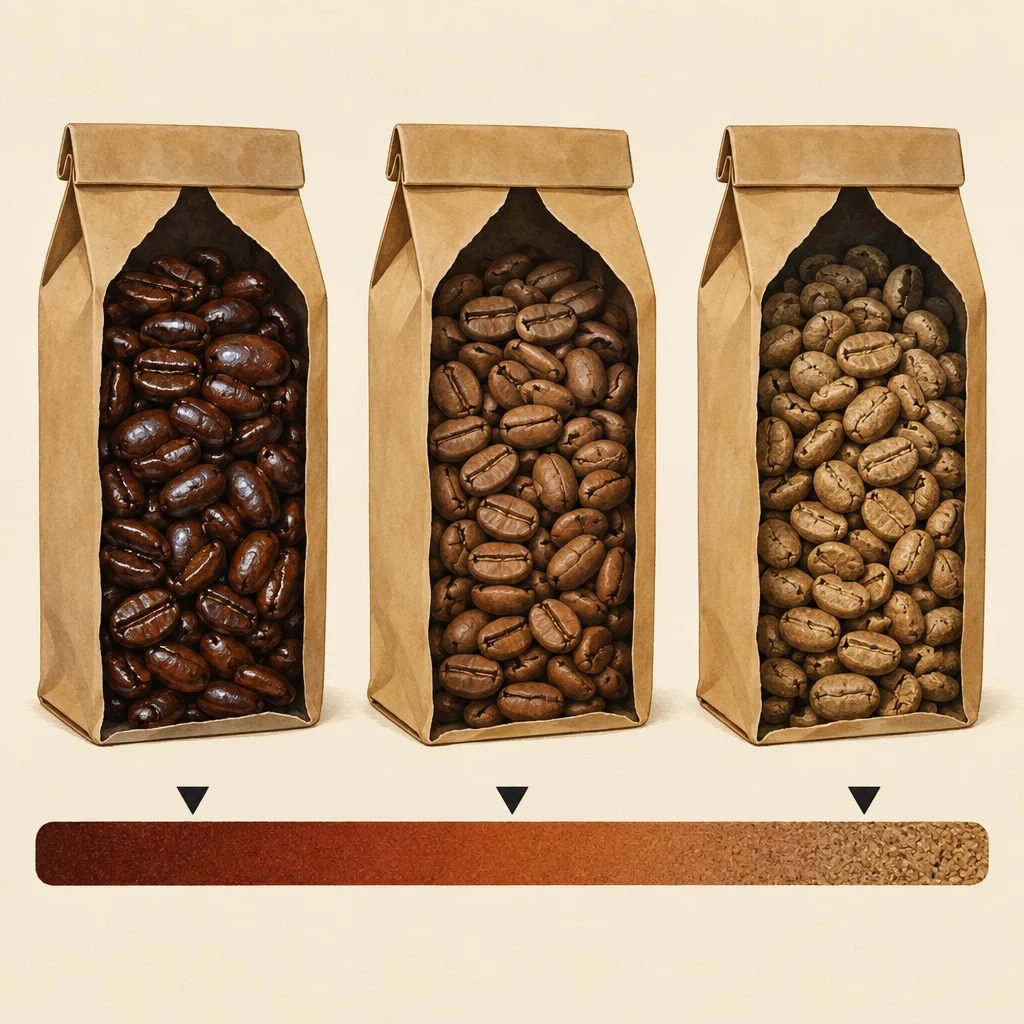
You can get a rough sense of this by simply looking at and handling the beans. Do they look noticeably smaller or larger than the previous bag? Do they feel heavier for their size? A new lot that looks more compact and feels heavier is likely denser and may need a fractionally finer grind to get the same extraction level. One that looks more open or hollow for its size may extract faster and benefit from a slightly coarser setting.
This is not a precise measurement, and you don't need it to be. You're just calibrating your expectations before the first brew rather than after a confusing first cup.
Moisture content shifts with harvest timing and storage before roasting
Green coffee (the unroasted beans) absorbs moisture from the air during storage and transport. The amount of residual moisture that survives the roasting process varies, and it influences how the finished beans feel and how they grind. Slightly more moisture means the beans compress a little more under the burrs, which can produce a marginally different grind texture even at the exact same setting.
You don't need a moisture meter to notice this. After grinding your first dose from a new bag, rub a small amount of the grounds between your fingertips. If it feels noticeably clumpier or stickier than you remember from the end of the previous bag, that's a signal to check your extraction carefully and be ready to adjust. If it feels drier and more powdery, the opposite may be true.
A simple three-step approach when a new bag arrives
Rather than brewing on autopilot and then trying to diagnose problems after the fact, a short reset when you open a new bag makes the whole process easier.
First, check the roast date and compare it to where your last bag was in its timeline. If it's more than a week fresher, give the beans a day or two to degas before brewing, or adjust your recipe to account for more active off-gassing.
Second, take a close look at the beans before you grind. Note whether they seem visually different in size or surface texture. That visual check is a low-effort early signal.
Third, brew a small test cup using your usual settings and taste it before you commit to a large batch or a full recipe. Pay attention specifically to whether the cup feels balanced, or whether it's leaning toward thin and sour on one end (under-extracted) or heavy and bitter on the other (over-extracted). A small grind or time adjustment in the right direction usually fixes it on the second try.
The broader habit this builds
Treating each new bag as slightly unknown rather than identical to the last one is one of the most practical shifts a home brewer can make. It reframes a frustrating mystery as a predictable, manageable variable. Your recipe is a starting point, not a permanent setting. The beans get a vote.
Over time, this habit also makes you better at reading your cup and faster at adjusting. You start to notice patterns, like the fact that one roaster's bags tend to run fresher and need a day of rest, or that a particular origin always grinds a little finer than it looks. None of that knowledge requires expensive equipment or formal training. It just requires paying attention once a bag instead of assuming consistency that isn't there.