How to Brew a Smaller Cup Without Wrecking the Flavor
Scaling your brew ratio down to a single small cup requires one specific adjustment most home brewers skip, and skipping it makes the cup taste hollow.
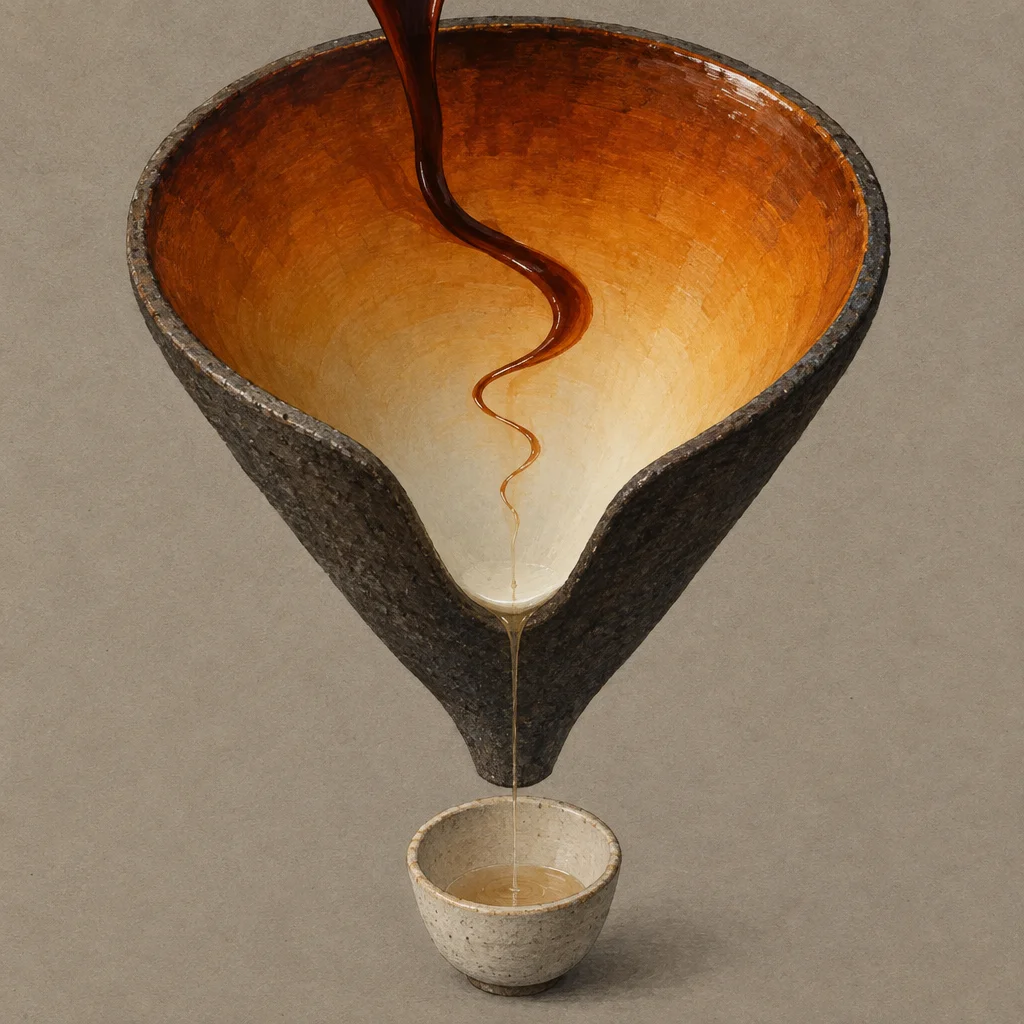
Most pour-over recipes are written for two cups, sometimes more. That makes sense for a café or a household that runs on coffee, but a lot of mornings you just want one small cup and nothing more. So you halve the dose, halve the water, keep the same grind, and the result tastes thin or oddly sharp. You blame the beans. You should blame the math.
Scaling a brew down is not simply dividing everything by two. There is one variable your ratio does not automatically account for: contact time relative to bed depth. Understanding that one thing explains why your small cup keeps disappointing you, and fixing it is straightforward once you see it.
Why a Smaller Dose Brews Differently
When you reduce your coffee dose, you also reduce the depth of the grounds bed sitting in your brewer. A shallower bed means water passes through faster. Faster passage means less contact time between the water and the grounds. Less contact time usually means under-extraction, which shows up in the cup as sourness, a kind of hollow brightness, or flavor that starts promising and finishes nowhere.
This is not a flaw in your technique. It is just physics. The same grind setting that worked beautifully at a larger dose is now letting water slip through before it can do its job.
The fix is simple: grind a little finer when you brew a smaller dose. Not dramatically finer, just slightly. On most home grinders, moving one or two steps finer is enough to slow water down through the shallower bed and recover the contact time you lost.
How Much Finer Is Enough
This depends on your grinder and your brewer, so treat what follows as a starting direction rather than a precise instruction.
If you normally brew 30 grams of coffee to 500 grams of water and you want to drop to 15 grams and 250 grams, try moving your grind one setting finer than your usual position. Brew it, taste it, and notice what changed. If it is still thin and bright, try one step finer at the same dose. If it tips into bitter or heavy, you have gone too far and you can step back.
Two or three attempts across different mornings is usually enough to find a small-cup grind that works for your specific setup. Once you have found it, write it down or mark it with tape on your grinder. You do not want to rediagnose this every time.
What About Brew Time
Brewers who track their total draw-down time will notice something useful here. If your usual brew at full dose finishes in, say, three and a half minutes, and your scaled-down brew finishes in under two and a half minutes, that shorter time is telling you the water moved too fast. It confirms the bed is too shallow for your current grind setting. A finer grind should pull that time back toward your normal range, and when it does, your cup will taste noticeably fuller.
You do not need to be precise about this to the second. Just notice whether the small brew is finishing conspicuously faster than the large one. If it is, that is your signal.
The Pour Matters More at Small Volumes
Another thing that amplifies with a smaller dose: your pour becomes proportionally more powerful. When there is less coffee to absorb and buffer your water, a heavy or rushed pour disturbs the bed more aggressively. That can channel water through specific spots rather than distributing it evenly, which produces uneven extraction and a cup with strange patches of sourness alongside flatness.
For a small brew, pour more deliberately and slowly than you would at full dose. A gentle, centered pour during the bloom and a slow circular pour during the main extraction give the shallow bed the best chance to work evenly. If your kettle has a narrow gooseneck spout, this is easier. If it does not, pour from lower and let gravity do less of the work.
Dose Minimums Worth Knowing
There is a practical lower limit to how small a dose most pour-over brewers handle well. For a standard V60 or similar cone brewer, doses below about 12 grams tend to produce very inconsistent results regardless of grind adjustment, because the bed becomes so thin that even tiny variations in your pour create dramatically different extractions. If you find yourself wanting a very short, concentrated cup, you might be better served by a different brew approach entirely, like a small French press or a moka pot, which are designed to work well at small volumes.
For most home brewers with a cone or flat-bottom pour-over, 15 grams with 250 grams of water is a workable small cup. Below that, the physics become harder to manage consistently.
One Adjustment, Kept Simple
The broader point here is that brew ratio gives you proportional control over strength, but it does not automatically compensate for the physical changes that come with scaling. When your dose goes down, your bed gets shallower, your contact time drops, and your grind needs to compensate by slowing water down slightly.
You do not need to overthink this or memorize formulas. The practical habit is just: when you scale down, go a little finer. When you scale up, you may want to go a little coarser for the same reason in reverse. Notice your brew time as a quick check. Taste the result. Adjust once more if needed.
Small cups can be excellent cups. They just need one small calibration your recipe did not include.