How to Brew Coffee for Someone Whose Taste Is Completely Different From Yours
Brewing one coffee to satisfy two people with opposite preferences is solvable without making two separate batches or compromising both cups.
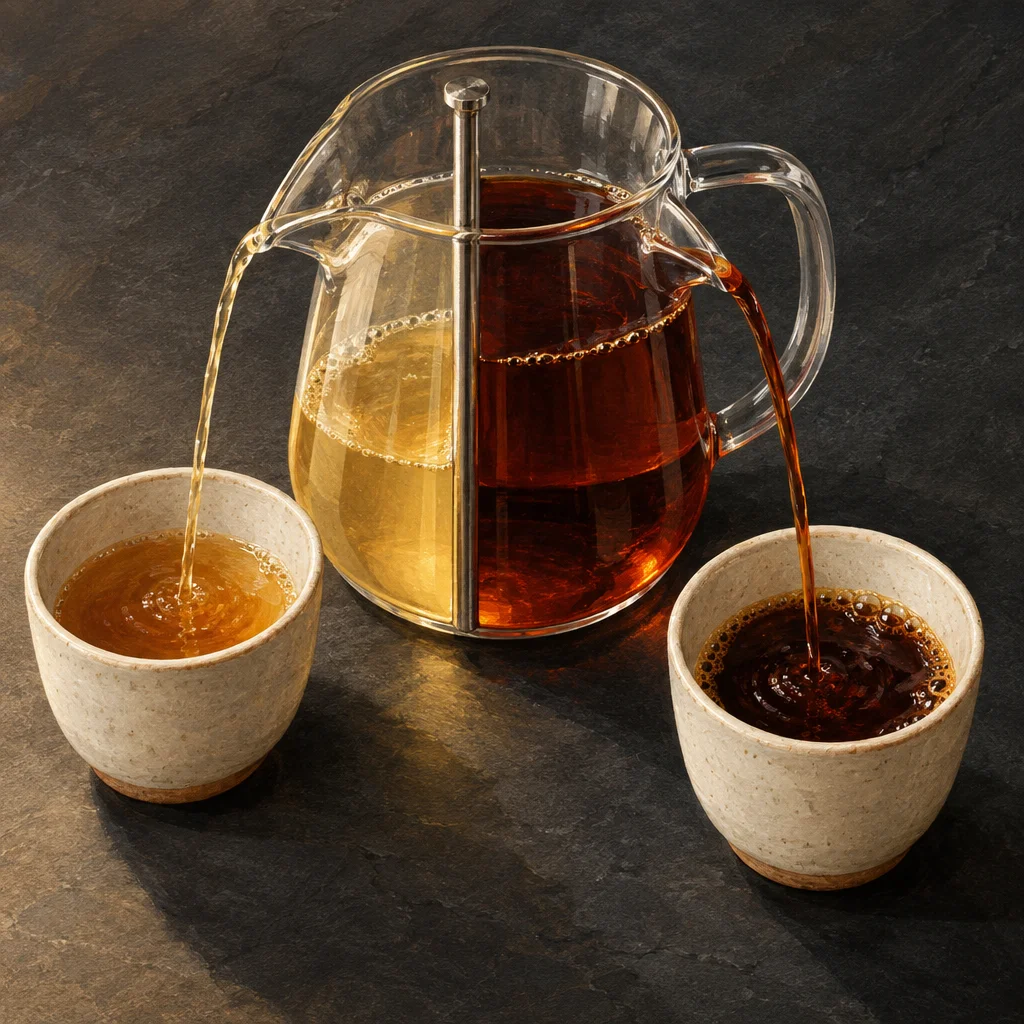
Most brewing advice assumes one person, one preference, one cup. But a lot of home brewing happens for two people, and two people rarely want the same thing from a coffee. One person likes it bright and a little fruity. The other wants it round, full-bodied, and low on acidity. You have one bag, one grinder, one kettle. What do you actually do?
This is a more solvable problem than it sounds, and the solution sits in understanding one thing clearly: a single brew produces a spectrum of flavors from start to finish, and where you pull from that spectrum is adjustable.
Why the Same Brew Contains More Than One Flavor Profile
When water moves through coffee grounds, it extracts compounds in a rough sequence. Early in the extraction, you get brighter, more acidic, sharper flavors. As extraction continues, you move into sweeter, more balanced territory. Push further and you pick up heavier, more bitter compounds. This is why grind size, brew time, and water temperature all matter so much: they shift where along that sequence your cup ends up.
This also means a longer, hotter, or finer-ground brew will taste different from a shorter, cooler, or coarser-ground one, even from the same beans. And it means that with some deliberate choices, you can brew one batch and divide it in ways that genuinely serve different preferences.
The Simplest Approach: Split the Pour
If you use a pour-over brewer, the liquid that comes through first and the liquid that comes through last taste noticeably different from each other. The early drips are brighter and sharper. The later drips are heavier and more muted. The middle of the brew is where balance lives.
You can take advantage of this. If you are brewing for two people and one prefers brightness while the other prefers body, try this as an experiment: brew your normal recipe into a server, but pause around the halfway point and swap in a second cup directly under the dripper for a short interval, maybe thirty seconds, before letting it finish into the server. The cup that caught only those middle-to-late drips will taste noticeably different from the full mixed brew.
This is not a precise technique, and your results will vary based on your brewer, your grind, and your ratio. But the concept is real: you are not locked into uniform extraction across the whole brew.
A More Controlled Approach: Brew Two Small Batches at Different Grind Settings
If your grinder lets you adjust quickly and your brewer is small, consider making two sequential brews at different grind sizes rather than one large one. A coarser grind will produce a lighter, less extracted cup with more acidity and a cleaner texture. A finer grind will produce more body and a heavier, fuller flavor.
Brewing two smaller batches takes more time, but it is the most direct way to serve two genuinely different preferences from the same bag. Set your grinder one notch coarser for the brighter cup, then one notch finer for the fuller cup. You do not need dramatic adjustments. Small shifts in grind size produce noticeable differences when you are comparing the two side by side.
To make this feel less like a production, keep your scale nearby and reduce each batch to roughly half your usual dose so the total coffee used stays the same. Brew times will shift slightly with grind size, but you are not chasing perfection here. You are chasing a cup that each person actually wants to drink.
When You Cannot Do Any of the Above
Sometimes the setup does not allow for much adjustment. Maybe your grinder is finicky to move mid-session, or you are brewing for more than two and cannot split easily. In that case, lean into the middle and let the additions do the work.
A cup that leans slightly fuller and less acidic is easier to brighten with a small amount of added hot water than to deepen once it is already brewed thin. If one person wants a lighter experience, diluting slightly is an honest option and not a failure. If the other wants more weight, a slightly smaller pour from the same batch concentrates the cup without any extra brewing.
This is not a pure solution, but it acknowledges that coffee does not have to land in one fixed place for everyone at the table.
What to Tell the Other Person
One underrated option is simply talking about what is actually happening in the cup. If you explain to someone that a coarser grind tends to taste brighter and less heavy, or that drinking from the first half of the pour will feel different than the blended version, they often find it interesting rather than annoying. People who share a household and share a coffee bag are usually more willing to experiment than you might expect.
Brewers who get good at brewing for two often stop thinking of it as a compromise problem and start thinking of it as a tasting problem. You are helping two people locate where they each land on a preference scale, which turns out to be genuinely useful information for buying beans in the future.
A Note on the Bean Selection Layer
None of this solves a situation where one person wants a dark, smoky roast and the other wants a light, floral one. If your preferences diverge at the roast level rather than the extraction level, technique can only do so much. In that case, two small bags of different coffees brewed on alternating mornings is genuinely the better answer. Brewing technique is not a substitute for starting with a bean both people can work with.
But if the preference gap is more moderate, and it usually is, the tools described above get you further than most people try before assuming the problem is unsolvable.
The main shift is recognizing that your brew is not a single fixed output. It is a range, and you get to decide which part of that range ends up in each cup.