How to Brew Coffee When You're Making It for a Group and Ratios Stop Making Sense
Scaling a single-cup recipe up to serve several people breaks in specific ways, and two adjustments keep the flavor intact across the whole batch.
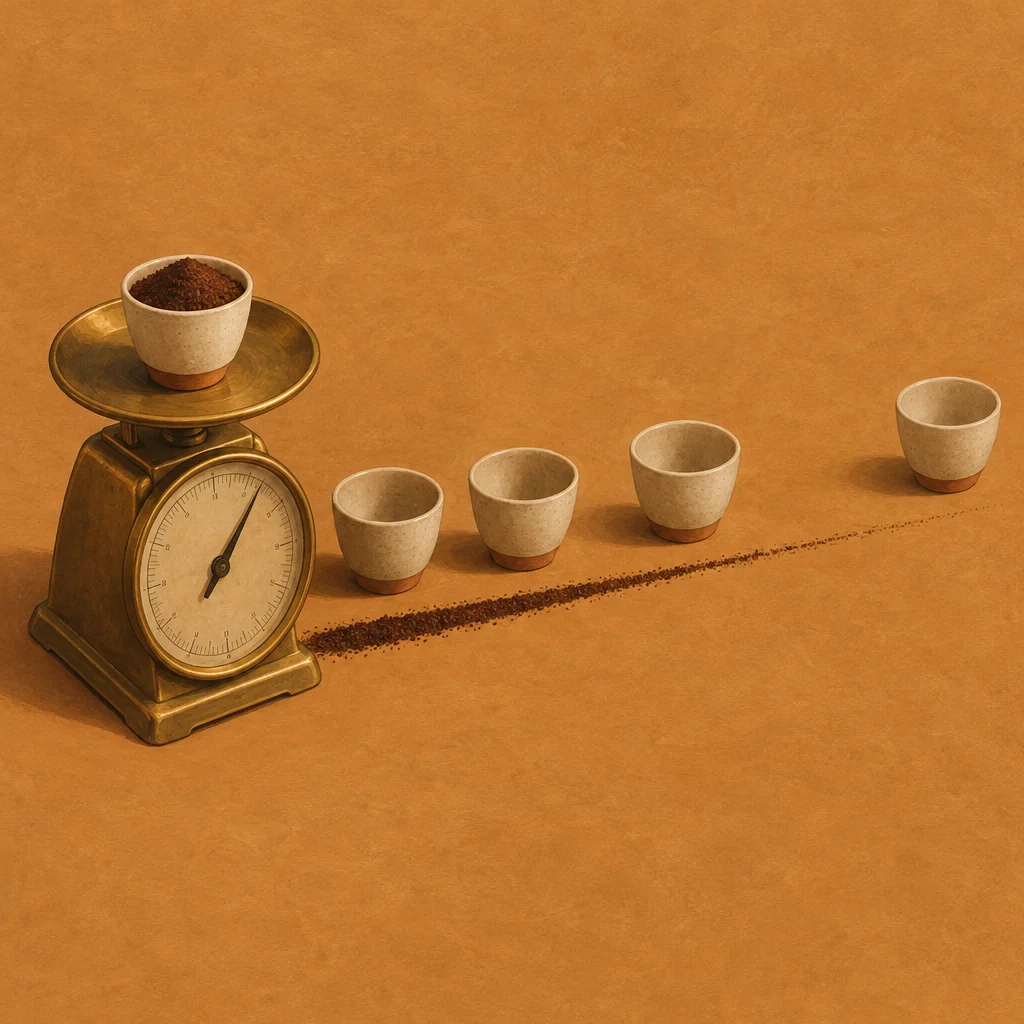
Most home brewing advice assumes one person, one cup, one quiet morning. Then someone asks if they can have some, and suddenly you're doing math in your head over a bag of coffee you barely understand to begin with. Scaling up sounds simple until the cup tastes thin, or bitter, or weirdly flat compared to what you normally make.
The good news is that the scaling problem is predictable. It happens for two specific reasons, and once you understand them, making coffee for four or six people feels a lot less like guessing.
Why Scaling Up Isn't Just Multiplication
Your single-cup recipe probably works because your brewer, your grind, and your pour are all calibrated to a specific volume of water moving through a specific amount of coffee in a specific amount of time. When you multiply everything by four, the ratio stays the same on paper, but the physical reality changes.
The most common issue is brew time. More coffee in the bed means water drains more slowly. That extra contact time pulls more from the grounds than your recipe intended. The result often tastes heavy, slightly bitter, or muddy compared to your usual cup. If you've ever made a big batch and thought it tasted over-extracted even though you used the exact same ratio, this is why.
The second issue is heat loss. A larger volume of water cools more slowly, but it also takes longer to pour and longer to brew. If you're using a pour-over, longer brew times expose the coffee to more agitation and longer extraction windows than your smaller recipe ever did. If you're using a drip machine, filling it to its upper limit often changes how evenly it distributes water across the grounds.
Neither of these problems means you can't make good coffee for a group. They just mean the recipe needs a small adjustment on two fronts.
The First Adjustment: Go Slightly Coarser
When you scale up a pour-over or similar recipe, grind a little coarser than you normally would. You don't need a dramatic change. On most burr grinders, moving one or two clicks coarser is enough. The goal is to slow down extraction slightly to compensate for the longer brew time that comes with a larger coffee bed.
This is counterintuitive if you've been told that coarser grinds produce weaker coffee. They can, but here you're not changing the ratio, just offsetting the extra extraction time the larger batch creates. Think of it as balancing one variable against another rather than weakening your brew.
If you don't have a grinder with click stops and you're working by feel, aim for grounds that look and feel just slightly less fine than your usual setting. A modest shift is all you need.
The Second Adjustment: Slow Your Pour
For pour-over methods, the biggest practical problem with a large batch is that it's hard to pour four times the water at the same pace you'd pour it for one cup. People tend to rush, pouring faster to get through the volume, which creates uneven saturation and channeling through the coffee bed.
Slowing down your pour to something more deliberate helps more than people expect. You're not trying to be precious about it. You're just keeping the water contact even across the whole bed instead of letting it gush through one spot faster than another. Circular pours that cover the surface of the grounds work better than pouring in one place and hoping it spreads.
If you're using a drip machine rather than a pour-over, the pour is handled for you, but you can still give the grounds a gentle stir with a spoon right after the first water comes through. This breaks up any dry pockets in a larger dose of coffee, which become more common when you're filling the basket fuller than usual.
What to Do About Batch Size Limits
Some brewers have a ceiling. A standard pour-over dripper designed for one to two cups will overflow if you try to push four cups through it in one go. In those cases, brewing two back-to-back batches into the same carafe usually produces a better result than forcing more coffee into a brewer that wasn't designed for it.
This sounds like more work, but the second batch takes only a few minutes longer, and the cups it produces are noticeably better than what comes from an overloaded brewer. The coffee bed needs room to bloom and drain properly. When it's packed past its comfortable capacity, extraction becomes uneven and the cup reflects that.
If you brew two batches, keep the carafe covered or set it somewhere warm while you brew the second one. Heat loss over two batches is real, and a cold first batch sitting out while you finish the second is a small but solvable problem.
Ratio Still Anchors Everything
All of these adjustments work around a consistent ratio. Whatever you normally use, stick close to it when scaling up. If you typically use one gram of coffee per fifteen grams of water, use that same proportion across the larger batch. The grind and pour adjustments above address the physical differences in large-batch brewing, but they can't compensate for a ratio that's gone wrong at the start.
If you're not currently measuring by weight, a consistent volume measure works reasonably well for a group batch. Something like a rounded tablespoon per six ounces of water is a common and workable starting point. It won't be as precise as weighing, but consistency within the same brewing session matters more than the specific number.
The Realistic Expectation
A group batch is almost never as good as a carefully made single cup. The physics of scale work against you in small ways that are hard to fully overcome. But a batch made with a slightly coarser grind and a deliberate pour can be genuinely good, clearly better than whatever gets made on autopilot for guests.
Most people drinking your coffee for a group occasion are not evaluating it the way you do on a focused Tuesday morning. They want something warm, real, and not burnt-tasting. The adjustments above get you there without any complicated equipment and without starting your morning over from scratch.