How to Brew Coffee When You're Switching Brew Methods and Your Old Grinder Settings Are Now Wrong
Changing your brew method while keeping your grinder settings is one of the most common reasons a familiar coffee suddenly tastes broken.
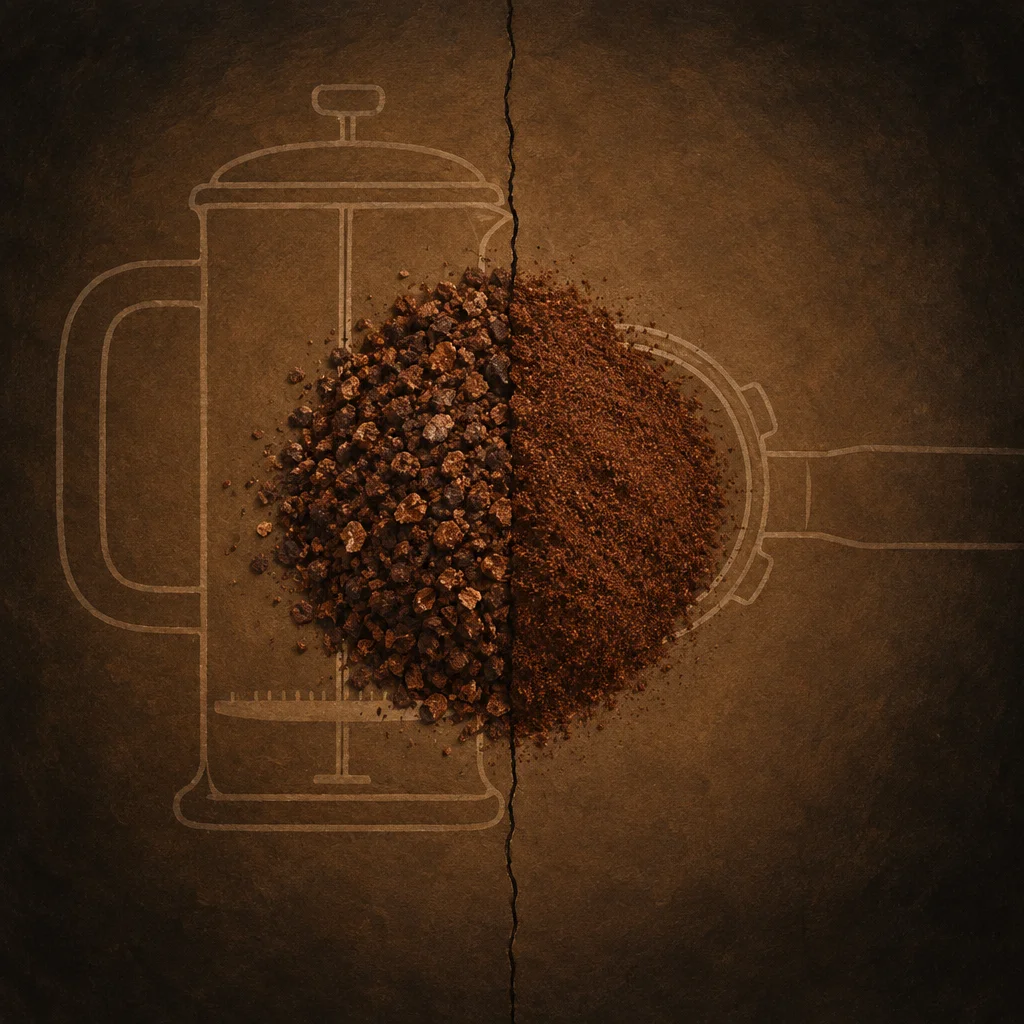
If you've ever moved from a French press to a pour over, or swapped out your drip machine for a Moka pot, you probably noticed that the coffee tasted off. Maybe it tasted watery, or harsh, or strangely flat. The beans were the same. The water was the same. Your process was careful. So what went wrong?
The grinder settings were wrong. More specifically, they were right for your old brewer and completely wrong for your new one.
This is one of the most overlooked friction points in home brewing, because the grinder feels like a neutral tool. You set it once, it grinds consistently, and you move on. But grind size isn't an absolute measurement like grams or milliliters. It's always relative to how your brewer extracts. The same physical grind setting produces very different results depending on how much contact time the water has with the grounds, and how that water moves.
Why the Same Grind Behaves Differently in Different Brewers
Every brew method has a different relationship between water and coffee grounds. In a French press, water sits in contact with grounds for three to four minutes, which is a long, slow extraction. In a pour over, water flows through the grounds in one to three minutes depending on your technique. In a Moka pot, pressurized steam passes through tightly packed grounds in under two minutes.
When you grind at a certain coarseness, you're setting up a specific surface area for water to work on. More surface area means faster extraction. A fine grind has more surface area than a coarse one. If your method already produces slow extraction through long contact time, a coarse grind balances that out. If your method produces fast extraction through pressure or quick flow, you might need a finer grind to compensate.
Here's the practical part: moving from a slow method to a fast one and keeping your grind too coarse leads to underextraction, which tastes thin, sour, or hollow. Moving from a fast method to a slow one and keeping your grind too fine leads to overextraction, which tastes bitter, dry, or chalky.
A Simple Way to Reset When You Switch
The good news is that you don't need to start from scratch every time you change brewers. You just need to reset your grinder with the new method in mind.
A useful starting framework, and this is a suggestion rather than a rigid rule, is to think of grind size as needing to match the speed of your brew method. Faster methods generally need finer grinds, and slower methods generally need coarser ones. Most grinder manufacturers publish rough grind size recommendations for common brew methods, and those are worth consulting as a starting point.
What this means in practice: if you're switching from a French press to a pour over, start by moving your grinder a few steps finer than your French press setting. Brew a test cup, taste it, and adjust from there. If you're switching from a drip machine to a French press, move several steps coarser. The first cup probably won't be perfect, and that's expected.
The One-Cup Diagnostic
When you brew your first cup on a new method with adjusted grind settings, taste it specifically for extraction cues rather than just whether you like it.
If the cup tastes sharp, sour, or weak and watery, the coffee is likely underextracted. The water didn't have enough contact with a fine enough grind to pull the full range of flavors. Try grinding finer by a few steps and brew again.
If the cup tastes bitter, dry, or leaves a rough coating on your tongue, it's likely overextracted. The water pulled too much from the grounds. Try grinding coarser.
This two-direction check works for any brew method and takes only two cups to get reasonably close to a workable range. You won't hit your ideal result in one try, but you'll be in the right neighborhood.
Keep Notes on Your Grinder, Not Just Your Recipe
One habit that makes switching between methods much easier over time is writing down your grinder setting for each method you use, not just the brew ratios and times.
If you own two brewers and alternate between them, keeping a small note on your grinder or near your brewing station with something like "pour over: setting 14, French press: setting 22" saves you from relearning every time. It also helps you notice patterns. You might find that your particular grinder at setting 18 works well for your drip machine, which gives you a reference point when you eventually try a Chemex or an Aeropress.
This kind of practical record-keeping isn't precious or overly technical. It's just using your own experience as information instead of throwing it away after each brew session.
When You Share a Grinder Across Methods
If you live with someone who uses the same grinder for a different method, switching between settings becomes part of the routine. The simplest approach is to designate the adjustment as part of setup, the same way you'd fill the kettle or measure beans. Before you grind, check the setting. Before they grind, they check it again.
This only adds about ten seconds to the process and prevents the kind of silent, confusing problem where the coffee tastes wrong and no one knows why, because both people are certain they didn't change anything.
The Underlying Principle
Your grinder setting is always in conversation with your brew method. Changing one without adjusting the other is a bit like changing the speed of a recipe but keeping the oven temperature the same. Things get out of balance.
When you switch brew methods, treat the grind reset as part of the transition, not an afterthought. Two diagnostic cups and a quick note is usually all it takes to get your new setup dialed into a range that actually tastes like the coffee you bought.