How to Brew Coffee When You're Working With Two Different Grind Sizes at Once
Mixing coarser and finer grounds in one brew is usually an accident, but understanding what it does lets you use it deliberately.
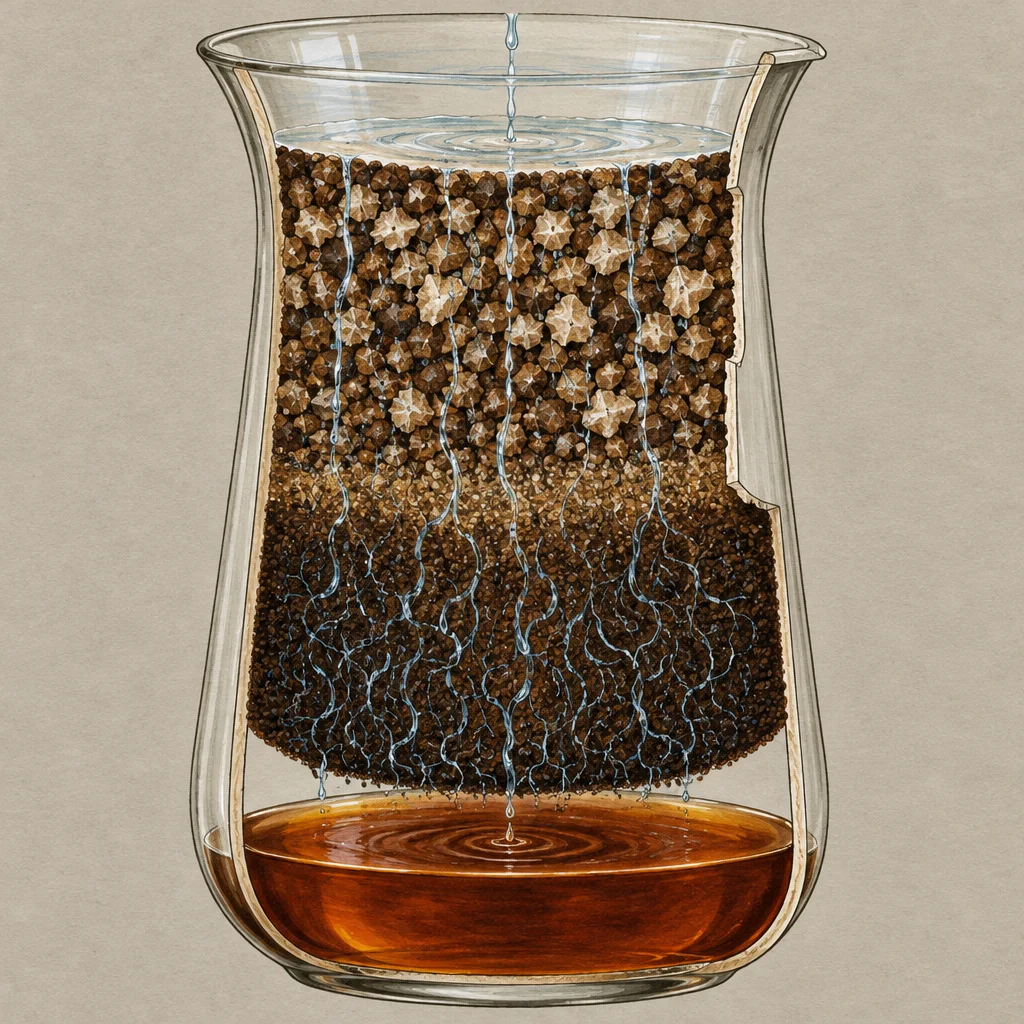
Most brewing advice treats grind size as a single number. Pick a setting, grind your beans, brew your coffee. But if you own a grinder and brew at home regularly, you have almost certainly experienced a cup that tasted oddly complex, or oddly muddled, without any obvious reason. One likely explanation: your grounds were not all the same size.
This happens more than people realize, and it happens in two very different ways. One is accidental and worth fixing. The other is something you can do on purpose with interesting results.
Why mixed grind sizes happen in the first place
Every grinder produces a range of particle sizes, not a single precise size. Burr grinders produce a tighter range than blade grinders, but even a good burr grinder sends out a mix. The main cluster of particles sits near your target size, but there are always finer particles called fines, and occasionally larger chunks.
Fines extract faster than your target grind. Larger particles extract slower. When the proportions are normal, this just rounds off the edges of your cup a little. When the proportions tip too far in either direction, your cup starts tasting like two different brews happened at once.
A few things push fines higher than usual. Grinding faster generates more heat and can fracture beans unevenly. Grinding very light roasts, which are denser and harder, tends to produce more fines than grinding medium or dark roasts. An older grinder with worn burrs can also drift toward more fines over time. If your cup has been tasting unexpectedly bitter alongside other flavors you enjoy, elevated fines are worth investigating before you change anything else.
What mixed sizes actually taste like
The useful thing to know is that coarser and finer particles contribute differently to flavor. Fines, because they extract so quickly, tend to give you bitterness and body. Coarser particles extract more slowly and contribute brightness and lighter, sometimes fruitier notes. When both are present in meaningful amounts, you get some of each.
For a lot of people, this is not a bad thing. A cup that has a little more body and a little more brightness than expected is often one that people enjoy without quite knowing why. The trouble comes when the balance is off. Too many fines and the bitterness drowns out everything else. Too few and the cup can taste thin and sharp.
If you have been puzzled by a cup that seems to have two competing personalities, one bright and lively but also slightly harsh, this is probably what you are tasting. The solution is not always to chase a perfectly uniform grind. Sometimes it is just to understand what you have and decide whether you want more or less of it.
The accidental case: when fines are hurting you
If your cup is too bitter and you have already tried coarsening your grind without much improvement, fines might be the issue rather than overall grind size. A few practical things help here.
First, slow down your grind. If your grinder has a chute-feed or hopper, grinding in smaller batches with a brief pause can reduce heat buildup that contributes to extra fines. This is a small effect, but it is real over many sessions.
Second, consider a quick rinse of the grinder before your brewing dose. Running a small amount of stale or discarded coffee through before your good beans clears out static-clinging fines from previous grinds. Some people call this seasoning the grinder. It costs you a small amount of coffee but improves consistency.
Third, and simplest, is to try a coarser grind and a slightly higher water temperature together. Coarser grounds need more extraction energy to get the same yield, and nudging your temperature up a few degrees compensates without forcing you to grind finer again and reintroduce the fines problem.
The deliberate case: blending coarseness on purpose
Here is where it gets genuinely interesting. Some experienced home brewers deliberately grind a small portion of their dose finer than the rest, then combine the two before brewing. The goal is to add body and extraction depth to a coffee that might otherwise taste a little thin at their preferred coarser setting.
This is worth trying as an experiment, not as a daily habit. If you have a light roast that tastes bright but hollow, try grinding ninety percent of your usual dose at your normal setting, then grinding the remaining ten percent one or two steps finer. Combine them, brew as usual, and taste the result against your standard cup.
You will probably notice the cup has more presence and a rounder finish. Whether you prefer it is personal. Some people love it. Some find it muddier. The point is that grind uniformity is a variable you can actually adjust rather than just a problem to solve.
If you try this and want to push it further, the ratio to experiment with is somewhere between five and fifteen percent finer grounds in the mix. Below five percent the effect is hard to taste. Above fifteen percent the fines start dominating and bitterness creeps in. The sweet spot for most coffees and most people tends to be around ten percent, but treat that as a starting point, not a rule.
One thing worth watching
When you deliberately mix grind sizes, your brew time may change slightly. Fines slow down water flow through most filter-based methods, so a pour-over or drip brewer might drain a little more slowly than usual. If your brew time jumps noticeably, that is a sign you have gone a bit heavy on the fines. Back off the proportion rather than trying to compensate through pour rate or grind adjustment alone.
For immersion methods like a French press or AeroPress, mixed grind sizes matter less for flow but more for how long you steep. If you are adding fines to an immersion brew, shorten your steep time slightly to prevent over-extraction.
The practical takeaway
Grind size is rarely as uniform as it looks coming out of your grinder, and that is not automatically a problem. When you understand what fines and coarser particles each contribute to the cup, you can work with what you have instead of just troubleshooting against it. Whether you want to reduce unwanted bitterness from excess fines or intentionally add body to a thin-tasting light roast, the same underlying knowledge gets you there. Your grinder is doing more than you think, and so can you.