How to Taste Your Coffee on Purpose (Instead of Just Drinking It)
Developing a simple tasting habit at home builds the vocabulary and attention that let you adjust your brew with confidence instead of guessing.
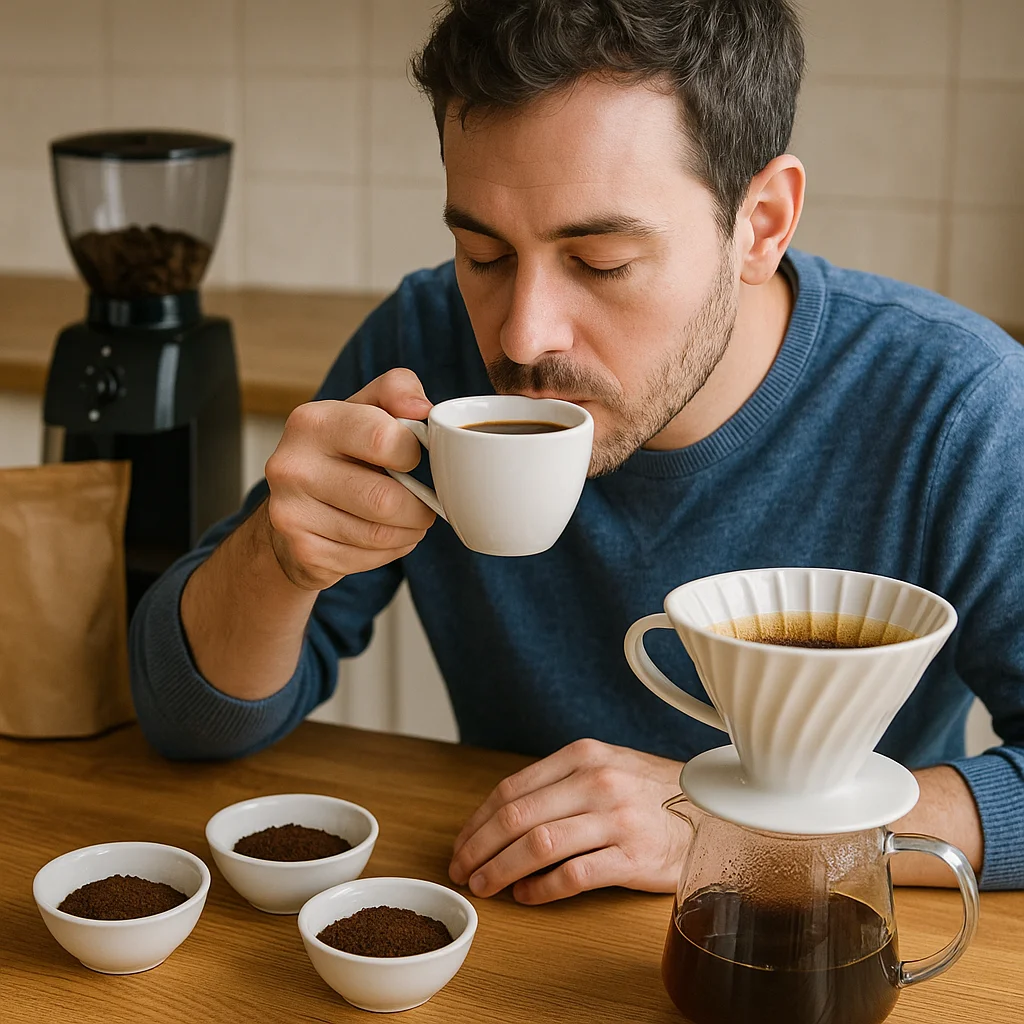
Most home brewers taste their coffee every morning but rarely notice it in a useful way. There's a difference between drinking coffee and tasting it, and that difference is mostly just intention. You don't need a formal cupping setup or a trained palate to start. You need a quiet thirty seconds and a small shift in attention.
This matters because troubleshooting a brew problem without tasting deliberately is like trying to fix a noise in your car while playing loud music. The information is there. You're just not listening for it.
Start Before You Sip
Before the cup reaches your mouth, smell it. Not a quick inhale, but a slow, close breath over the surface of the liquid. The aromatic compounds in coffee are volatile, meaning they escape quickly, and they carry a lot of useful information. If a cup smells musty, papery, or flat, that's worth noting. If it smells bright and fruit-forward, or toasty and nutty, that tells you something about what the brew is doing before your taste buds get involved.
You're not trying to identify specific flavors with technical precision. You're building a personal reference library. Even writing down one word after you smell your cup, every morning for a week, will start to create patterns you can actually use.
Break the Sip Into Stages
A single sip of coffee has roughly three distinct moments if you slow down enough to catch them.
The first is the entry, what you taste immediately when coffee hits the front and sides of your tongue. This tends to be where sweetness registers, and where any sharp brightness or acidity shows up first. If a cup tastes thin or watery right away, that's worth tracking.
The second is the middle, the body of the flavor as the coffee spreads across your palate. This is where you'll feel the weight, or mouthfeel, of the coffee. A heavier body often feels coating or slightly thick. A lighter body feels cleaner, almost tea-like. Neither is better on its own, but knowing which one you're getting helps you evaluate whether the brew matched what you were going for.
The third is the finish, what lingers after you swallow. A long, pleasant finish is often a sign of good extraction. A finish that turns bitter quickly, or leaves a rough, dry feeling, is pointing toward something worth adjusting. A finish that disappears almost immediately, leaving nothing behind, can suggest under-extraction.
You don't have to analyze all three stages every morning. But picking one to pay attention to each day builds the habit without making breakfast feel like homework.
The Temperature Variable Most People Miss
One of the most useful tasting habits is simply trying your coffee at different temperatures during a single session. Pour a cup, take a sip while it's hot, and then come back after a few minutes.
Coffee changes significantly as it cools. Flavors that were hidden under heat start to open up. Acidity often becomes more pronounced. Sweetness can become clearer. If a cup tastes harsh when hot but gets noticeably better as it cools, that's useful diagnostic information. It might suggest the brew water was too hot, or that the grind is pushing toward over-extraction. If a cup tastes fine hot but turns sour or thin as it cools, that's pointing in the other direction.
This isn't a strict rule. It's a signal. Coffee that improves as it cools gives you something to work with.
The One-Word Note Method
Keeping notes doesn't have to mean carrying a notebook or filling out a flavor wheel. The simplest version is one word, written anywhere, right after you taste your cup.
Something like: bright, flat, bitter, smooth, thin, earthy, long, sharp. Anything that honestly describes what you actually tasted, not what you think you should be tasting or what the bag promised. Over time, these single words become a personal calibration system. You start to notice when the same beans you've been buying suddenly taste flat for three mornings in a row, and that observation gives you something real to investigate.
If you want to add one more dimension, note the temperature at which you tasted it and whether the cup was from the beginning or end of your pour. Both affect what you're tasting, and tracking them alongside your one-word impression adds context without adding much effort.
What You're Actually Training
The point of developing a tasting habit isn't to turn your kitchen into a coffee lab. It's to close the loop between what you brew and what you experience. Right now, most adjustments home brewers make are based on a vague sense that something is off. A deliberate tasting practice gives that vague sense a specific shape.
When you can say the finish is drying and bitter but the body feels full, you're much closer to knowing what to change than when you can only say this doesn't taste right. That specificity is what lets you adjust one variable at a time instead of randomly changing your grind, your dose, and your brew time all at once and having no idea which one helped.
You're also training your palate to distinguish between problems caused by the beans and problems caused by the brew. If a new bag of coffee consistently tastes grassy or green no matter what you do with the recipe, that's probably a roast issue. If a bag that tasted great last week suddenly tastes flat, and you can identify that the flatness is in the aroma and the finish specifically, that's much more likely to be a freshness or storage issue you can address.
A Practical Starting Point
If you want to start small, try this for one week. Every morning, take one slow sip of your coffee while it's still hot and pick one word for what you notice most. Then take one more sip after the cup has sat for five minutes and notice if anything changed. That's it.
You'll be surprised how quickly those observations start to connect to your brewing choices. And you'll find that adjustments you make after that habit starts to form feel a lot more grounded than the ones you were making before.