How to Use Your Kettle's Pour Rate to Control Extraction (Without Changing Anything Else)
The speed at which water leaves your kettle and hits the grounds is an adjustable extraction variable most home brewers never think to control deliberately.
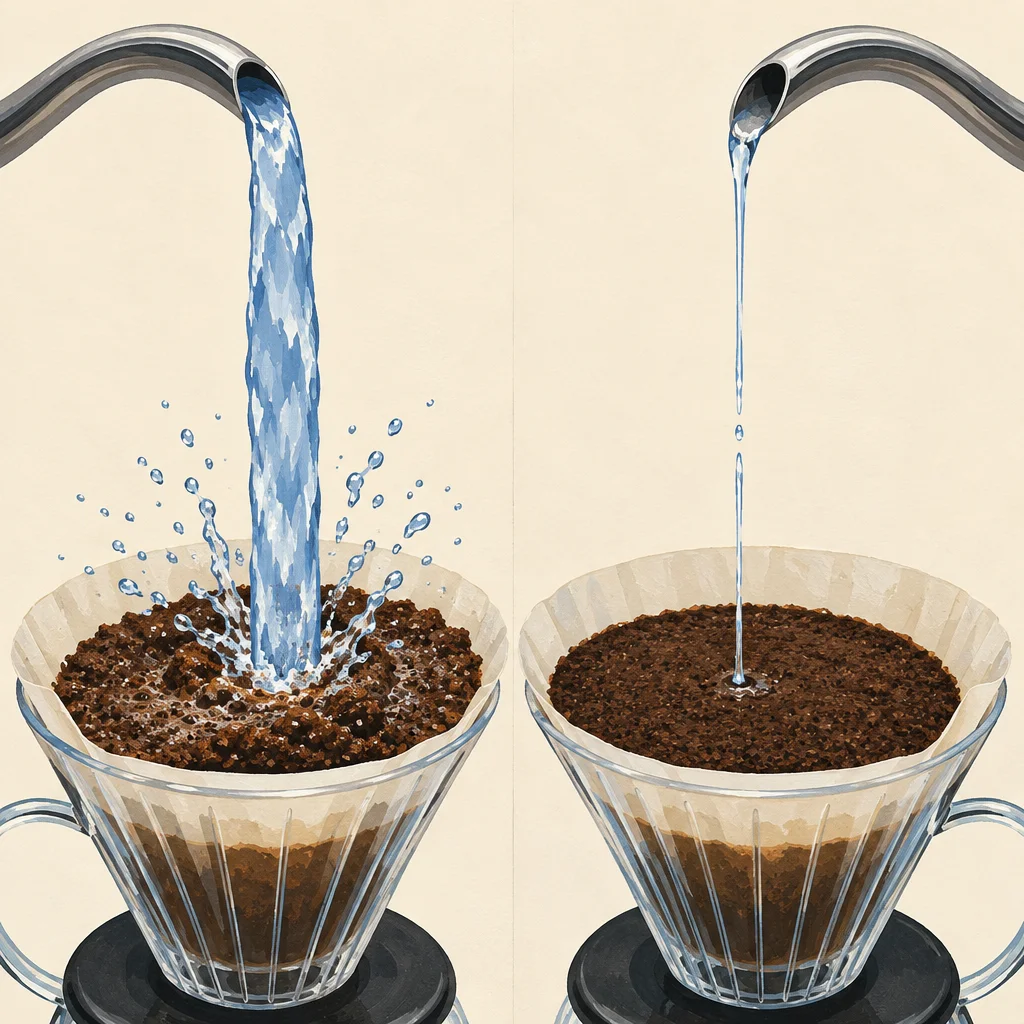
Most home brewing advice focuses on the variables you set before the water pours: your grind size, your dose, your water temperature, your ratio. Those matter. But once you pick up the kettle, there's another variable quietly running the whole time, and most people never touch it intentionally. That variable is pour rate, meaning how fast water actually flows from your kettle onto the coffee bed.
This isn't about blooming or skipping a bloom. It's not about how many pours you do. It's about the physical speed of the water coming out of the spout, and what that speed does to your grounds once it arrives.
Why Pour Rate Does Anything at All
When water hits a bed of coffee grounds, it does two things simultaneously. It saturates the grounds so extraction can begin, and it agitates them. That agitation is the part pour rate controls most directly.
A fast, aggressive pour physically disturbs the grounds more than a slow, controlled one. More disturbance means more turbulence in the slurry, which accelerates extraction because fresh water is constantly being pushed into contact with unsaturated particles. A slow, gentle pour settles water onto the bed with minimal disruption, which lets extraction happen at a calmer pace.
Neither approach is wrong. They produce genuinely different cups, and understanding which direction each one pulls helps you use pour rate as a deliberate tool.
What a Faster Pour Does to the Cup
A faster pour tends to produce a brighter, more extracted result, all else being equal. The agitation it creates moves water through the grounds more actively, which can pull more solubles in less time. If your cup is tasting a little flat or under-developed, or if your brew time is running long and the cup still tastes thin, a slightly more aggressive pour rate is worth trying before you reach for the grinder dial.
There's a limit, though. If you pour too fast, especially with a flat or uneven coffee bed, you risk channeling. Channeling is when water finds the path of least resistance and rushes through one area of the grounds rather than saturating them evenly. You can sometimes see this as a depression or hole forming in the bed during your pour. A cup that resulted from channeling often tastes uneven, simultaneously a little bitter and a little sour, because different parts of the grounds were extracted very differently.
If you're using a gooseneck kettle, you have real control here. A standard kettle with a wide spout is harder to slow down, which is one practical reason gooseneck kettles genuinely help with pour-over beyond just aesthetics.
What a Slower Pour Does to the Cup
A slower, more restrained pour keeps the coffee bed calmer and distributes water more gently across the surface. This tends to produce a slightly softer, rounder extraction. If your cup is tasting sharp, harsh, or over-extracted even after you've adjusted grind and temperature, slowing your pour rate is a meaningful thing to try.
A slow pour also gives you more control over where water lands, which matters more with some brewers than others. In a flat-bottomed dripper with a wide bed, a slow pour lets you guide water systematically from the center outward and back, keeping the whole bed saturated without letting any dry patches form at the edges. In a cone dripper, a slow central pour tends to draw water gently through the cone without disturbing the fine-particle layer that settles at the bottom during brewing.
One thing a very slow pour can do that's worth knowing: if you slow down too much across a long brew, you can actually extend your brew time beyond what your recipe intended, which changes extraction in a different direction than pour speed alone. So if you slow your pour and notice your total brew time stretching significantly, that's useful information, not a failure. It means pour rate and brew time are connected, and adjusting one adjusts the other.
A Simple Way to Experiment
If you want to feel the difference in your own cup, try this over two consecutive brew sessions with the same coffee and the same recipe. Keep every variable identical: grind setting, dose, water weight, temperature, number of pours. The only thing you change is your pour rate.
In the first session, pour deliberately slowly, aiming to take twice as long as you normally would to deliver each pour. In the second, pour at a pace that's noticeably faster and more assertive, though still controlled enough that you're not splashing water over the edge of the bed. Then taste them side by side if you can, or at least take notes on each.
What you're looking for isn't which one is "better." You're trying to notice whether there's a real difference in the cup, and which direction that difference points. Some people taste a clear shift. Some find their setup is less sensitive to it. Either result is useful.
Matching Pour Rate to Your Coffee
Different coffees can actually respond differently to pour rate, which is one reason this variable is worth revisiting when you open a new bag rather than just locking in a habit.
Lighter roasted coffees are often denser and can benefit from a more aggressive pour that helps drive extraction. Very dark roasts, which are more porous and extract faster, sometimes respond better to a gentler approach that keeps things from tipping into harsh or bitter territory. Freshly roasted coffee with a lot of CO2 still in it can produce a lot of turbulence on its own during the bloom, so easing up on pour rate slightly during the main pour can help compensate.
None of this is a rule. It's a starting direction, and your own cup will tell you whether it applies.
The Bigger Takeaway
Pour rate is one of those variables that's easy to overlook because there's no number on a dial to track. But your hands are doing something specific every time you brew, and being intentional about what that is gives you one more lever that doesn't require buying anything new or changing your recipe. It's already there every time you pick up the kettle.