Grinding Your Coffee in Two Smaller Batches Instead of One
Splitting your grind dose into two back-to-back batches may produce more consistent particle distribution than grinding the full dose at once, because of a mechanical pattern common to many home burr grinders.
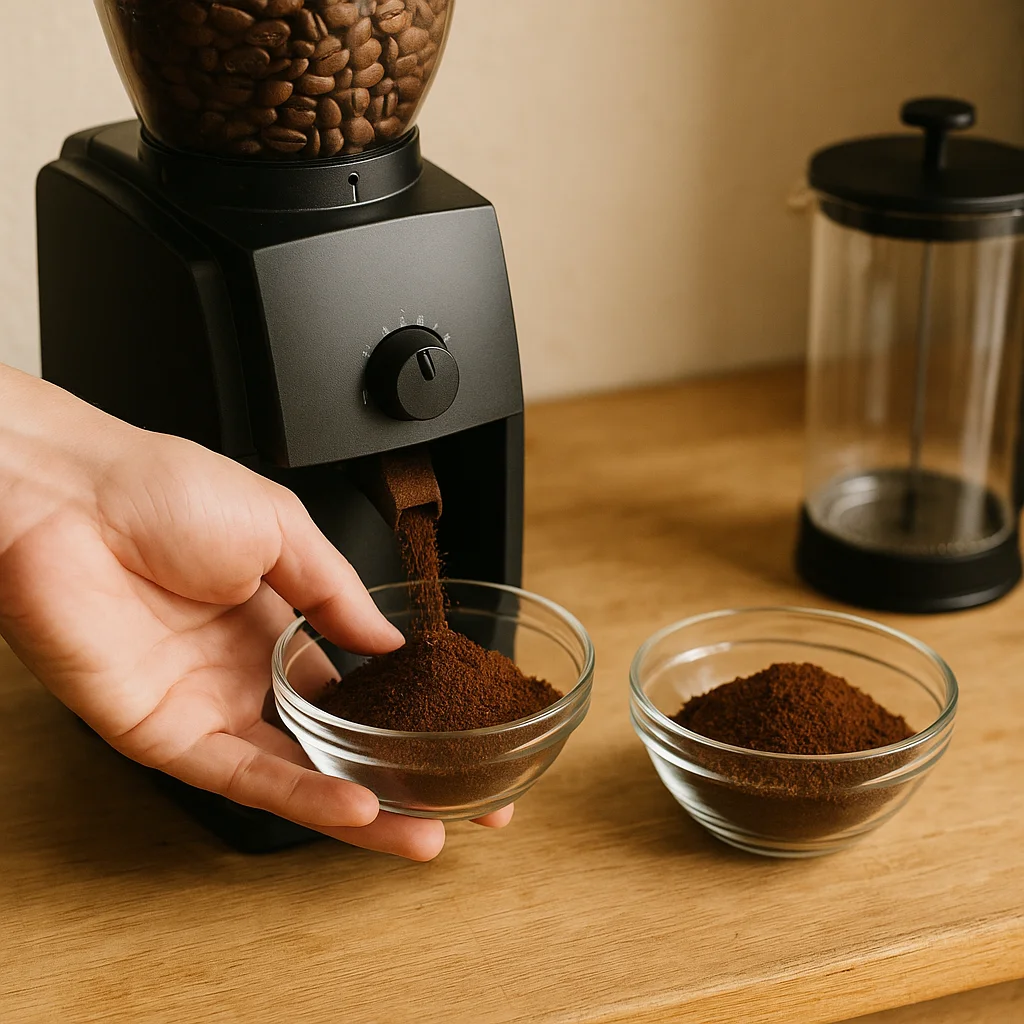
If you want something simple to try tonight, here is one option. Grind your normal full dose in one go, brew your cup, and taste it. Tomorrow morning, split that same dose in half, run the first half through your grinder, then immediately run the second half, and brew an identical cup. Many home brewers who try this notice a difference in the cup, and there is a mechanical reason worth understanding.
What Is Happening Inside Your Grinder
Burr grinders, both flat and conical, work best when beans feed into the burr set at a steady rate. When the feed is consistent, the burrs can do what they are designed to do: fracture each bean along its cell walls rather than smashing it unevenly. The result tends to be a tighter particle distribution, meaning more of your grounds fall into a similar size range with fewer very fine or very coarse outliers.
A full dose of beans does not always feed at a perfectly consistent rate. It tends to follow a pattern: heavier and faster at the start as beans tumble in freely, then slower and more erratic as the remaining beans arrange awkwardly, bridge across the throat of the chute, or fall in clusters rather than individually. You can sometimes hear this if you listen closely. Many grinders sound slightly different in the last few seconds of a grind cycle compared to the first.
That uneven feed translates into uneven burr loading. When beans rush through together, the burrs work harder and may produce a slightly different particle profile than when working at a steadier pace. The last few grams of a full dose can end up ground under different conditions from the first few grams, and those grams all end up in the same brew bed.
Why Splitting May Help
When you split your dose and run two smaller batches, you reset the feed conditions twice. Each half-batch starts fresh, with beans tumbling in at that initial steadier rate, and finishes before reaching the erratic tail-end behavior of a larger load. The burrs spend more of their working time in the stable, well-fed zone.
This can result in a somewhat tighter particle distribution across your full dose. That matters because extraction happens across the whole bed at once. When a bed contains a wide spread of particle sizes, finer particles can over-extract while coarser ones under-extract at the same time, and both outcomes end up in your cup together. A tighter spread gives you a better chance of tasting what the coffee is actually offering.
This effect tends to be more noticeable with conical grinders that have narrower throats, where bean flow is more restricted and bridging happens more easily. Flat burr grinders with wider throats may show less difference, but the principle still applies. If your grinder has a removable top burr with a small central opening, it is a reasonable candidate for noticing a real change.
How to Try This
The split-dose approach is straightforward. If your normal dose is 18 grams, grind 9 grams, let it finish, then immediately grind the second 9 grams. If you use 30 grams for a French press, try 15 and 15. The split does not need to be perfectly equal. Somewhere between 40/60 and 50/50 is fine. The main thing you are avoiding is running the entire dose in one uninterrupted stream.
You do not need to wait between batches. Running them back-to-back is the point. The second batch also benefits from burrs that are already warmed up and have any residual grounds cleared from the first pass, which may add a small additional consistency benefit.
If you dose by weight and grind directly into a vessel on a scale, simply zero your scale after the first batch, then add the second. Your total dose and recipe stay exactly the same. You are only changing how many times your grinder starts from a fresh feed condition.
When It Seems Most Worth Doing
For espresso, split-dose grinding may be worth building into your regular routine. The difference between a flat shot and a good one can be narrow, and the extra ten seconds is small relative to the rest of your workflow.
For pour-over, it is worth trying any time you are brewing a coffee you want to understand better, such as a new origin, a new roaster, or a bag that tastes promising but has not quite come together. Removing this one source of variability can make it easier to notice what the coffee is actually doing.
For French press and batch brew, the effect may be smaller because immersion brewing at coarser settings is generally more forgiving of particle spread. Whether the habit change is worth it for those methods is something you can decide after trying it once.
The Broader Idea
Most conversations about improving home grinding focus on hardware upgrades: better burrs, more powerful motors, improved feed geometry. Those upgrades are real and can make a meaningful difference. But the grinder you already own has a range of performance, and it is worth exploring the less-discussed end of that range. Split-dose grinding is one of the simpler ways to work with your grinder's mechanics rather than against them, without changing any settings, spending anything, or adding more than a few seconds to your morning.