Why Your Grinder Lies to You After a Long Break
When a home grinder sits unused for several days or weeks, three specific internal changes accumulate that cause it to produce a measurably coarser, less consistent grind at the exact same setting you've always used — and knowing what those changes are lets you compensate immediately instead of chasing a ghost problem.
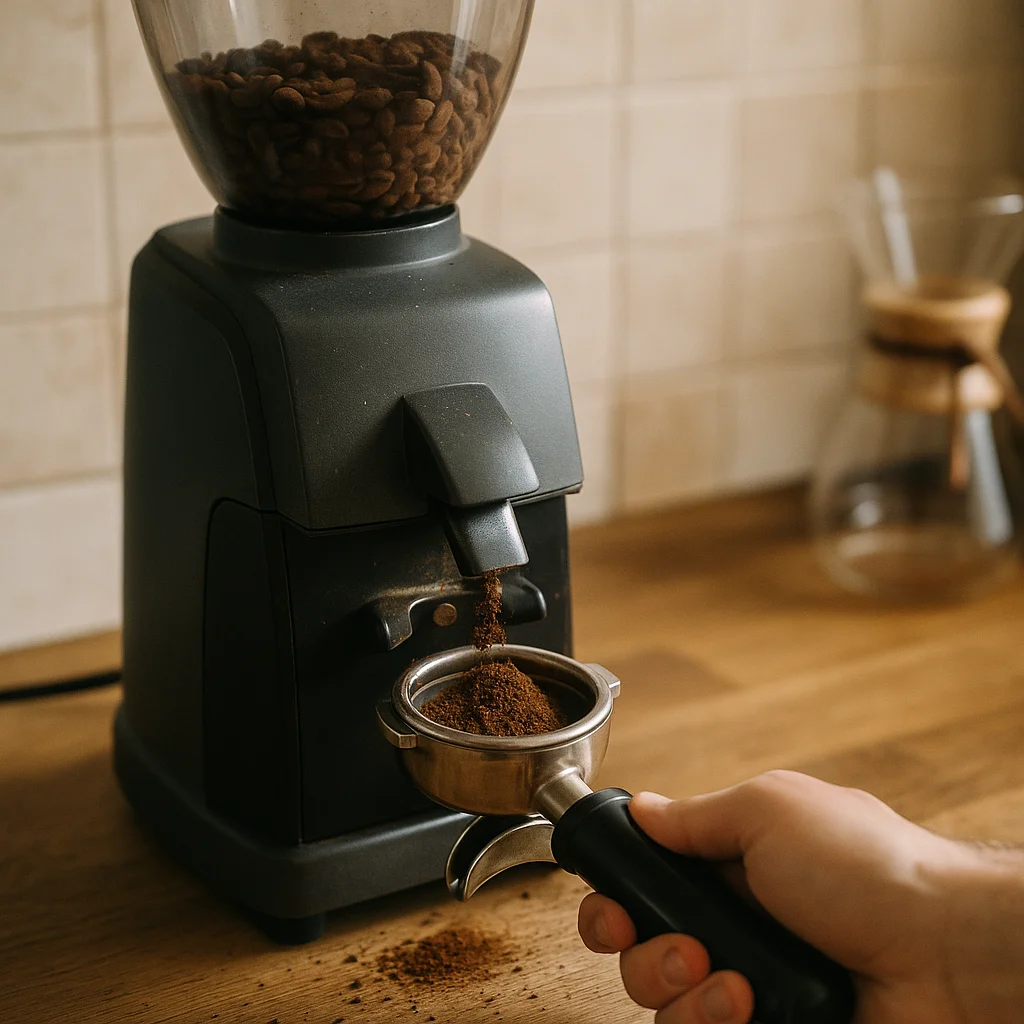
Most home brewers treat their grinder like a light switch: same setting, same result. That assumption holds up reasonably well during a normal weekly routine. But come back after a vacation, a busy stretch where you defaulted to instant, or a long holiday weekend of sleeping in and skipping the ritual entirely — and something feels off. The coffee tastes thin, hollow, slightly under-extracted. You check your dose. You check your water temperature. Everything looks the same on paper. The grinder is the one thing you don't question, because nothing about it has visibly changed.
Here's what actually happened while it was sitting there.
The oil film on your burrs has changed state
Every time you grind, coffee oils coat the burr surfaces in a thin, fairly uniform layer. This isn't contamination — it's closer to seasoning on cast iron. That layer acts as a mild lubricant that affects how beans feed into the burr gap and how aggressively the burrs grip them before cutting. During active use, the layer stays relatively fresh and pliable.
When the grinder sits for a week or more, those oils oxidize and partially polymerize. The surface becomes slightly tackier and less uniform. The practical result is that beans don't feed through the gap with the same consistency — they catch and release in a less rhythmic way, which introduces more variation into particle size. The average particle comes out a bit coarser than you'd expect, because the burrs are no longer grabbing beans at quite the same moment in the rotation cycle. Your setting hasn't moved, but the effective behavior of that setting has.
This resolves on its own after a few grind cycles as fresh oils resurface and re-coat the burrs, but if you don't know it's happening, you'll taste those first two or three sessions and start questioning your whole setup.
Retained grounds have dried out and shifted position
No grinder evacuates itself completely. There are always some particles left in the chute, around the burr chamber walls, and in whatever catch mechanism your machine uses. During normal daily use, these retained grounds are relatively fresh — they cycle out with the next day's grind and don't cause much trouble.
After a multi-day rest, those retained particles lose moisture and become lighter, drier, and more electrostatically active. When the grinder starts up again, they get swept into your fresh grounds in a proportion higher than normal. Dry, stale particles don't extract at the same rate as fresh ones — they're more porous and structurally different. They pull extraction in an inconsistent direction, which you experience as a cup that tastes muddled or flat in a way that doesn't quite match either over- or under-extraction. It's its own specific flavor of wrong.
The fix here is simple and takes ten seconds: run a small sacrificial dose — about five grams — through the grinder and discard it before grinding your actual dose. This purges the stale material and primes the burr surfaces with fresh oil. It's a step worth doing anyway, but it matters far more after a break than during a routine week.
The grinder's calibration reference has thermally drifted
This one is subtle but real. Home grinders use a combination of mechanical stops, burr carrier positions, and in some cases spring tension to hold a given setting. These components are made of metal and plastic with different thermal expansion coefficients. During regular use, the grinder cycles through warm and cool states daily, and those components settle into a stable equilibrium over time.
After extended disuse — especially if the ambient temperature in your kitchen shifted seasonally while the grinder sat idle — those components settle into a slightly different equilibrium. The setting number on your dial corresponds to the same physical position on the adjustment mechanism, but the actual gap between burrs may have shifted by a small but meaningful amount. We're not talking about dramatic changes. But in espresso especially, even a shift of a few microns in burr gap changes your extraction time and flavor profile noticeably. For filter brewing, the effect is less dramatic but still detectable as a cup that tastes less structured than you remember.
The practical response isn't to take your grinder apart — it's to treat the first session back like a soft reset. Grind, taste, and adjust as if you're dialing in for the first time, without assuming your old setting is the right starting point. Give it one or two sessions to re-stabilize before you decide something is actually wrong.
What a sensible return-from-break routine looks like
None of this requires new equipment, special tools, or a lot of time. When you come back to your grinder after a meaningful gap, run through this once:
First, check the burr chamber visually if your machine allows it. Brush out any visible clumped or dried retained grounds before you start. A cheap pastry brush works fine.
Second, run a small purge dose through at your normal setting and discard it. This handles the stale-grounds problem and begins resurfacing the burrs with fresh oil.
Third, grind your actual dose and brew, but taste the result as if you've never made this recipe before — with no expectations. Note whether it tastes coarser or finer than your target. Adjust one increment in the relevant direction and repeat if needed.
By the second or third session, the oil layer will have refreshed, the retained grounds will be fresh again, and the burr gap will have re-stabilized at your operating temperature. Your grinder will behave exactly the way you remember it.
The takeaway
Your grinder isn't broken when this happens, and your technique hasn't degraded. The machine is just reflecting the physical reality of what extended rest does to its internal environment. Understanding that the problem is temporary, specific, and predictable means you can respond to it directly instead of spinning through every other variable in your setup looking for something to fix. The grinder is telling you something true. It just needs a session or two to remember what it's doing.