Why Your Grinder Lies to You After a Long Weekend
The sequence in which you use your grinder each morning—not your settings, not your beans—creates a predictable drift in particle distribution across consecutive shots that explains why the first cup always tastes different from the second.
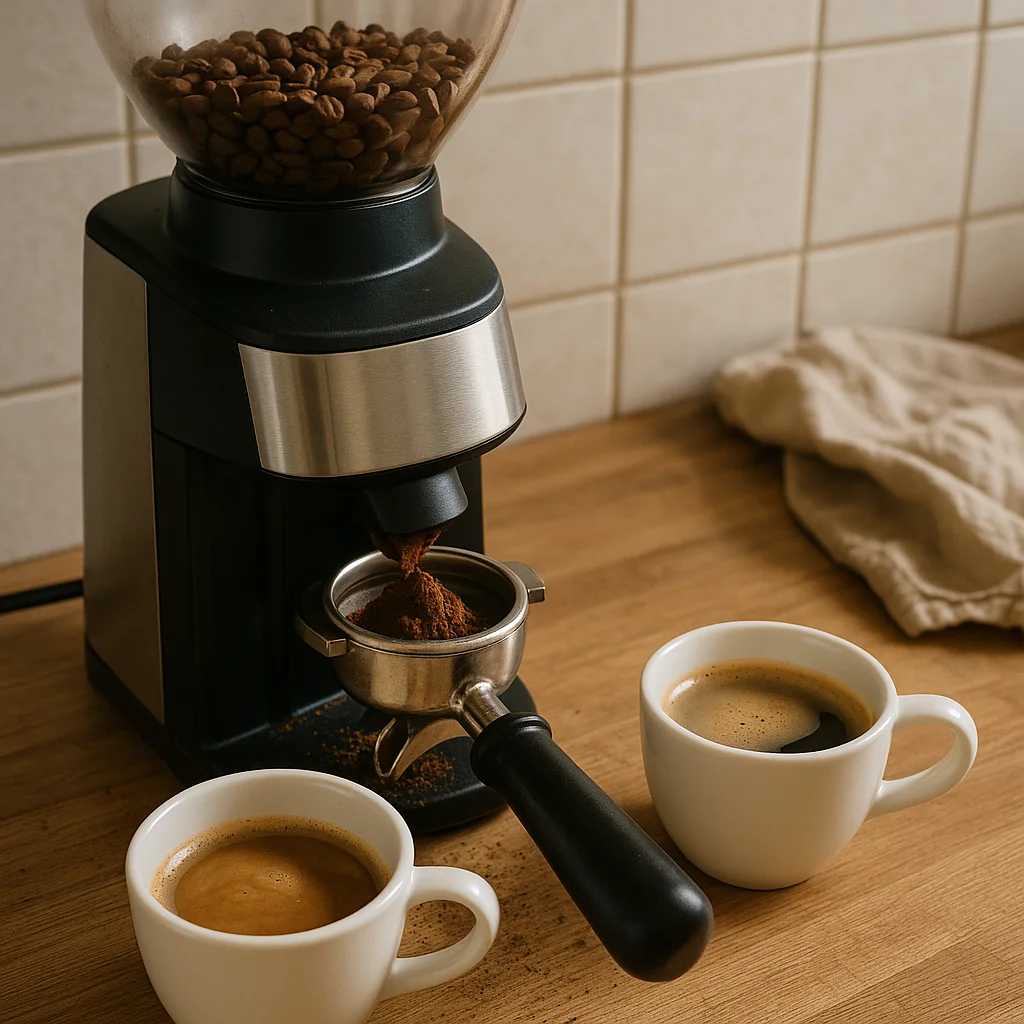
Most home brewers troubleshoot their coffee like detectives looking for a single culprit: wrong grind size, stale beans, bad water. But some inconsistencies don't have one cause. They have a sequence. And one of the most reliable, least-discussed sources of cup-to-cup variation in home grinding is the order in which things happen—specifically, what your grinder goes through between dose one and dose two on any given morning.
Here's the pattern worth understanding. If you grind twice in a row—two shots back to back, or a double dose split across a few minutes—the second grind almost always produces a slightly finer, more consistent particle distribution than the first. Not dramatically different, but enough to shift your extraction. Enough that if you're calibrated, you can taste it. And once you understand why, you can stop treating it as random noise.
What's actually happening inside the burrs
Burrs generate friction. Friction generates heat. The first grind of the day starts with burrs at ambient room temperature—let's say 68°F on a typical morning. By the end of even a single 18-gram dose, the burr chamber has warmed several degrees. That thermal change has two effects.
First, the burrs themselves expand slightly. Most home grinder burrs are steel, and steel has a coefficient of thermal expansion. Even a modest temperature rise tightens the effective gap between burrs by a small but real amount. A tighter gap means finer particles. This isn't a setting change you made—it's physics happening without your input.
Second, the coffee oils and fine particles that coat the burrs after grinding behave differently when warm. Cold, they sit relatively inert. Warm, they're slightly more fluid, which changes how subsequent coffee moves through the burr chamber. A freshly warmed, lightly coated burr surface produces a more uniform shear on incoming beans than a cold, dry one.
Together, these two effects mean your second grind of the morning is happening in a fundamentally different mechanical environment than your first—even if you waited only ninety seconds between them.
Why this matters more for espresso than filter
If you're brewing filter coffee, this drift is real but usually minor enough to land within your margin of tolerance. A few extra fines won't wreck a pour-over. But espresso is a different animal. Espresso extraction is sensitive to particle distribution changes that would be invisible in a French press. A shift toward finer particles increases surface area, slows flow, and pushes extraction higher—sometimes from a bright, balanced shot to one that tastes flat or bitter, with no other variable changed.
This is why many espresso drinkers have learned to run a small "purge" dose before pulling their actual shot. They're not wasting coffee out of ritual—they're thermally stabilizing the burr chamber so the shot that matters happens in a consistent environment. If you've never tried this and your first shot consistently underperforms your second, that's worth testing.
The longer the gap, the bigger the drift
The thermal stabilization effect resets completely if your grinder sits idle long enough. In most home environments, that means anything over about 20–30 minutes returns the burrs close to ambient temperature. So if you grind your morning shot, go pour your water, get distracted, come back, and grind a second dose fifteen minutes later—that second grind is starting close to cold again, not picking up where the first left off.
This matters for households where one person grinds for themselves, then another grinds for themselves twenty minutes later. Both are effectively getting "first shot" conditions, not the sequential warming effect. That's actually fine, and more consistent than you might assume—but it does mean you can't treat those two experiences as directly comparable when troubleshooting.
The gap that creates the most confusion is the medium one: five to ten minutes. Long enough that you might assume the grinder cooled down, short enough that it hasn't. You get a burr temperature somewhere between cold and fully warmed, which produces results that don't cleanly match either your first-shot or second-shot expectations. This is the window where a lot of head-scratching happens.
What to actually do with this
You don't need to buy anything or change your setup. You just need to decide which condition you're optimizing for and brew consistently within it.
If you want your first dose of the day to behave more like a warmed-up grinder, run three to five grams of beans through before your actual dose and discard them—or run them through dry if you want to save the coffee. This isn't a placebo. You're genuinely changing the thermal and coating state of the burr surface.
If you'd rather not purge, accept that your first dose needs a slightly coarser setting than your subsequent ones. For espresso, this might mean dialing your first shot half a click coarser than your usual setting, then resetting for any additional shots. For filter, it rarely matters enough to act on.
What you shouldn't do is chase this variable by constantly adjusting your grind setting mid-session. The drift is predictable once you understand it. Treating it as random noise by tweaking your settings in response will introduce real randomness on top of a pattern that would otherwise be easy to manage.
The underlying habit that makes this easier
Consistency here isn't about perfection—it's about grinding in the same thermal state each time. That means picking a routine and keeping the timing stable. If you always grind immediately after your kettle reaches temperature, you'll have roughly the same idle time between waking up and grinding every morning. If your gap between grind one and grind two is usually two minutes, keep it two minutes.
Your grinder is a machine with thermal memory. It doesn't reset cleanly between uses the way your brewing software resets between sessions. The more you treat it as a system with a warm-up state rather than an on/off switch, the more reliable your results will be—and the less you'll find yourself blaming the beans.