Why Your Grinder Lies to You After a Recipe Change (And How to Catch It)
When you change your brew method—switching from pour-over to French press, or espresso to drip—your grinder's calibration drifts in a predictable, physics-driven way that has nothing to do with your setting, and understanding the three mechanical reasons why lets you re-dial accurately on the first try instead of the fifth.
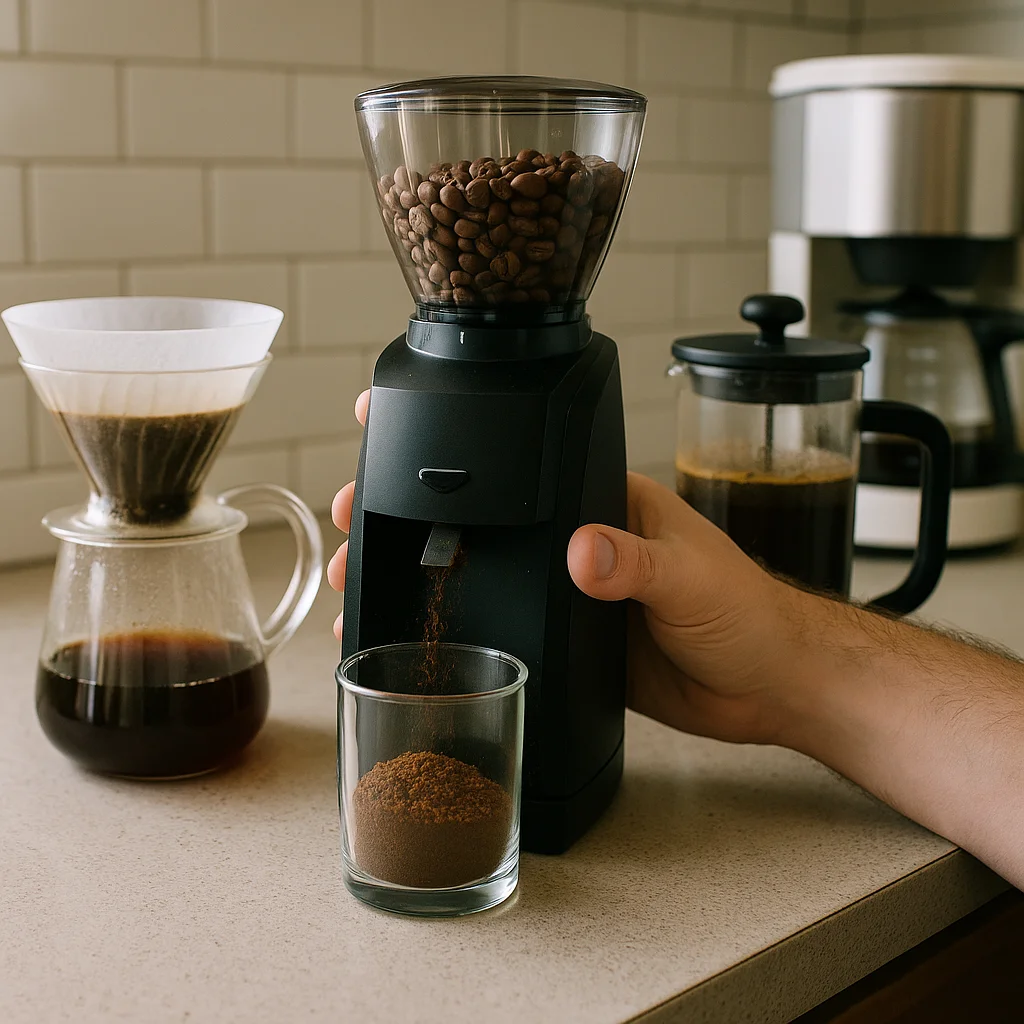
Most home brewers treat their grinder setting like a saved preset. You find a number that works for your pour-over, you write it down or memorize it, and you expect to return there anytime. The problem shows up the moment you switch methods. You jump from pour-over to French press for the weekend, dial coarse, then come back to your usual spot on Monday—and suddenly your pour-over tastes wrong. You didn't touch anything. Nothing broke. But the cup is off.
This isn't bad luck. It's mechanics, and once you understand it, you stop wasting coffee chasing a setting that moved without your permission.
The Burrs Remember the Last Thing They Did
Flat burrs and conical burrs both create particle distribution through a combination of shearing and grinding pressure. When you grind coarser—for French press or cold brew—the gap between burrs is wider, beans pass through faster, and the burrs experience less lateral pressure from the coffee mass. When you grind finer, pressure increases, the burrs flex microscopically toward each other, and your motor works harder.
Here's what matters: that flex isn't perfectly elastic. Metal and polymer components in the burr carrier and adjustment collar have a small amount of hysteresis—meaning they don't return to exactly the same resting position after high-stress and low-stress cycles. When you move from a tight espresso grind to a coarse French press setting and back, you're cycling stress on those components in a way that leaves the physical gap slightly different from where it was, even if the setting indicator reads identical.
The practical result: returning to your "same" setting after a large grind swing often delivers a slightly different particle size than it did before. Not drastically different, but enough to shift extraction time and flavor. Your number didn't move. Your grinder did.
The Residue Load Changes What the Burrs Actually Do
Every grind leaves behind a small amount of coffee particles—fine powder, oils, and fragments—lodged in the burr teeth and the exit chute. The quantity and distribution of that residue shifts depending on what you ground last.
Finer grinds produce dramatically more fine powder (called fines) than coarse grinds. When you grind for espresso and then immediately switch to pour-over, the first few seconds of your pour-over grind are processing through a burr surface coated with a fines layer from the previous session. That layer changes the effective cutting geometry slightly, producing a coarser output than a clean burr would at the same setting—because the fines are filling in the tooth geometry and reducing the shearing aggression.
Conversely, if you've been grinding coarse and switch to a finer method, you're starting with relatively clean burrs. The first grind at your fine setting will behave more aggressively than subsequent grinds because there's no accumulated layer buffering the cut.
This is not a small effect. Depending on your grinder design and how different the consecutive settings are, this residue load shift can move your effective grind by the equivalent of one to two notches on a typical home grinder's dial—enough to produce a noticeably faster or slower brew.
The Adjustment Collar Sits Differently After a Large Movement
This one is the most overlooked. Every home grinder uses some form of stepped or stepless adjustment mechanism—a collar, a dial, a knob—that physically repositions the top burr relative to the bottom. These mechanisms have mechanical play, which is the small amount of movement that doesn't immediately translate into burr movement. Think of it like steering wheel slack before the wheels respond.
When you turn your adjustment collar in a consistent direction—say, always fine-tuning finer from a starting point—the play in the mechanism is taken up in one direction, and the burr sits at a predictable position for a given setting. But when you swing the collar far the other way for a coarser grind and then return, you've introduced play from the opposite direction. The collar reads the same number, but depending on how you approached it—from coarser or from finer—the burr is sitting in a slightly different physical position.
The fix for this is simple and reliable: always approach your target setting from the same direction. If you use a coarse setting in between, when you return to your fine setting, go past it slightly and back up to it from the finer side. This eliminates directional play and ensures the burr sits in the same mechanical position every time. Grinder technicians call this "zeroing from one direction." It takes about three extra seconds and removes one of the most common sources of unexplained inconsistency in home grinders.
How to Actually Re-Dial After a Method Switch
Knowing the three mechanisms gives you a practical sequence that takes less than a minute.
First, purge before you brew. After switching settings, grind and discard about three to five grams of coffee. This clears the residue layer from your previous session and gives the burr surface time to reach a consistent temperature and fines distribution. Your actual brew starts from a stable baseline instead of a transitional one.
Second, approach your target setting from the finer side. Overshoot slightly toward fine, then back out to your intended setting. This standardizes the mechanical play position every time, regardless of where you were before.
Third, expect a small calibration shift after large swings. If you spent a weekend grinding for French press and you're returning to pour-over, your first session back may run slightly faster than expected. This is the residue effect clearing. Adjust your grind one notch finer than your saved setting, run a cup, and evaluate. You'll likely find your usual setting again within one or two adjustments rather than six.
None of this requires new equipment or a professional calibration. It requires understanding that your grinder is a mechanical object that responds to history, not just to where you currently have it set. The setting is an instruction. What the burrs actually do with that instruction depends on what they just finished doing.
Once you account for that, recipe changes stop feeling like starting from scratch. They become a predictable reset with a known procedure—and your first cup after a method switch starts tasting like it should.