Why Your Grinder Lies to You Right After You Adjust It
When you move your grinder's setting to a new position, the burrs don't immediately produce the grind you asked for — there's a mechanical lag with a specific cause and a specific duration, and knowing about it turns frustrating dial-chasing into a predictable, fixable sequence.
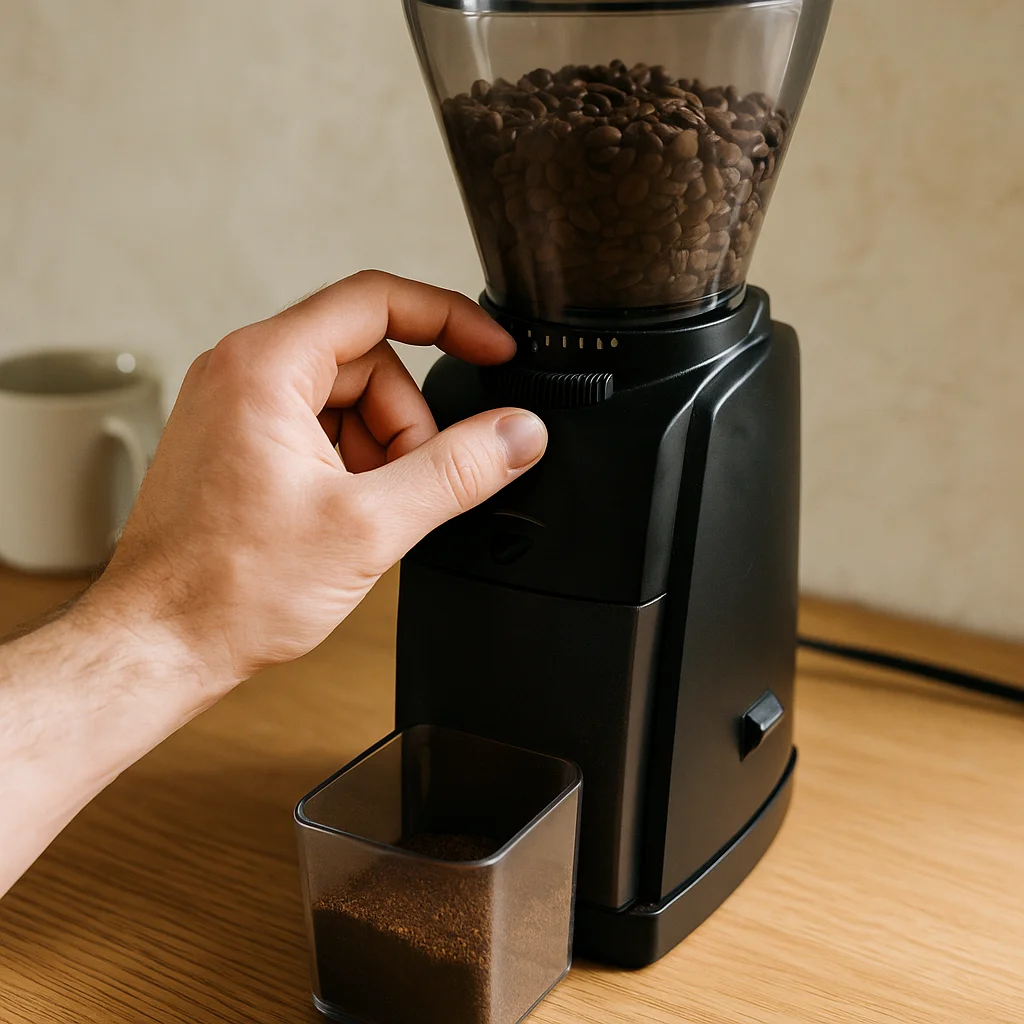
You nudge your grinder one click finer. You pull a shot or brew a cup. It tastes almost the same as before. So you nudge it again. Then again. Then you've gone three or four clicks past where you probably needed to be, and now you're chasing your tail back in the other direction.
This is one of the most common home brewing frustrations, and it has almost nothing to do with your taste buds or your patience. It's a mechanical reality built into how burr grinders work — one that most people never get told about because it looks, from the outside, exactly like user error.
Here's what's actually happening.
The Retention Chamber Problem
Every burr grinder holds some amount of already-ground coffee inside itself at any given moment. This is called retention, and it lives in the throat of the grinder — between the burrs and the exit chute, in the chute itself, and sometimes in small pockets around the burr carrier depending on your grinder's geometry.
When you change your setting, the burrs move to a new position. But the coffee that comes out of the grinder for the next several seconds — sometimes longer — was ground before you made that change. It's the retained coffee from the previous setting, working its way through the system.
The practical consequence is this: if your grinder retains roughly two grams of coffee in its internal geometry (a completely normal number for a mid-range home grinder), and you're dosing eighteen grams per cup, your first post-adjustment dose contains a mixture. Maybe twelve grams at the old setting, six grams at the new one. The second dose is closer to the new setting. By the third dose, you're finally getting a clean read on what your adjustment actually did.
If you're tasting and adjusting after every single dose — which is the right instinct — you're making decisions based on blended output from two different grind settings simultaneously. The cup doesn't taste quite right, but it's not because your new setting is wrong. It's because you haven't flushed the old setting out yet.
The Burr Seating Lag
There's a second, less obvious thing happening when you change settings, particularly on conical burr grinders. The burrs themselves have a small amount of give — not slop, exactly, but a seating behavior where the grinding position stabilizes slightly differently depending on which direction you turned the adjustment ring and how the burrs are loaded with coffee under grinding pressure.
When you adjust finer, the burrs compress together. When you adjust coarser, they release. In both cases, there's a brief period where the actual gap between the burrs isn't fully settled at the new position — it's finding its equilibrium under load. The grinding pressure of coffee moving through the burrs, combined with the motor's torque, will seat the burrs into their final position over the first few seconds of grinding.
This lag is small — we're talking fractions of a millimeter — but at the particle sizes relevant to espresso especially, fractions of a millimeter in burr gap translate to meaningful differences in extraction. It contributes to the same phenomenon: the first grind after an adjustment isn't representative of the setting you selected.
What This Means in Practice
Once you understand these two mechanisms, the fix is straightforward.
Always purge after adjusting. Grind a small amount of coffee — somewhere between two and five grams depending on your grinder's known retention — and discard it or add it to your compost. This clears the retained coffee from the previous setting and lets the burrs settle under load. Then grind your actual dose. What comes out now is a genuine sample of your new setting.
How do you know your grinder's retention? Weigh your dose going in, grind it, and weigh what comes out. The difference is your retention. Do this a few times with your normal beans at your normal setting and you'll have a reliable number to work with.
Stop adjusting in rapid succession. The instinct to nudge-taste-nudge-taste is understandable, but it compounds the retention problem. Each quick adjustment adds another layer of blended output to what you're evaluating. If you're going to adjust, purge, then give yourself a full clean dose before deciding whether to move again.
Adjust in one direction when possible. Many grinder mechanisms have slightly different seating behavior depending on whether you're going finer or coarser. If you've overshot — gone too fine — don't just back off two clicks. Go noticeably coarser than your target, then approach from the coarser side. This ensures the burrs are seating in a consistent direction and reduces the gap inconsistency that comes from reversing mid-adjustment.
Account for larger adjustments requiring longer flushes. Moving one click finer requires a smaller purge than moving five clicks finer. The bigger your adjustment, the more retained old-setting coffee you're working through. This is obvious in retrospect, but it's easy to forget in the moment when you're impatient to taste the result.
The Bigger Picture
None of this means your grinder is broken or that you need to upgrade. It means your grinder is a mechanical object behaving exactly as mechanical objects do — with inertia, with lag, with geometry that takes a moment to catch up to where you asked it to go.
Most dial-chasing spirals that turn a five-minute adjustment into a thirty-minute debugging session aren't happening because the right setting is hard to find. They're happening because the feedback loop is corrupted by retained coffee and unsettled burrs, and the brewer doesn't know to account for the lag.
Once you know the lag is there and why, you stop fighting it. You purge, you wait for a clean dose, you evaluate. The setting you wanted is usually a lot closer than it seemed when you were chasing it blind.