Why Your Grinder Lies to You When the Bag Gets Light
As a bag of coffee empties, the decreasing column of beans above the burrs changes how your grinder feeds, times, and distributes grounds in three specific ways that shift extraction even when your setting, dose target, and technique stay identical.
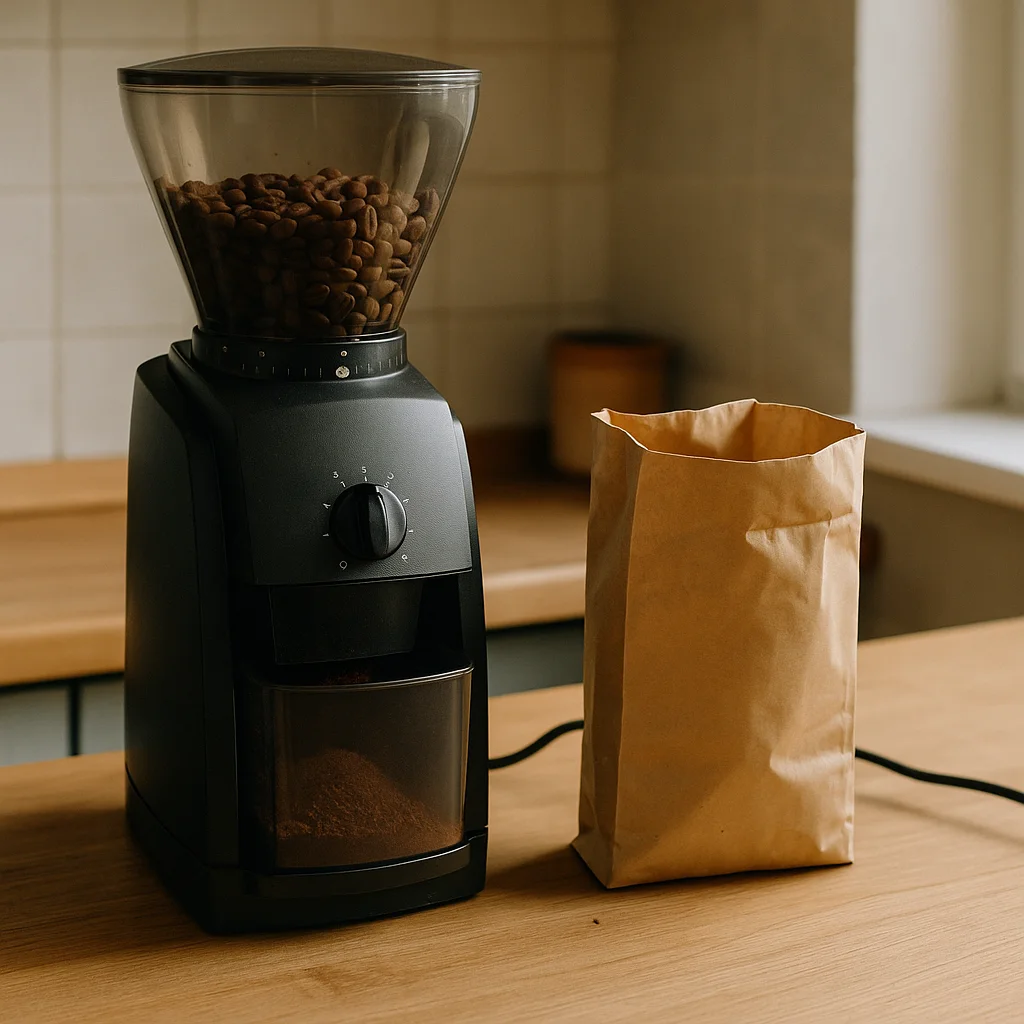
There's a frustrating pattern that shows up in home brewing and almost nobody talks about it: you dial in a recipe early in a bag, it tastes great for a week or so, and then somewhere in the final third the cup quietly gets worse. You didn't change anything. The beans are the same roast, the same origin, the same bag. But something shifted.
Blame the bag. Specifically, blame how much of it is left.
Most home grinders — flat burr, conical burr, doesn't matter — rely on gravity and the weight of stacked beans to push coffee consistently into the grinding chamber. When a bag is full or even half-full, that column of beans above the entry point creates reliable, steady pressure downward. Beans line up, feed evenly, and your grinder hums through a dose in a predictable rhythm. When the bag gets light, that pressure drops. The beans left in the hopper (or the portion you've dumped in if you grind on demand) sit with less mass bearing down. Feed rate slows slightly and becomes less uniform.
The immediate effect is that your grind time stretches. If your dose normally takes 18 seconds at your setting, a sparse hopper might push that to 21 or 22 seconds. That doesn't sound dramatic, but a longer grind cycle means more time for heat to transfer from the burrs into the grounds themselves. Slightly warmer grounds off the burrs changes how aromatic compounds volatilize before water ever touches them. The result in the cup skews flatter, a little dull at the finish — and because the change is gradual, you rarely connect it to the depleting bag.
The contact time problem nobody measures
Beyond heat, slower feed rate changes something more mechanical: the average time each coffee particle spends in contact with the burrs. When beans drop quickly and steadily into the grinding chamber, fresh material continuously pushes processed grounds out. When feed rate is sluggish, particles linger slightly longer between the burrs before exiting. This doesn't mean they get ground twice in any dramatic sense, but the extended burr contact does round off more of the sharp particle edges that contribute to clean, bright extraction.
Rounded edges extract differently than sharp ones. Sharp-edged particles have high surface area relative to their mass and give up their solubles quickly and efficiently. Particles with abraded, rounded edges extract more slowly and less evenly. At your usual brew time and water temperature, this shifts the extraction profile toward a muddier, less defined cup — again, without you touching a single setting.
Bean orientation changes when the pile thins
Here's the one that surprises people most. When a hopper or chamber is well-loaded, beans tumble over each other and enter the burr throat in a fairly random mix of orientations. Beans are not uniform spheres — they're oval, with one flat side and one curved side, and their long axis varies. In a full hopper, the variety of approach angles averages out over a dose. Particle distribution stays relatively consistent.
When only a thin layer of beans remains, that randomization disappears. Beans tend to lie flat on the bottom of whatever surface is holding them, presenting similar orientations as they drop. The burrs see a more uniform approach angle, which sounds like it should be a good thing, but it actually reduces the variability that helps particle size distribution stay balanced. You end up with a narrower, more peaked distribution — more particles clustering at one size, fewer of the coarser fragments that would otherwise slow extraction slightly and add body. The cup can taste sharper and thinner than you expect.
What to actually do about this
None of this means you need to buy more coffee before you run out, or waste the last hundred grams of a bag. It means you need to know the adjustment is coming and meet it deliberately.
The most direct fix is to grind slightly finer as a bag empties — not dramatically, just a small nudge toward fine once you're in the bottom third. How much depends on your grinder and your method, but a one-step adjustment on a numbered grinder, or a 15-degree twist on a stepless one, is usually enough to compensate for the slower feed and rounded-particle effects. You're correcting for what the machine is actually doing, not for any change in the beans themselves.
If you brew pour-over or other gravity methods, you can also compensate with a slightly finer grind and a marginally longer total brew time. For espresso, a small dose bump of half a gram or so can restore the resistance in the puck that the rounded particles are quietly stealing.
For grind-by-weight users, this problem is slightly mitigated because you're hitting a weight target rather than running a timer — but it's not eliminated, because the feed inconsistency still introduces variation in how long the grinder runs to reach that weight, which reintroduces the heat and contact-time issues above. Knowing that the problem exists helps you watch for it.
The cleanest solution, if your setup allows it, is to grind the last portion of a bag all at once rather than grinding on demand from a nearly empty hopper. A consistent column of material — even a small but uniform one — behaves more predictably than a thin, unpredictable scatter of beans dropping in ones and twos. Grind the remainder, store it in an airtight container, and brew from that. You lose a tiny bit of freshness over a day or two, but you gain a consistent extraction profile for those final cups.
The real takeaway
Your grinder's setting is not a fixed output. It's the beginning of a description, not the whole story. The mechanical reality of how beans enter the burrs — how much weight is behind them, how evenly they feed, what orientation they present — changes what comes out the other end, even when the number on the dial doesn't budge.
A bag of coffee isn't uniform from first dose to last. Once you know that, the late-bag slump stops being a mystery and starts being something you can actually manage.