How Weather Affects Your Grinder (And What to Do About It)
Ambient temperature and humidity can physically affect how your grinder's burrs interact with coffee beans in a few specific ways, shifting your grind even when your setting stays the same. Understanding each one can help you make a small, targeted adjustment before you brew.
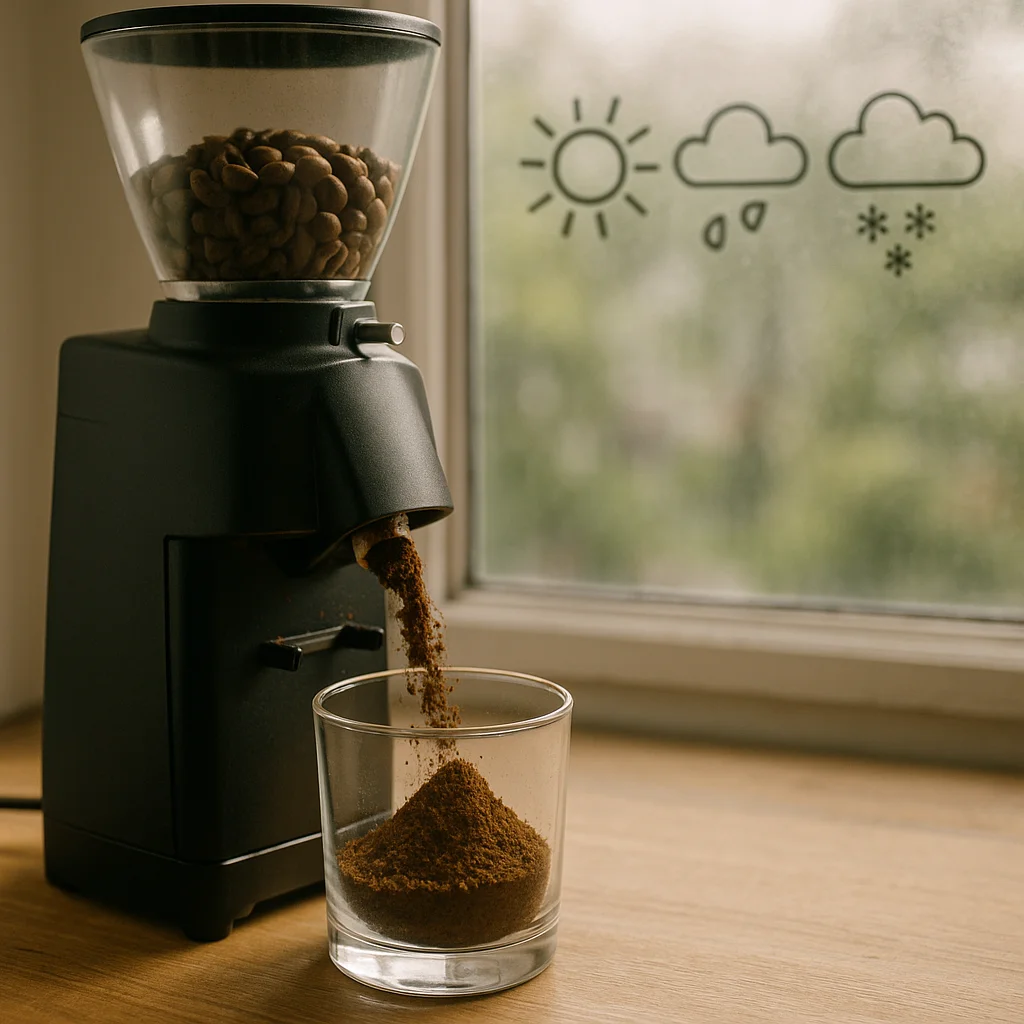
There is a particular frustration that visits home brewers in late spring, during a heat wave, or on the first cold morning of autumn. Your recipe is locked in. You have not changed your setting, your beans, your dose, or your pour. And yet something is off -- slightly bitter, a little flat, or oddly sour in a way that is hard to pin down. You adjust things. You chase it. You do not quite find it.
One likely culprit is the environment around your grinder. Temperature and humidity can each affect what happens inside the machine in distinct ways. Once you understand those ways, you have something specific to check instead of randomly poking at variables.
What Happens to Metal When Temperature Changes
Burrs are precision-machined metal. Metal tends to expand in heat and contract in cold. The gap between two burr faces -- the physical space that shapes your grind -- is measured in fractions of a millimeter. Thermal expansion can shift that gap even when your dial reads the same number.
A warm kitchen may produce a slightly wider burr gap than the same grinder on a cold morning. A wider gap tends to produce a coarser grind. A coarser grind can mean faster water flow, less extraction, and a thinner or more acidic cup. The reverse -- a narrower gap from cold -- can push toward slower flow and more extraction, which may bring bitterness forward.
The grind size range for pour-over or espresso is already fairly narrow, so relatively modest temperature swings between seasons could be enough to notice a difference.
A practical suggestion: if your coffee suddenly tastes underdeveloped in summer or over-extracted in winter at a setting that has always worked, temperature-related burr shift is a reasonable first thing to consider, before assuming your technique has changed.
How Humidity Can Affect Your Grounds Before Brewing
Coffee absorbs moisture from the air -- this is well known for storage. It can also happen during grinding, and it affects how the resulting particles behave.
In humid conditions, ground coffee particles may clump more than usual. Moisture on particle surfaces can create a mild stickiness between them. Clumped grounds tend not to distribute or extract evenly. Water can find easier paths through a clumped bed, over-extracting some areas and under-extracting others at the same time. The result can taste muddy -- not quite bitter, not quite sour, just muted.
This is more likely in humid climates during summer, or in kitchens where cooking steam or a nearby dishwasher raises the local moisture level. The grounds may look normal coming out of the grinder but feel slightly stickier or more compacted in the catch.
A practical suggestion: in high-humidity conditions, a brief stir of your grounds before brewing may help break up surface clumping without meaningfully affecting temperature or distribution. It is a small step, not an elaborate technique.
How Static Behavior Reverses With Humidity
Most home brewers are familiar with static -- grounds that cling to the catch cup, spray onto the counter, or drift back toward the chute. What is less obvious is that static behavior tends to reverse depending on humidity, in a way that can make the correction feel counterintuitive.
Dry air -- cold winter air in particular -- tends to increase static charge buildup inside the grinder. Grounds carry a stronger charge, repel each other more, and spray. This looser distribution can affect how water flows through them, sometimes resulting in faster extraction than you expect.
Humid air tends to dissipate static charge. Grounds cling to each other and to the catch rather than spraying. This may look like an improvement -- less mess -- but the underlying cause (moisture-loaded particles with reduced charge) is what contributes to the clumping described above.
So the two conditions tend to look like this: more static in dry air (grounds scatter, extraction may run faster than your setting suggests), less static in humid air (grounds clump, extraction may run unevenly). Both can shift your cup away from where you dialed it in, and the appropriate response is different for each.
In dry, high-static conditions: if your result tastes thin, consider nudging your grind slightly finer. In humid, low-static conditions: try stirring your grounds, and if the problem continues, consider nudging slightly coarser to give water a more forgiving path through the bed.
A Simple Seasonal Check-In
None of this requires new equipment or complex charts. It just requires noticing a few things when your cup drifts without an obvious cause.
First: Has the temperature in your kitchen changed noticeably since you last dialed in? If it is meaningfully warmer, the burr gap may have widened slightly -- a small finer adjustment could help. If it is meaningfully cooler, the gap may have narrowed -- a small coarser adjustment might be worth trying.
Second: Is the air noticeably humid or dry? In humid conditions, stir your grounds and consider opening the grind slightly. In dry conditions, watch for faster extraction and consider nudging finer.
Third: Has the static behavior from your grinder changed? More spray than usual points to dry air. Less spray but stickier grounds points to humid air. This can serve as an early signal before you even taste the cup.
Any adjustment in these cases is likely to be small -- perhaps half a step on a stepped grinder, or a minor turn on a stepless one. You are not starting over. You are trimming to account for conditions your grinder cannot control or communicate.
The Larger Idea
Your grinder is not a sealed system. It exists in your home, which exists in a climate that shifts by season, by weather, sometimes by the hour. The burrs, the grounds, and the air around them all interact in small ways. Knowing that does not mean becoming obsessive about it. It means having a plausible place to look when something drifts, and a specific adjustment to try instead of guessing.
Good coffee at home is not about controlling everything perfectly. It is about knowing which variables are actually moving so you can touch the right one.