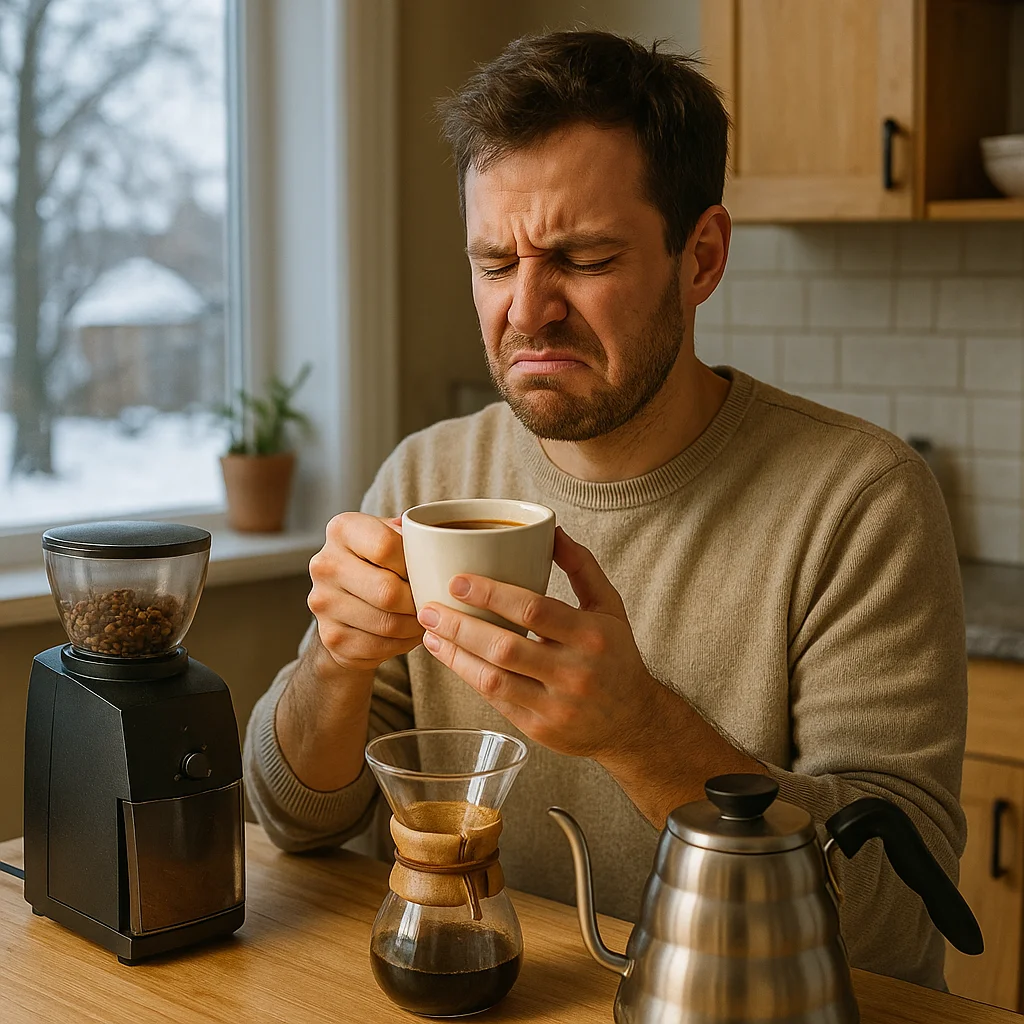
It happens every year around the same time. You haven't changed anything — same beans, same grinder setting, same ratio — but your morning cup starts tasting flat, or bitter, or just weirdly off. You fiddle with the grind. Maybe you try a new bag. Nothing quite clicks.
Here's what's probably happening: winter arrived, and your brewing environment changed with it.
This isn't mysticism. It's physics, and once you understand the three specific ways cold temperatures mess with extraction, you can actually fix the problem instead of chasing your tail.
The Water Gets There Cooler Than You Think
Most kettles — electric or stovetop — are set and forgotten. You dial in 200°F (93°C) once and assume that's what hits your grounds. But in a cold kitchen, the thermal mass of everything around your brew station is working against you.
A ceramic pour-over dripper sitting in a 62°F kitchen will drop your brew water temperature by 10–15°F in the first 30 seconds of contact if you haven't preheated it. A cold carafe underneath pulls heat downward as you pour. Even the ambient air chilling your stream mid-pour matters more than you'd expect.
The result is under-extraction: sour, thin, oddly sweet in the wrong way. You reach for a finer grind to compensate, which sometimes helps but often makes things worse by introducing channeling or bitterness.
The fix is boring but effective: preheat everything. Fill your dripper, your server, even your mug with hot water and let it sit for 60 seconds before you start. If you're using a kettle with a temperature setting, bump it up 3–5 degrees from your summer setting — not forever, just seasonally, the way you'd adjust your thermostat.
Your Grinder Is Running Cold
Burrs grind differently when they're cold. This surprises people, but it's well-documented in commercial roasting and increasingly discussed among home brewers: metal contracts slightly in lower temperatures, and more practically, cold burrs produce a different particle distribution than warm ones.
In a warm kitchen, your grinder has usually done a few rounds before your main brew — maybe yesterday's cup, or just sitting in a heated room. In winter, especially if you keep your grinder near an exterior wall or unheated surface, those burrs start genuinely cold.
Cold grinding tends to produce more fines — the tiny particles that extract fast and bitter. This is the same reason commercial espresso bars run a few throwaway shots after opening in the morning: they're warming up the grinder, not wasting product for the fun of it.
The practical fix: run a small purge dose (5–10 grams is enough) through your grinder before your actual grind. You don't need to brew with it — just grind it, discard it or keep it for cleaning purposes, and then grind your real dose. If you notice your first cup of the day is consistently worse than your second in winter, a cold grinder is a likely culprit.
The Beans Themselves Are Behaving Differently
If you store your beans anywhere near an exterior wall, in a cabinet above an unheated garage, or even on a counter that gets cold overnight, you're brewing with beans that are measurably cooler than they were in July.
This matters because CO2 off-gassing — the process that affects bloom and extraction — slows down significantly with temperature. Fresher-roasted beans in cold storage behave more like older beans in warm storage. Your bloom might look weak not because your beans are stale, but because they're cold and sluggish.
Under a cold bloom, CO2 is still trapped in the grounds and will release unevenly during the main pour, creating channeling and inconsistent extraction.
The simplest fix: bring your beans to room temperature before grinding. If your storage spot is genuinely cold, let the bag sit on your counter for 20–30 minutes before you open it. This sounds fussy, but it takes zero effort — you just move the bag when you wake up. By the time your kettle is boiling, you're in a better position.
One More Thing Worth Checking
Your tap water itself is colder in winter — in many places, meaningfully so. If you use tap water directly or filtered tap water and you've noticed your coffee trending bitter in cold months, this is worth paying attention to.
Colder incoming water means your kettle is starting from a lower baseline and may behave slightly differently if you're using a cheaper kettle without precise temperature control. Some cheaper electric kettles calibrate poorly at low ambient temperatures. Not a crisis, but worth knowing.
If you fill your kettle from a tap that runs noticeably colder in January than in August, just give it an extra 30 seconds after your kettle clicks off. You're not going to hit perfect temperature without a thermometer anyway — but you're at least not starting your brew already behind.
Putting It Together
None of these fixes require new gear or obsessive precision. The seasonal recalibration looks like this:
- Preheat your brewing vessel more aggressively than you do in summer — add 60 full seconds, not a quick rinse.
- Run a purge dose through your grinder on cold mornings before your actual grind.
- Move your beans to room temperature the night before or first thing in the morning.
- Bump your kettle temperature up slightly — 3 to 5 degrees — and revisit it when spring arrives.
The underlying principle is simple: your coffee setup assumed a certain baseline temperature when you dialed it in, and winter changed that baseline. You're not starting from scratch, you're just accounting for a shift that happens every year and is easy to forget about because it happens gradually.
The cup you had in September is still achievable. You just have to give your gear a fighting chance in the cold.