Your Grind Timer Is Lying to You
The duration of your grind cycle—not your setting, not your dose—silently compresses particle distribution during longer runs, causing systematic over-extraction that mimics a grind that's too fine even when nothing else has changed.
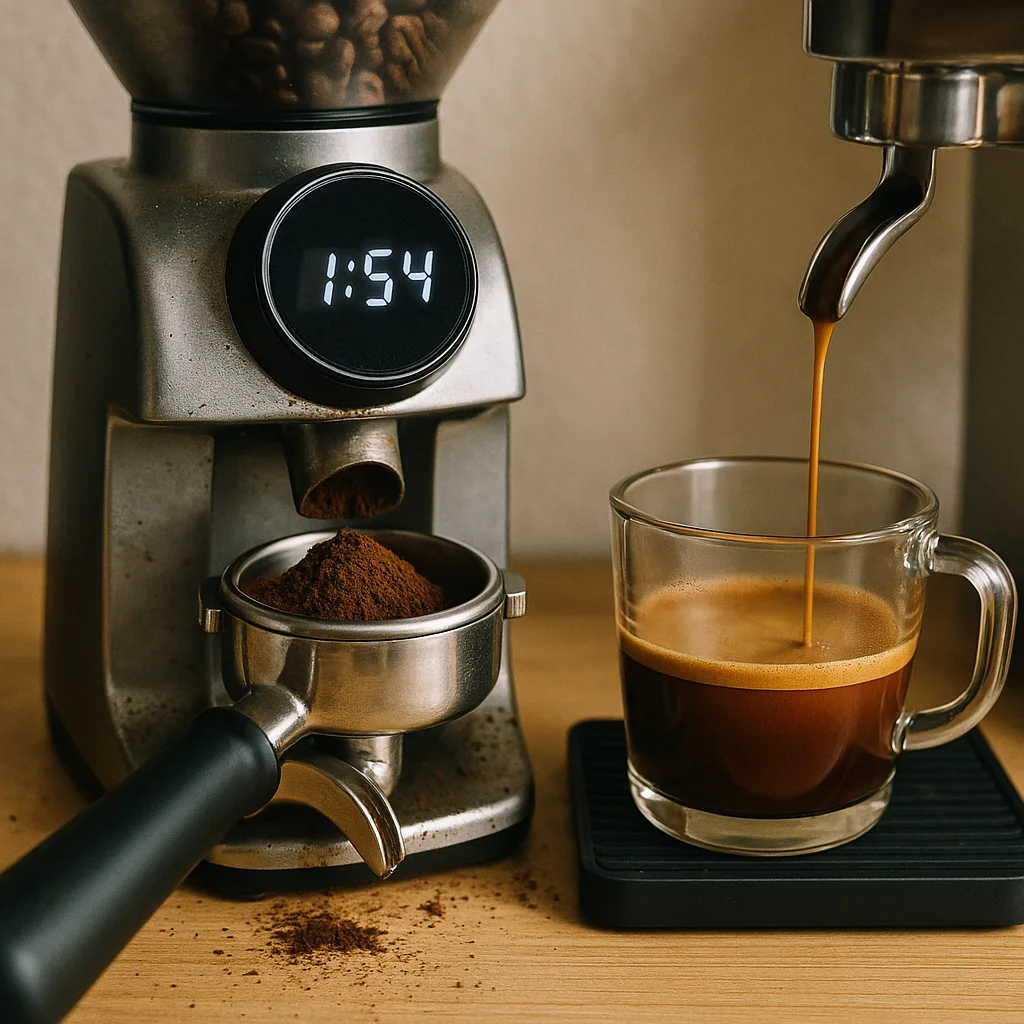
There's a category of brewing problem that's almost impossible to find because it looks exactly like a different problem. You taste something bitter and astringent, you go finer on your brew ratio or coarser on your grind, and things improve slightly. Then the next day it's back. You're not crazy, and your equipment isn't broken. You're just measuring the wrong thing.
Most home grinders are timed, either by a built-in timer or by the habit of running them until the hopper sounds empty. That duration—how long the burrs spin against the beans—turns out to matter in a way that almost no one accounts for.
What Actually Happens Inside a Running Grinder
Burrs don't grind coffee passively. They generate friction, and friction generates heat. That's obvious when you think about it, but the implication isn't: the longer your grinder runs in a single session, the warmer the burr chamber gets, and warmer burrs produce a measurably different particle distribution than cool ones.
The effect compounds. Coffee particles that pass through warm burrs are slightly more brittle at the moment of impact. They fracture along different stress lines than cool beans do, producing more fine particles relative to your coarser target size. Those fines aren't dramatic—you won't see a visible change in your grounds—but they're real enough to shift extraction.
This is distinct from the well-documented problem of a cold grinder at startup. That's been written about. What's less discussed is the opposite end: what happens when you run your grinder longer than you usually do.
When Duration Changes
Consider two scenarios that happen constantly in real home-brewing life.
First: you're making coffee for guests instead of just yourself. You grind twice as much as usual. Your grinder runs for forty-five seconds instead of twenty. The burrs are meaningfully warmer by the end of that run, the later-ground coffee has a shifted particle distribution compared to the first, and when you brew the full batch, the result is muddier than you'd expect from the same beans and the same settings.
Second: you run out of beans mid-bag and switch to a new one partway through a week. The new beans are less dense—many roasters source from different farms across seasons—and your grinder has to work harder, running a few seconds longer to produce the same weight. Those extra seconds aren't neutral.
In both cases, the grind setting hasn't changed. The beans are ostensibly the same. But the cup tastes different in a specific way: a lingering bitterness that feels like over-extraction from grounds that are too fine.
The Confirmation Test
You can verify this yourself without any special equipment. Grind your normal dose on a cool grinder and brew. Note the result. Then run your grinder empty for thirty seconds before grinding the same beans at the same setting, and brew again. The second cup will taste noticeably different—typically more bitter and with less brightness—because the burrs were pre-warmed.
This isn't a subtle effect. It's the kind of thing that makes you wonder if you accidentally changed your setting. You didn't. You changed your grinder's thermal state.
If you want numbers: entry-level flat burr and conical burr grinders in the home price range have relatively low thermal mass. Their burr surfaces can shift ten to fifteen degrees Celsius in a thirty-second run depending on ambient temperature and bean density. Higher-end grinders with heavier steel burrs are more resistant to this drift, which is one of the reasons they're more consistent—not because of burr geometry alone, but because mass stabilizes temperature across a grind session.
Three Practical Adjustments
Match your grind duration to your setting decisions. If you dial in your grinder for single-cup use and then grind for four people, you can't use the same setting without adjustment. A reasonable starting point: go one step coarser for every additional dose you're grinding beyond your normal single run. This compensates for the fines increase from accumulated heat. Dial back in from there based on taste.
Establish a consistent thermal starting point when you can. This doesn't mean doing anything complicated. It means being aware that a grinder that's been sitting cold for twelve hours behaves differently than one you used twenty minutes ago. If you're troubleshooting inconsistency, rule out session timing before you rule out anything else. The fix can be as simple as grinding a small amount of stale or already-used beans—sometimes called purging—to bring the burrs to a stable working temperature before you touch your good coffee. A five-gram purge on a cool morning gets you much closer to the thermal state your recipe was dialed in at.
Pay attention to grind duration when you adjust your recipe. If you've been pulling a slightly finer grind for a few days and things taste good, ask yourself whether you changed anything else—including whether you've been brewing smaller doses than usual. Smaller doses grind faster. Faster grinds run cooler. You may be attributing the improvement to your setting change when part of it is actually the shorter run time. This matters because when you go back to grinding your full usual amount, the problem may return, and you'll think your setting has stopped working.
The Broader Point
Grinders have settings, but they also have states. The setting is the gap between the burrs. The state is everything else: how warm they are, how seasoned, how aligned, how loaded with grounds from the previous session. Most troubleshooting focuses on settings because settings are legible—they have numbers, or at least consistent click positions. States are invisible, which is why they account for so many of the coffee problems that seem to have no explanation.
Duration is one of the easiest states to overlook because it feels like a non-variable. You grind until the beans are gone. Of course you do. But the grinder doesn't know how many beans you started with. It just knows friction and heat and time.
Once you account for it, a specific pattern of inconsistency that has probably bothered you for a long time—the larger-batch problem, the guest-coffee problem, the midweek setting drift—tends to resolve itself. Not because you bought anything or learned an elaborate technique, but because you stopped treating your grinder as a static machine and started treating it as one that changes state with use.