Your Grinder Dose Changes Every Time You Refill the Hopper — Here's the Mechanism
The fill level of coffee sitting above the burrs creates measurable back-pressure that changes how much actually falls through per revolution, meaning a full hopper and a nearly empty one deliver different doses at the same setting without anything else changing.
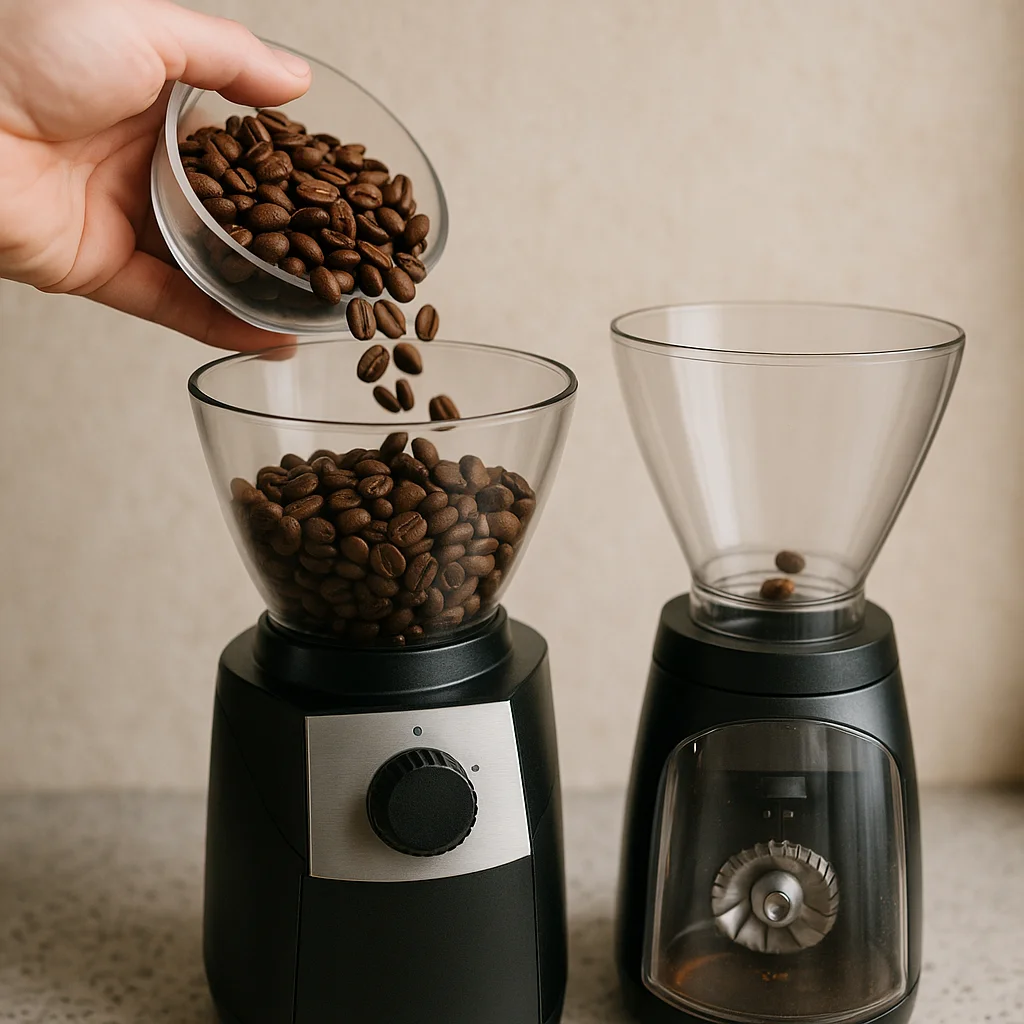
Most home brewers treat the hopper as a passive container — a place to store beans until the grinder needs them. Fill it up, set your grind weight or time, walk away. The assumption is that whatever the grinder does with a full load, it'll do the same with a quarter load. That assumption is wrong, and the physics behind why it's wrong explains a frustrating pattern of inconsistency that looks like it's coming from somewhere else entirely.
What's Actually Happening Above the Burrs
In any grinder where beans feed from a hopper down through a chute into rotating burrs — which covers the vast majority of home conical and flat burr machines — the beans don't fall freely. They stack. That stack has weight, and that weight pushes down on whatever is directly above the burr entry point.
When your hopper is full, that column of beans is tall. The beans near the bottom are being pressed downward by everything above them, and that pressure assists feeding. Beans move into the burrs readily because gravity and the weight of their neighbors are actively pushing them there. The burrs pull in material at a consistent rate, and your dose per unit time is relatively predictable.
As the hopper empties, that column shortens. The beans sitting just above the burr throat have less weight above them. They're not being pushed — they're essentially just resting there, waiting for the burrs to drag them in through friction and the geometry of the entry point alone. The feed rate slows, sometimes subtly, sometimes noticeably. If you're grinding by time, you get less coffee. If you're grinding by dose weight with a more sophisticated setup, the grinder has to run longer to reach target weight, changing your grind cycle duration — which is its own separate variable.
Why This Shows Up as Flavor Drift
The practical result is that a timed grind from a full hopper and a timed grind from a hopper with 50 grams left at the bottom will often produce different output weights. The difference can be small — sometimes two or three grams — but two or three grams of coffee at a standard espresso or pour-over dose is not a trivial shift. It changes your coffee-to-water ratio, and that change moves your extraction in a direction that's indistinguishable from having adjusted your recipe.
Under-dosing because of a slow hopper feed makes coffee taste thin, sharp, and bright in an unpleasant way. Over-dosing from a pressured full hopper makes things heavier and potentially muddy. Neither symptom obviously points to hopper fill level as the cause. They look like a grind setting problem, a water temperature problem, a bean freshness problem — anything but the amount of coffee sitting above the burrs.
The Shape of the Bean Matters Too
This effect isn't uniform across coffees. Bean geometry plays a role. Rounder, denser beans — typically lower-altitude naturals or certain washed Brazilians — pack together with fewer air gaps. The column above the burrs behaves almost like a semi-solid, transmitting pressure efficiently downward. These coffees show a more pronounced difference between full and low hopper states because the pressure differential is larger.
Longer, more irregular beans — many Ethiopian heirlooms or dry-processed lots with uneven surfaces — interlock and arch. They sometimes create bridging above the burr throat, where beans lock across the chute and effectively block feed entirely for a fraction of a second before the stack collapses. With these beans, you might notice erratic grinding sounds and slightly clumpy output. That bridging is more common with a lower fill level, which reduces the weight that would otherwise break the arch passively.
Checking Whether This Is Affecting You
You don't need any special equipment to find out if hopper fill level is influencing your doses. Run three timed grinds — same setting, same duration — with a full hopper, a half-full hopper, and a nearly empty hopper (15-25 grams left). Weigh each output on a scale. If the numbers vary by more than one gram across those three states, hopper fill level is a real variable in your brewing, not a theoretical one.
Many home brewers who do this test are surprised. The gap between full and nearly empty is often larger than expected, particularly with timed grinders or older machines where burr geometry doesn't actively compensate for feed rate variation.
What You Can Actually Do About It
The simplest fix requires no equipment changes at all: stop refilling your hopper mid-session. Grind your full dose with whatever fill level you started with that day, and refill after you're done. This doesn't eliminate the variable, but it makes it consistent within a single brewing session.
The more deliberate approach is to pick a fill level and maintain it. Some experienced home brewers keep their hopper within a narrow range — say, always between 50 and 100 grams — and treat a refill as a moment to recalibrate their timed output. They'll run a brief test grind and weigh it before relying on it for their actual cup, adjusting duration slightly if needed.
For espresso specifically, where dose precision matters more, this is a genuine argument for single-dosing — loading exactly what you need for each shot, bypassing the hopper entirely, or using the hopper only as a temporary staging area rather than a reservoir. The feed pressure from a full column simply doesn't exist when you're dropping 18 grams directly above the burrs.
The Bigger Takeaway
Your grinder is a mechanical system, and mechanical systems respond to the physical conditions they're operating under. The amount of material loaded above the burrs is a physical condition, not a setting — which is exactly why it doesn't show up on any dial or screen. Nobody tells you to account for it. It just quietly changes your output while you're focused on everything else.
Knowing this doesn't require you to become obsessive about hopper management. It just means that the next time your cup tastes off and you genuinely haven't changed anything, it's worth asking: how full was the hopper when I ground that?