Your Grinder Is Lying to You About Dose Weight — Here's the Physics Behind It
Static charge buildup inside your grinder varies with seasonal conditions, bean surface chemistry, and grind setting in ways that cause your actual dose to diverge from your target weight by enough to shift extraction — and understanding the mechanism lets you correct for it instead of blaming your scale.
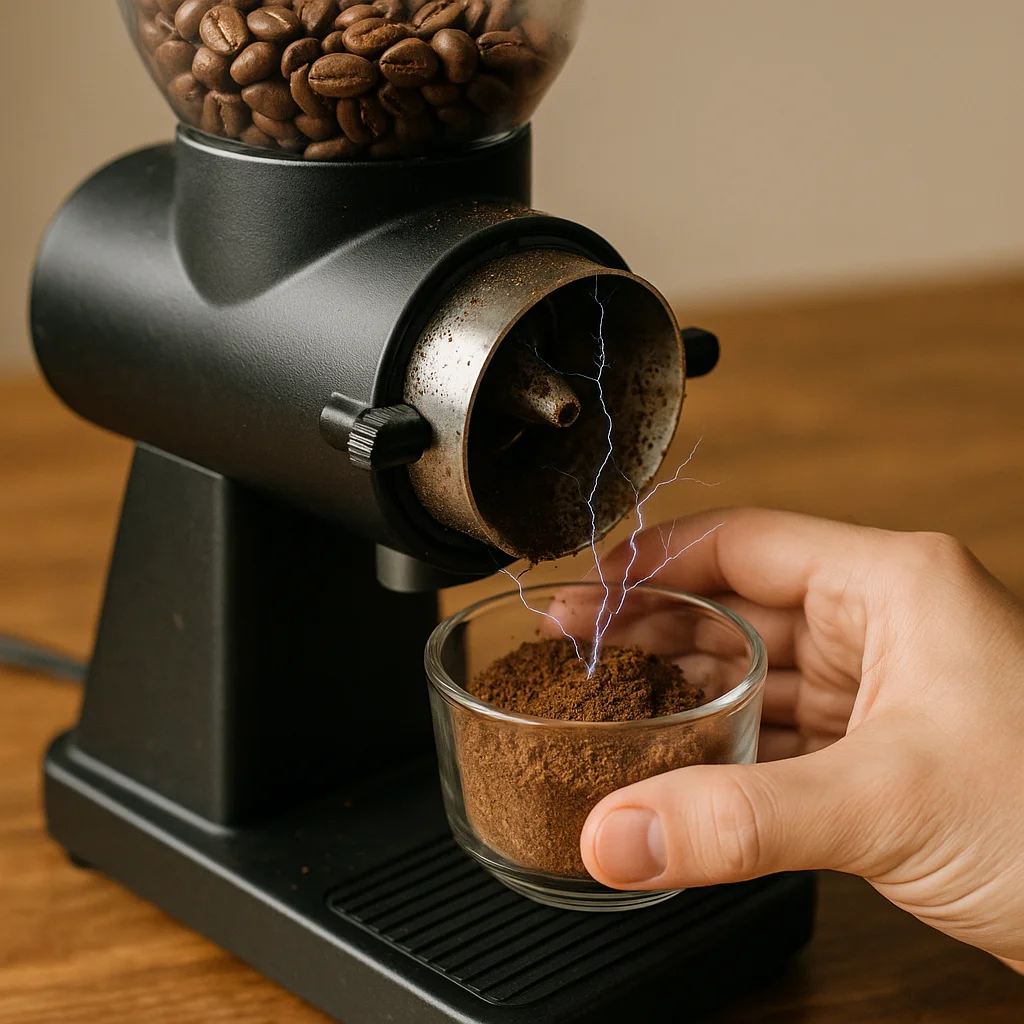
If you weigh your dose before grinding and your output after, you've probably noticed the numbers don't always match. You load 18 grams, grind, and catch somewhere between 17.3 and 18.6 grams in your portafilter or brew basket. The rest is either stuck inside the machine or arrived in a small explosion of grounds that coated your counter. You adjust your input dose. You tap the grinder. You curse quietly. What you probably haven't done is figure out why the number drifts, because the cause isn't random — it's predictable once you understand what's generating it.
The culprit is electrostatic charge, and it's more systematic than most home brewers treat it.
What's Actually Happening Inside the Chamber
When coffee beans are ground, the friction between bean surfaces and burrs strips electrons from the coffee particles themselves. This is triboelectric charging — the same basic physics behind a balloon sticking to a wall after you rub it on your hair. Ground coffee particles end up carrying a net negative charge, and those charged particles repel each other while simultaneously attracting to any conductive or semi-conductive surface nearby: the exit chute, the grounds bin, the portafilter basket walls, the inside of a paper filter.
The size of that charge is not fixed. It scales with several things you can actually observe and influence.
First, particle surface area. Finer grinds produce dramatically more total particle surface than coarse grinds from the same dose weight, which means more friction events, more charge generated, more static in the system. If you dial finer for espresso versus coarser for pour-over, you're not just changing particle size — you're changing the electrostatic environment of every gram leaving your burrs.
Second, bean moisture content. Drier beans — older roasts, beans that have been open to low-humidity air, or light roasts that were processed to lower moisture levels — charge more aggressively than fresher or higher-moisture beans. Water is mildly conductive, and some surface moisture lets charge dissipate rather than accumulate. This is why a new bag of fresh beans often flings grounds everywhere for the first few sessions, then settles down as the bag opens and the beans reach equilibrium with ambient air moisture.
Third, ambient humidity. This one connects to bean moisture but operates independently. When the air in your kitchen is dry — winter heating season, or an arid climate year-round — charge has nowhere to bleed off into the atmosphere. When it's humid, dissipation happens faster and the clinging behavior diminishes noticeably. Same beans, same grind setting, measurably different behavior.
Why This Matters for Your Actual Cup
Here's where it stops being physics trivia and starts being a brewing problem. When grounds cling to the inside of your grinder, they don't cling uniformly. Fines — the smallest particles, which carry the highest charge-to-mass ratio — are disproportionately likely to stick. That means your caught dose is systematically missing some fraction of its finest particles compared to what actually left the burrs.
Fines drive extraction rate. They extract faster and more completely than coarser particles. When your dose is light on fines, it pulls differently than a complete dose would — often producing a slightly thinner, less developed cup even though your weight looks close to target. When a pocket of stuck fines releases all at once and drops into your next dose, you get an unexpected spike of over-extraction.
This also means your effective grind distribution isn't just what your burr setting produces. It's what your burr setting produces, minus what static retained, plus whatever static released from the previous grind. The two are related but not identical.
Three Things That Actually Help
The Ross Droplet Technique — adding a single drop of water to your beans before grinding — has become widely known because it works. The thin surface moisture gives static charge somewhere to bleed off, and grounds flow out of the chute cleanly instead of clinging and clumping. A single drop. Not enough to affect extraction measurably, but enough to change the bean surface's ability to hold charge. If you haven't tried this, try it before anything else.
Second, your grounds container matters more than you think. Metal grounds bins conduct charge away from the coffee as it lands. Plastic bins let it accumulate. If you're catching grounds in a plastic portafilter or a plastic dosing cup, you're giving static nowhere to go. A bare metal portafilter basket, or a stainless dosing cup, dissipates charge on contact. This alone reduces clumping and sticking noticeably in many setups.
Third, adjust your target input dose seasonally rather than treating it as fixed. In dry winter months, expect slightly more retention inside the grinder — grind a gram or two heavier than your target output and verify your catch weight on days when conditions change significantly. In humid summer months, you may find you need to dial back your input dose because retention drops and you start consistently over-dosing your basket. This isn't imprecision in your process — it's accounting for a real physical variable.
The Thing Worth Tracking
If you're already weighing your output dose (and you should be — weighing only input is measuring the wrong thing), start noticing whether your input-to-output gap changes with the seasons or with new bags of coffee. A gap that's consistently 0.2 to 0.3 grams is manageable. A gap that swings between 0.1 and 0.8 grams across different days is telling you something about your static conditions — and that variance, left unaddressed, is producing more cup inconsistency than most dialing adjustments can compensate for.
Your grinder's grind setting sets the particle size distribution. Static determines how much of that distribution actually makes it into your brew. Getting the two working together — rather than treating static as an annoyance to brush off the counter — closes one of the more underrated gaps between a good cup and a great one.