Your Grinder Is Lying to You About Particle Size — and Your Fingers Already Know the Truth
The texture of ground coffee against your fingertips reveals more about what your grinder is actually producing than any setting number does, and learning to read three specific tactile signals lets you catch extraction problems before water ever touches the grounds.
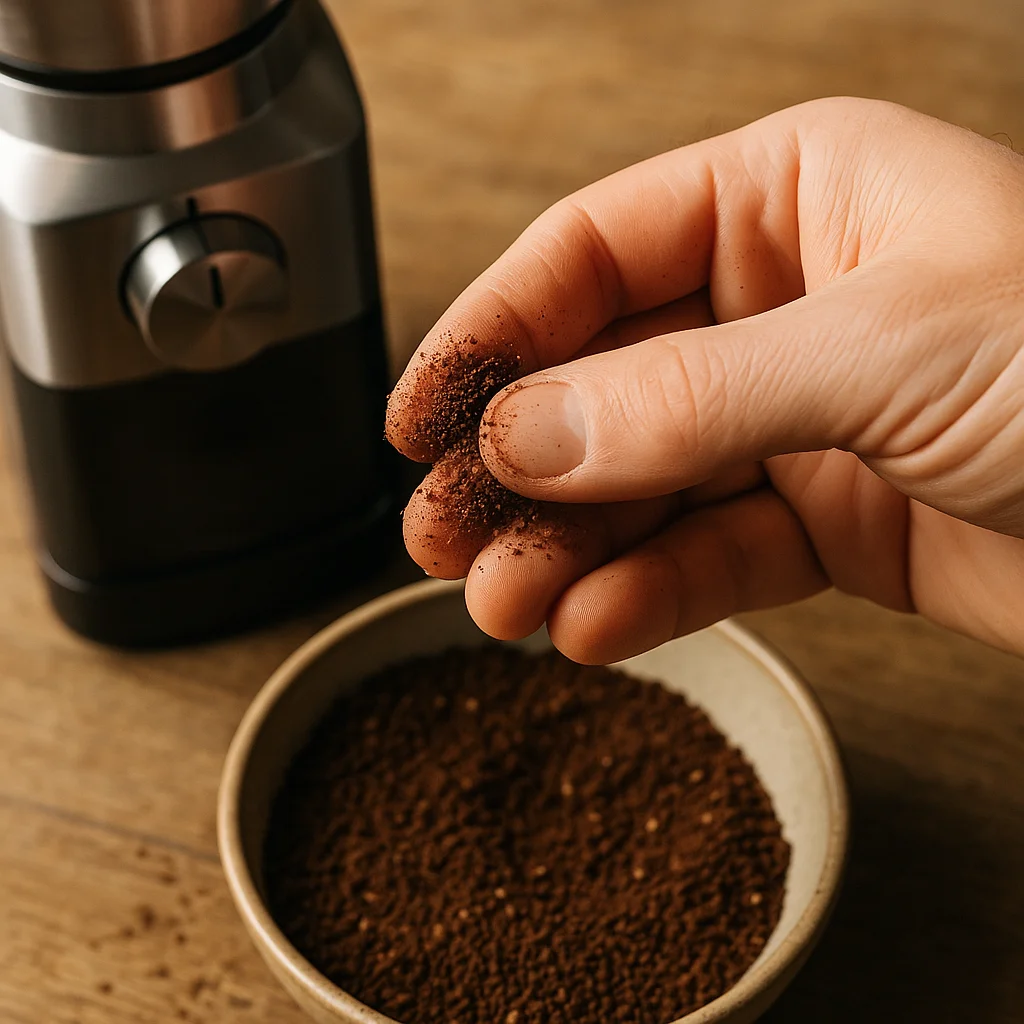
There's a number on your grinder. Maybe it's 14. Maybe it's 3.2. Maybe it's a notch somewhere between two unmarked clicks. Whatever it is, you trust it more than you should — not because you're naive, but because it's the only concrete feedback the machine offers you.
Here's the problem: that number describes burr gap, not particle size. And particle size is what actually determines extraction. The relationship between those two things shifts with bean density, roast level, humidity, burr wear, and a half-dozen other variables that your grinder's dial cannot see. The number stays the same. The coffee quietly changes.
Your fingers, though, don't lie.
Ground coffee has a tactile signature that tracks closely with what's happening in your cup. Once you learn to read it, you have a feedback loop that works regardless of what the dial says, what the bag claims, or what you dialed in six months ago when the grinder was newer and the beans were different.
Here are three signals worth building into your routine.
Signal One: Clump Behavior
Pinch a small amount of fresh grounds between your thumb and index finger, then release. Watch what happens.
Well-distributed grounds — meaning a particle spread that's reasonably consistent across sizes — will break apart easily and fall away cleanly. They might clump slightly from static, but gentle pressure dissolves those clumps without much resistance, and the pile doesn't hold its shape.
Now pay attention when the same grounds hold together stubbornly, or when the clumps feel dense and damp-ish even though the beans were dry. That cohesion usually signals a higher proportion of fines — very small particles — relative to the coarser fraction. Fines are sticky. They pack together and stay packed. When they do the same thing in your basket or filter, they slow water flow unevenly, extract faster than the surrounding particles, and push bitterness into an otherwise reasonable shot or brew.
The fix isn't always to grind coarser. Sometimes the problem is burrs that need cleaning, beans that are oilier than your last bag, or humidity that's changed the surface behavior of the particles. But the clump test tells you something is off before your taste buds do, which means you can adjust your dose, your distribution technique, or your grind before committing a full brew to the experiment.
Signal Two: Drag and Resistance When You Rub
Rub a pinch of grounds between your thumb and the pad of your index finger in a slow circle. You're feeling for drag.
Grounds that skate across your skin too easily — almost like fine powder — are usually too fine for filter brewing or sitting at the edge of over-extraction for espresso. Grounds that feel gritty and distinct, where you can almost sense individual particles, are in a different range. Neither is universally right. What matters is that you learn what your specific recipe's sweet spot feels like, so deviation becomes obvious.
This is particularly useful when you switch to a new bag of the same coffee. Roasters buy from the same farm, same lot — and then the harvest shifts, or the processing changes slightly, or the moisture content of that particular batch is a few points higher. The label is identical. The beans look similar. But the grounds will feel different under your fingers before you've tasted a single cup, because density and structure affect how burrs fracture the bean and what the resulting particles are like.
If the drag suddenly feels wrong compared to your baseline, that's your cue to grind slightly coarser or finer before you brew, rather than after.
Signal Three: Temperature Immediately After Grinding
This one surprises people. Touch the grounds right after they land in your portafilter or brew vessel. Not the equipment — the grounds themselves.
Fresh grounds carry heat from the burrs. That's normal and unavoidable. What you're reading for is the degree and duration of that warmth.
Grounds that feel noticeably warm — not just room temperature — tell you the burrs are running hot, which usually means you're grinding too fast for the grinder's thermal capacity, the burrs are working harder than usual (often a density issue with the beans), or the grinder hasn't had enough time between doses to dissipate heat from the previous grind. Heat accelerates degassing and slightly alters the surface chemistry of the particles in ways that affect extraction rate. Hot grounds going into a shot or brew are starting the process earlier than your recipe assumes.
If your grounds are consistently warm and your extractions have been trending bitter or sour in ways you can't explain, this is worth investigating. Slowing your grind rate, allowing more time between doses, or — for single-dosers — grinding in two shorter passes instead of one long one can bring temperatures back down.
Cool grounds, by contrast, are rarely a problem. If anything, they indicate the opposite: a machine that's running efficiently within its thermal comfort zone.
Making This Practical
You don't need to turn every morning into a lab session. The goal is to build a quick, unconscious check into your existing routine — the same way a good cook runs their fingers through flour to check texture without thinking about it.
For the first week, just touch your grounds every time you grind. Don't change anything. You're building a baseline for what normal feels like for your specific setup, your specific beans, your specific environment. After that, deviation becomes obvious, and obvious is useful.
The number on your grinder isn't useless. It's a starting point and a reference marker. But it's a blunt instrument describing a mechanical setting, not a direct measurement of the thing that matters. Your hands are more precise than the dial — they're reading the output directly.
That's a feedback loop worth developing. It costs nothing, takes about four seconds, and it works on every grinder, every bean, every brew method. No calibration required.