Your Grinder's Burr Gap Changes With Age — And It's Quietly Shifting Your Extraction
The physical gap between your grinder's burrs widens incrementally through normal use in a pattern most home brewers never detect, and understanding exactly how that drift manifests in the cup lets you diagnose and compensate for it without replacing anything.
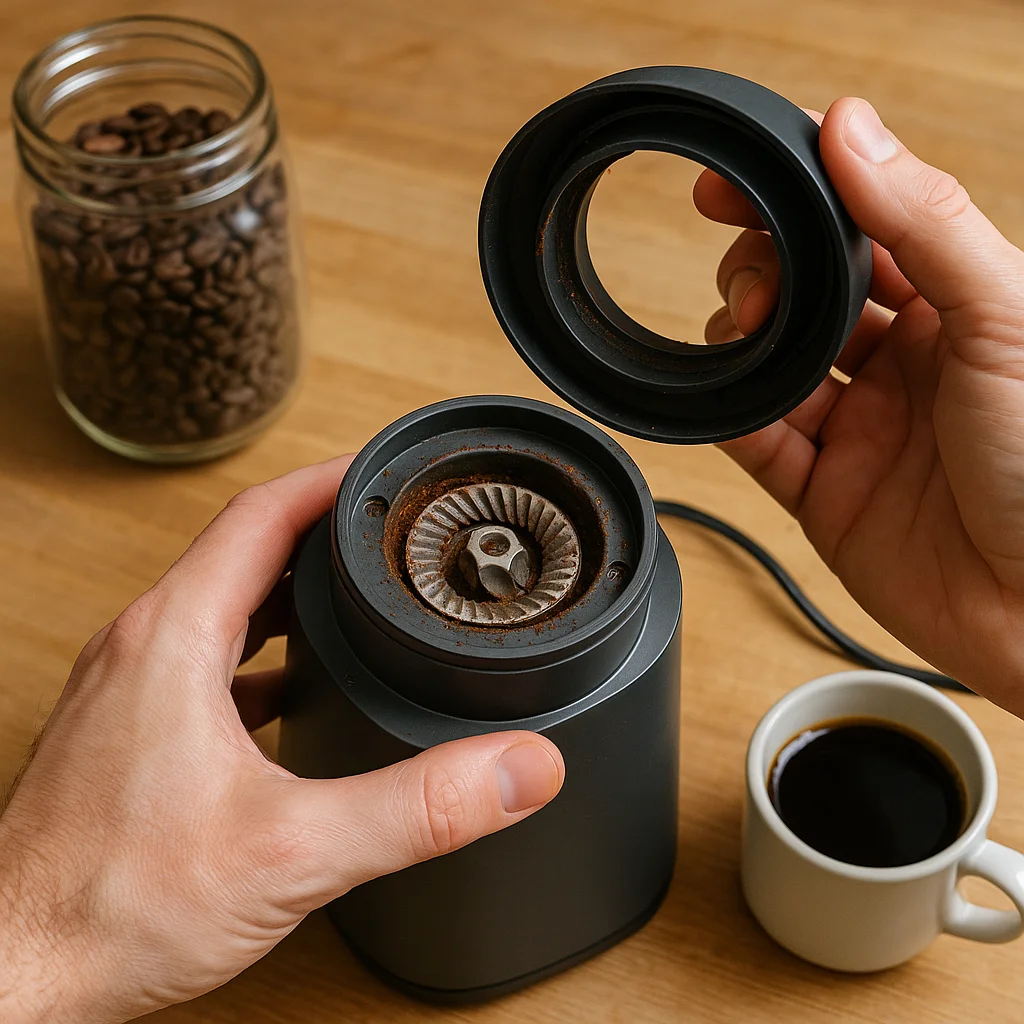
There's a specific frustration that home grinders produce after a year or two of regular use. Your technique hasn't changed. Your beans are the same roaster, same origin, roughly the same age. You haven't touched the settings. But the cup is different — flatter, a little thin in the middle, occasionally bitter at the edges. You've probably blamed the beans, the water, your tamping pressure, or some combination of all three. The actual cause is more mechanical and more fixable than any of those things.
Burr gaps drift. It's physics, and it happens in every home grinder regardless of build quality.
Here's what's going on. The burrs in your grinder — whether flat or conical — are held in position by a combination of a carrier plate, a retention collar, and whatever adjustment mechanism your grinder uses. That whole assembly experiences micro-vibration every single time the motor runs. Over hundreds of grinding sessions, those vibrations work against the friction and tension that hold the burrs in place. The gap between the burrs — the actual distance coffee particles travel through during grinding — widens by a fraction of a millimeter. That fraction is enough to matter.
What a wider burr gap actually does to your coffee
When the gap widens, two things happen simultaneously, and they pull in opposite directions in an annoying way. First, more particles escape the burr zone faster, which means less grinding work per particle and a coarser average output. This pushes your extraction shorter — less surface area, less soluble material dissolved per gram of coffee. Second, because particles are now varying more in size (some rush through, some don't), you get a wider distribution of particle sizes than your grinder was designed to produce at that setting. Small particles over-extract. Large particles under-extract. The result is a cup that tastes neither cleanly bitter nor cleanly sour — it tastes confused, flat, and somehow both watery and harsh at the same time.
This is the fingerprint of burr gap drift: not a clean extraction problem in one direction, but a muddy combination that resists the usual adjustments.
Why you don't catch it when it's happening
The drift is slow. It doesn't happen between Wednesday and Thursday. It happens across six months of morning use, and your brain adapts to gradual change in ways it doesn't adapt to sudden change. You compensate intuitively — a hair finer on the grind here, a few seconds longer on the brew there — without registering that you're compensating. By the time the problem is obvious, you've moved far enough from your original settings that the baseline feels lost.
There's also a confirmation bias problem. When a cup is off, you reach for the variables you can see and control: dose, grind setting, water temperature, brew time. The burr gap isn't on that list because you've never adjusted it intentionally. It doesn't feel like a variable. But it is.
How to check whether this is your problem
The most reliable low-effort test is a grind sample comparison. If you have any reference point for what your grinder's output looked like when it was new — a photo, a note about settings, even a memory of what grind number you used for a specific brew method — try to recreate that setting and assess the output. Spread a small amount of ground coffee on a white plate. Look at the range of particle sizes. If you're seeing a noticeably wider spread of fine dust and large chunks than you'd expect for that brew method, the gap has likely opened.
You can also use dose weight as a proxy. At the same setting, a grinder with a wider burr gap will grind faster — more coffee passes through in less time. If you're grinding by time and hitting your target dose faster than you used to, that's a meaningful signal. Not definitive, but worth noting alongside other symptoms.
A third signal is grind noise. A widening gap often changes the acoustic character of the grind — slightly less resistance, a marginally higher-pitched tone — because the burrs are doing less mechanical work per rotation. This one is subtle and takes familiarity with your specific machine, but if your grinder sounds a little lighter than it used to, file that away.
What you can actually do about it
Some grinders allow you to manually reset the burr carrier to a tighter zero point. This is sometimes called re-calibrating to zero, and the process varies by machine — but the principle is consistent. You bring the burrs together until you just hear them touch (with the machine off, never running), then back off to your usual starting position. If the burr gap has drifted, you'll find that your original setting numbers now correspond to a physically different gap than before. Re-zeroing re-anchors your reference point.
For grinders that don't offer easy zero-point access, you can compensate at the recipe level by stepping finer than your previous setting to achieve equivalent extraction. This isn't fixing the root cause, but it's practical and effective. The key is to stop chasing the problem through bean variables, water temperature, and brew ratios when the grinder is the actual moving part.
If your grinder has been in regular use for two years or more and the extraction has gotten progressively muddier despite reasonable recipe discipline, consider whether the burrs themselves are worn rather than just misaligned. Burr wear is a separate issue from gap drift, but they often occur together. Worn burrs lose their cutting geometry — edges round off, channels fill — and no amount of adjustment fully compensates. At that point, burr replacement is the practical call, and it costs significantly less than a new machine.
The practical takeaway
Your grinder is a mechanical device that wears. The gap between its burrs is not a permanent fixed reality — it shifts over time in a specific, diagnosable direction, and that shift produces a specific, diagnosable flavor profile. Once you know what to look for, you stop blaming the wrong variables. You stop buying different water. You stop suspecting your tamper. You look at the machine and you fix the machine.
Good coffee at home mostly comes down to removing sources of drift and inconsistency one by one. The burr gap is one of the bigger ones that most home brewers leave sitting on the table.