Your Grinder's Sweet Spot Is a Moving Target — Here's Why Dose Weight and Grind Setting Can't Be Set-and-Forgotten Together
The relationship between grind setting and dose weight is not fixed — changing one silently forces the other out of calibration in a specific, predictable way that explains why recipes dialed in at one dose consistently fail when you adjust how much coffee you're grinding.
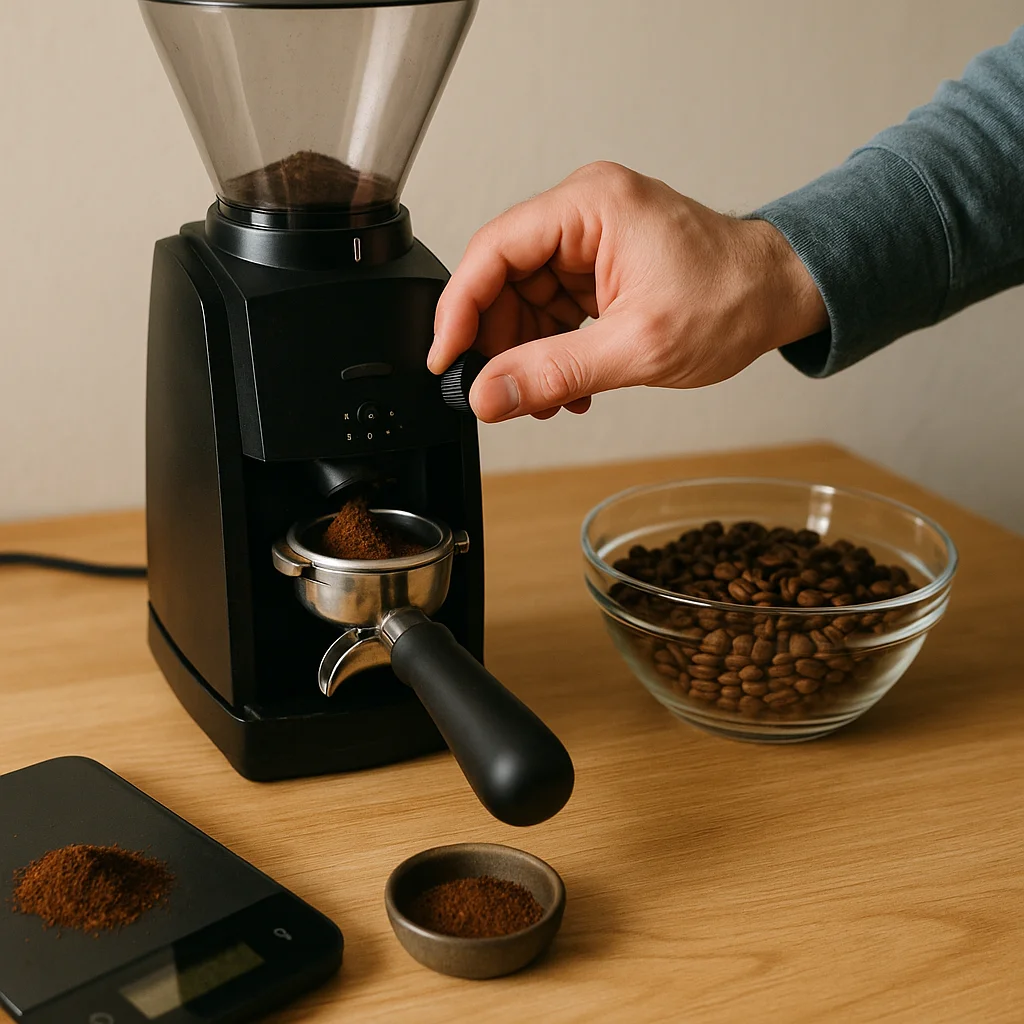
Most home brewers treat grind setting and dose weight as two independent knobs. Twist one, leave the other alone. That mental model is clean and intuitive, and it's also why so many otherwise careful brewers end up chasing extraction problems that move every time they get close.
The reality is that grind setting and dose weight are entangled variables. Changing one mechanically alters what the other delivers, even when the number on the collar stays identical. Understanding exactly how that entanglement works is the difference between dialing in a recipe that holds and spending every third morning wondering what went wrong.
The Mechanics Behind the Dependency
When coffee moves through a burr grinder, it doesn't simply fall through a fixed gap and emerge in uniform pieces. The burrs generate friction, heat, and pressure. Coffee particles tumble against each other and against the burr chamber walls before they exit. The density of that tumbling mass — which changes directly with how much coffee you're grinding — affects how long any given particle spends between the burrs and how much inter-particle compression happens on the way out.
Grind more coffee at once and you increase the density of material passing through the grinding zone. That added density creates more resistance, which means the burrs are working against a thicker, more compressed column of material. The practical result is that particles get slightly more processing time and slightly more inter-particle abrasion. The output skews finer than the same setting produces with a smaller dose. Not dramatically finer — but enough to shift extraction by a measurable margin.
Grind less coffee at once and the opposite happens. Sparser material, less resistance, particles move through faster and with less lateral compression. The output skews coarser relative to the same setting. Again, the shift is subtle, but subtle is all it takes to pull a previously dialed recipe into under-extraction territory.
This is why a setting that works perfectly for 18 grams can produce noticeably flat, under-extracted results when you bump to 20 grams without touching the collar — and why dropping to 15 grams can suddenly make the same setting taste harsh and over-extracted.
Where Home Brewers Typically Get Trapped
The most common version of this problem looks like this: you spend a week getting your single-cup pour-over dialed in at 15 grams. Extraction is balanced, you're happy. Then a friend stays over and you decide to brew a larger batch, so you scale up to 30 grams at the same setting. The result is too strong and slightly bitter — so you make a note that your recipe needs a coarser setting for batch brewing. That note is technically correct but incomplete, because it logs the symptom without capturing the mechanism.
The trap deepens when you switch back to single cups. You've now internalized two different settings for the same grinder, but the variable you're actually managing is dose size, not brewing method. Next time you change batch size again, you're starting from scratch instead of applying a principle.
The other common trap is seasonal. Many home brewers naturally shift between single cups in summer and larger pots in winter when more people are home. The recipe drift that follows feels mysterious because nothing about the beans, the water, or the equipment has obviously changed. But the dose has, and with it, the effective grind.
A Practical Framework for Keeping Them Calibrated
The most useful thing you can do is stop treating your grind setting as a fixed anchor and start treating it as the dependent variable it actually is. Your dose is often the more stable input — you know how much coffee you want to brew — so let the setting follow from it rather than the other way around.
When you change your dose, even slightly, do a quick recalibration pass rather than assuming the setting transfers. For most flat burr home grinders, a dose change of 3 grams or more in either direction is large enough to warrant checking your extraction. For conical burrs, the threshold tends to be slightly higher because conical geometry produces less inter-particle compression overall — the funnel shape moves coffee through faster and with less lateral resistance — but the relationship still exists.
The practical recalibration process is simple: brew at the new dose, evaluate extraction using your normal method — taste, TDS if you measure it, or flow rate if you're watching a pour-over. Then adjust setting, not dose, to compensate. Once you've corrected for the new dose, document both numbers together as a pair. Not just the setting, not just the dose — the pair. A recipe card that reads "setting 4" is incomplete. One that reads "setting 4 at 18g, setting 3.5 at 22g" is actually useful across different brewing situations.
The Adjustment Direction Is Predictable
The directional rule is consistent enough to use as a starting point before you even taste anything: increasing dose requires a slightly coarser setting to maintain equivalent extraction, and decreasing dose requires a slightly finer setting.
How much adjustment? That depends on your specific grinder, your burr type, and how large the dose change is, so no universal number applies. But for most home grinders with a dose change of around 3–5 grams, you're typically looking at a half-step to one full step on your grinder's collar — enough to notice, not enough to require starting from scratch. Use that as your starting hypothesis, brew, and refine from there.
The direction matters more than the magnitude at first. Knowing that a larger dose wants a coarser setting means you're never moving the dial the wrong way and compounding the problem — which is what happens when brewers try random adjustments without a model to guide them.
The Bigger Picture
This isn't a flaw in your grinder and it's not a reason to upgrade. It's a physical reality of how burr grinding works, and it applies across essentially every home grinder on the market regardless of price point. Knowing it exists changes how you troubleshoot, how you document your recipes, and how confidently you can scale a recipe up or down without losing the cup you worked to achieve.
Two numbers. Always record them as a pair. That single habit will save you more morning frustration than almost any other adjustment you could make to your routine.