How to Brew Coffee When You're Grinding at Home but Your Beans Keep Varying in Density Bag to Bag
Coffee beans from different origins and harvests grind and extract differently based on density, and two adjustments keep your cup consistent across bags.
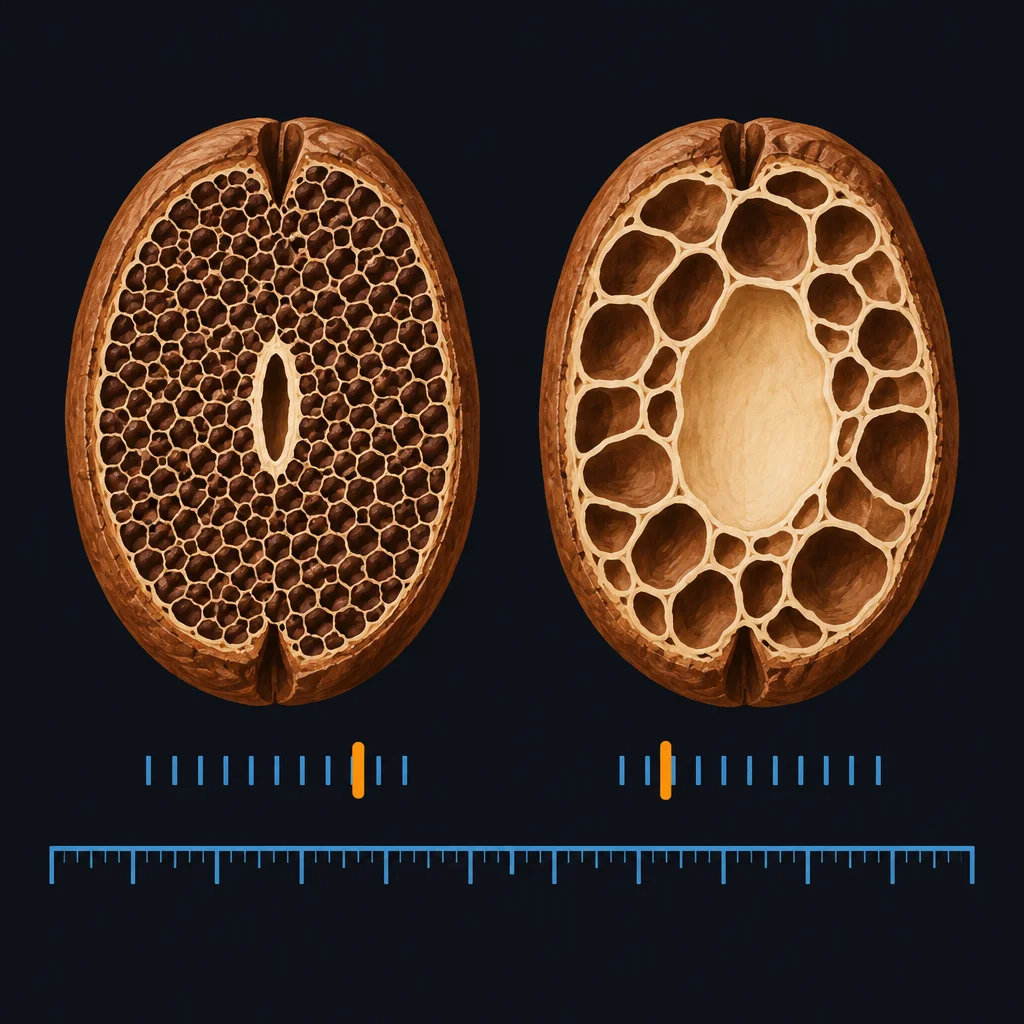
If you've ever opened a new bag of beans, ground them at your usual setting, brewed your usual recipe, and gotten a cup that tasted noticeably different from the last one, bean density is probably the reason nobody mentioned to you.
Density isn't something most home brewers think about. It's not printed on the bag, it's not adjustable, and it's invisible once the beans are roasted. But it quietly explains why the same grind size, the same ratio, and the same water temperature can produce a bright and balanced cup from one bag and a flat or sour cup from the next.
What bean density actually means
Density in coffee refers to how hard and compact the cellular structure of a bean is. Beans grown at higher elevations, in cooler and slower-growing conditions, tend to be denser. Beans grown at lower elevations in warmer climates tend to be less dense, with a softer cellular structure.
When you grind coffee, denser beans resist the burrs more and produce a slightly different particle distribution than softer beans ground at the same setting. Denser beans also require a bit more energy to extract, meaning water has to work harder to pull soluble material out of each particle.
In practical terms, this means that a grind setting dialed in on a medium-density bean from, say, a Central American farm may not translate cleanly to a high-grown Ethiopian bean or a lower-elevation Brazilian one. The numbers on your grinder stay the same. The behavior of the coffee does not.
How to notice when density is the variable
The clearest signal is when you open a new bag that is roasted to roughly the same level as your previous bag, grind it at the same setting, and immediately get a cup that tastes too sour or too weak. Or, conversely, too bitter and heavy. You haven't changed anything, but the coffee changed on you.
Another clue is how the beans feel and sound when you grind them. This is imprecise, but denser beans often sound a little crisper or higher-pitched going through the burrs, and your grinder may work slightly harder. Softer beans grind a bit more quietly and quickly. This is not a reliable diagnostic tool, but once you notice it a few times, it starts to give you a heads-up before you brew.
If your bag includes origin information, that's your most reliable early hint. High-grown East African coffees (Ethiopian, Kenyan, Rwandan) tend toward higher density. Lower-grown coffees from Brazil or Sumatra tend toward lower density. This is a generalization with plenty of exceptions, but it's a reasonable starting point when you're making a blind adjustment.
The two adjustments worth making
The first adjustment is grind size. When you switch to a bag that you suspect is denser than your previous one, nudge your grind setting slightly finer before your first brew. Not dramatically finer, just one or two steps. The logic is straightforward: denser beans resist extraction, so reducing particle size gives water more surface area to work with and helps close the extraction gap.
If you're switching to a bag you suspect is less dense, go slightly coarser. Softer beans give up their solubles more easily, and grinding them at the same setting as a denser bean can tip the cup toward bitterness or heaviness.
One click or step in either direction is a reasonable starting move. Brew, taste, and adjust from there. This is exactly the kind of micro-adjustment that makes dial-in feel intuitive rather than frustrating once you understand what you're responding to.
The second adjustment is brew time (for manual methods) or ratio. If you don't want to touch your grind setting, you can achieve a similar effect by adjusting how long water stays in contact with the grounds. For a pour-over, pouring slightly more slowly or in smaller pulses extends contact time and helps extract a denser bean more fully. For an Aeropress, a longer steep before pressing does the same thing.
Alternatively, if you're on a drip machine where you can't easily control brew time, adjust your dose slightly. Using a touch more coffee per gram of water with a denser bean, or slightly less with a softer one, can compensate for density differences without touching anything else. Try a half-gram or one-gram adjustment on your dose and see what it does to the cup before you go further.
A practical habit that makes this easier
Keep a simple note for each bag you buy. It doesn't need to be elaborate. Something like: origin, roast level, grind setting used, any adjustments made, and a one-line impression of the cup. When you open the next bag, that note tells you where your previous bag landed and gives you a logical starting point for comparison.
Over a few bags, you'll start to see patterns. You'll notice that certain origins consistently want a finer grind from you, or that you always need to adjust your pour speed with a particular type of coffee. This kind of accumulated personal data is more useful than any general guide, because it's calibrated to your specific grinder, your specific water, and your specific palate.
What this doesn't fix
It's worth being honest that density isn't the only reason cups vary bag to bag. Roast level differences, freshness, and even how a roaster developed a particular batch all play roles. But density is one of the more consistent and underappreciated variables, and it's one you can respond to with simple adjustments rather than a full recipe rebuild.
If you've adjusted for grind and brew time and the cup still isn't where you want it, roast development is worth considering next. A very lightly roasted dense bean is a genuinely different challenge from a medium-roasted dense bean, and may need more than a one-click grind adjustment to come into focus.
But starting with density as your first hypothesis when a new bag behaves unexpectedly is a good instinct. It's specific, it's adjustable, and it explains a lot of the mystery that makes home brewing feel inconsistent even when you're doing everything the same way you always have.