How to Brew Coffee When You're Using a Gooseneck Kettle for the First Time and Can't Control Where the Water Goes
A gooseneck kettle changes pour control in ways that surprise new users, and three short practice habits build the muscle memory that fixes it.
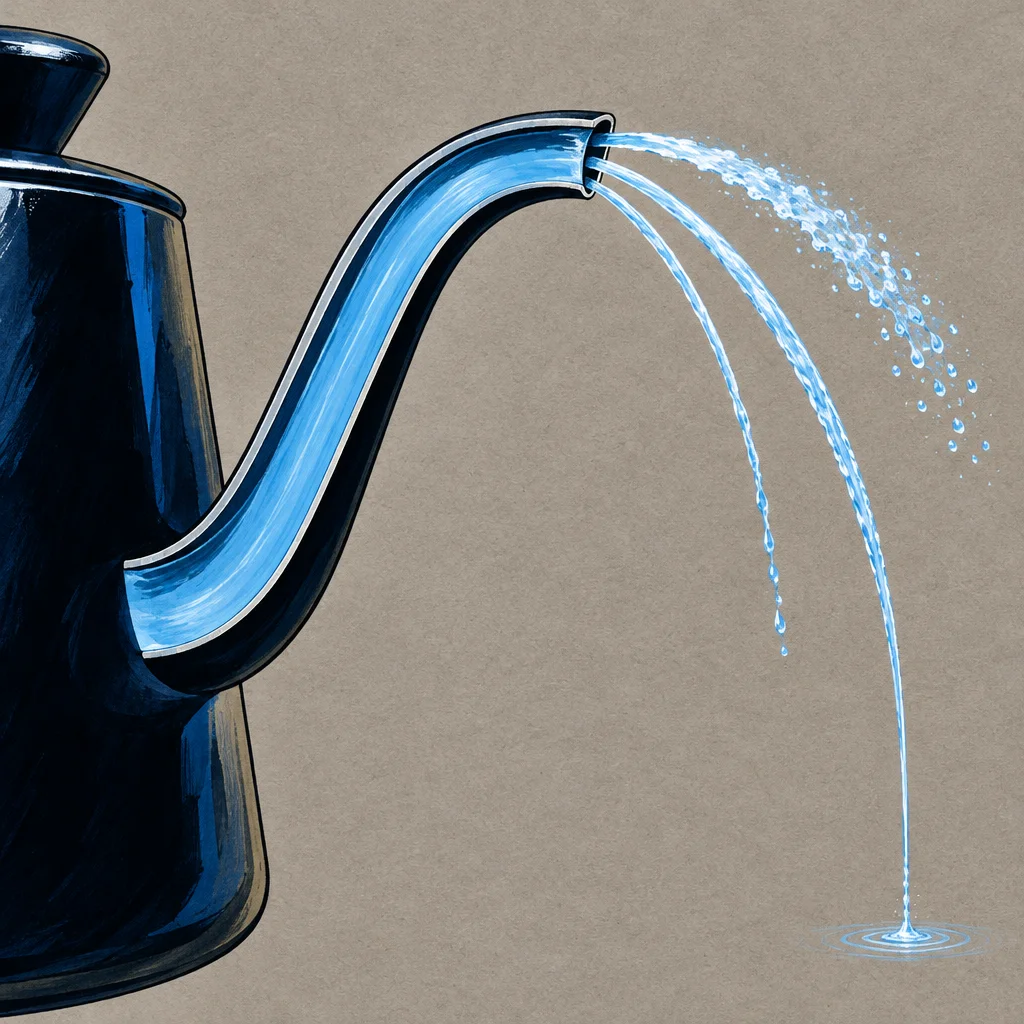
If you just bought a gooseneck kettle and your first few pours felt awkward, wobbly, or way too fast, you are not doing something wrong. You are doing something new. A gooseneck is a genuinely different tool from a standard kettle, and the learning curve is real even though it is short. A few targeted habits get you there faster than just pouring more and hoping it clicks.
Why the Gooseneck Feels Weird at First
A standard kettle dumps water wherever gravity takes it. You aim the spout and tip the whole body, and you get a wide, splashy pour. The gooseneck works differently. Because the spout is long and narrow and bends down toward the tip, the water exits with much more direction and much less pressure. That sounds like an advantage, and it is, but it also means the tool punishes hesitation. If you tip the kettle up too much, water rushes out fast. If you barely tilt it, water dribbles and stops. Finding the right angle is the whole skill, and it lives in a surprisingly small range.
The other thing that surprises people is weight distribution. A full gooseneck kettle is heavier at the back of the vessel, and as you pour it out, the balance shifts. Your wrist is doing more work than it was with a standard kettle, and many people grip too tightly at first, which makes fine control harder. Loosening your grip slightly and holding the handle closer to where it meets the body, rather than at the far end, usually helps.
Habit One: Practice Empty Pouring Over the Sink
This sounds silly but it is probably the fastest way to build the feel. Fill your kettle with plain water and pour it slowly over the sink, trying to hit a narrow target, like the drain opening or a single tile. Do this for two or three minutes before your first few brew sessions. You are not wasting water you heated, and you are building the wrist angle memory without the pressure of a real brew in front of you.
What you are looking for is the angle at which you get a thin, steady stream that you can slow down or speed up just by adjusting your wrist forward or back. That angle will be somewhere between barely tilted and about 45 degrees, and once you find it, it will feel consistent. Most people locate it within five or six practice pours.
Habit Two: Start Your Pour from Very Close to the Grounds
One of the main benefits of a gooseneck is the ability to place water precisely, but that only works if the spout tip is actually close to what you are watering. If you hold the kettle high above the brewer, the stream fans out and you lose control. Bring the spout down so the tip is roughly two to four centimeters above the coffee bed or the filter. From that height, you have real accuracy and the stream stays narrow.
This is especially important during the bloom, the initial small pour that lets CO2 escape from fresh beans. A slow, tight pour centered over the grounds saturates them evenly. A pour from too high splashes water against the filter walls and bypasses some of the coffee entirely. The gooseneck gives you the tool to avoid that, but only if you are close enough to use it.
As you add more water in later pours, you can move the spout in slow circles to cover the grounds evenly. That circular motion is easier to control when you are close because you are steering a short stream, not a long falling one.
Habit Three: Pour Slower Than You Think You Need To
Most new gooseneck users pour too fast in the first week. It feels natural to tilt the kettle enough to get water moving confidently, but that tends to overshoot. For a pour-over or Chemex, a gentle trickle that takes its time is almost always the right call. Faster pours move through the grounds before full extraction happens, and they also disturb the grounds in a way that creates uneven channels.
A useful reference point, though not a strict rule, is to try to keep your pour rate slow enough that you can count to two or three before the water level in the brewer rises noticeably. If the level jumps immediately with each pour, you are likely moving faster than the coffee can absorb evenly.
Slowing down also gives you more control over total brew time, which is one of the main reasons people move to a gooseneck in the first place. The brewer and the grind set the floor for extraction, but your pour rate shapes how that extraction happens across the full brew.
A Note on Temperature Control Models
Many gooseneck kettles sold today include temperature control, either a dial or digital display. If yours has this feature, you do not need to guess at water temperature or time your pour after boiling. Set it to your target temperature, usually somewhere between 88 and 96 Celsius for most home brewing, and let it hold there. This is a genuine convenience and worth using. If your kettle does not have temperature control, let it boil and then rest off heat for 30 to 60 seconds before pouring. That drops temperature out of the range that tends to over-extract lighter roasts.
When It Starts Feeling Natural
Most people find that the gooseneck starts feeling intuitive within a week of regular use. The sink practice shortens that timeline. What you will notice is that your cups start tasting more consistent, not because the kettle is magic, but because consistent pours lead to consistent extraction. The same grind and ratio brewed the same way will taste similar cup to cup, which makes it much easier to know what to adjust when something tastes off.
The gooseneck is not about precision for its own sake. It is about getting the same result more reliably than a standard kettle allows. Once the pour feels easy, you stop thinking about the tool and start tasting the coffee, which is the whole point.