How to Brew Coffee When You're Working With Two Different Brew Methods but Only One Grinder and One Bag
Owning one grinder and one bag of beans while switching between brew methods forces a choice most home brewers have never thought through clearly.
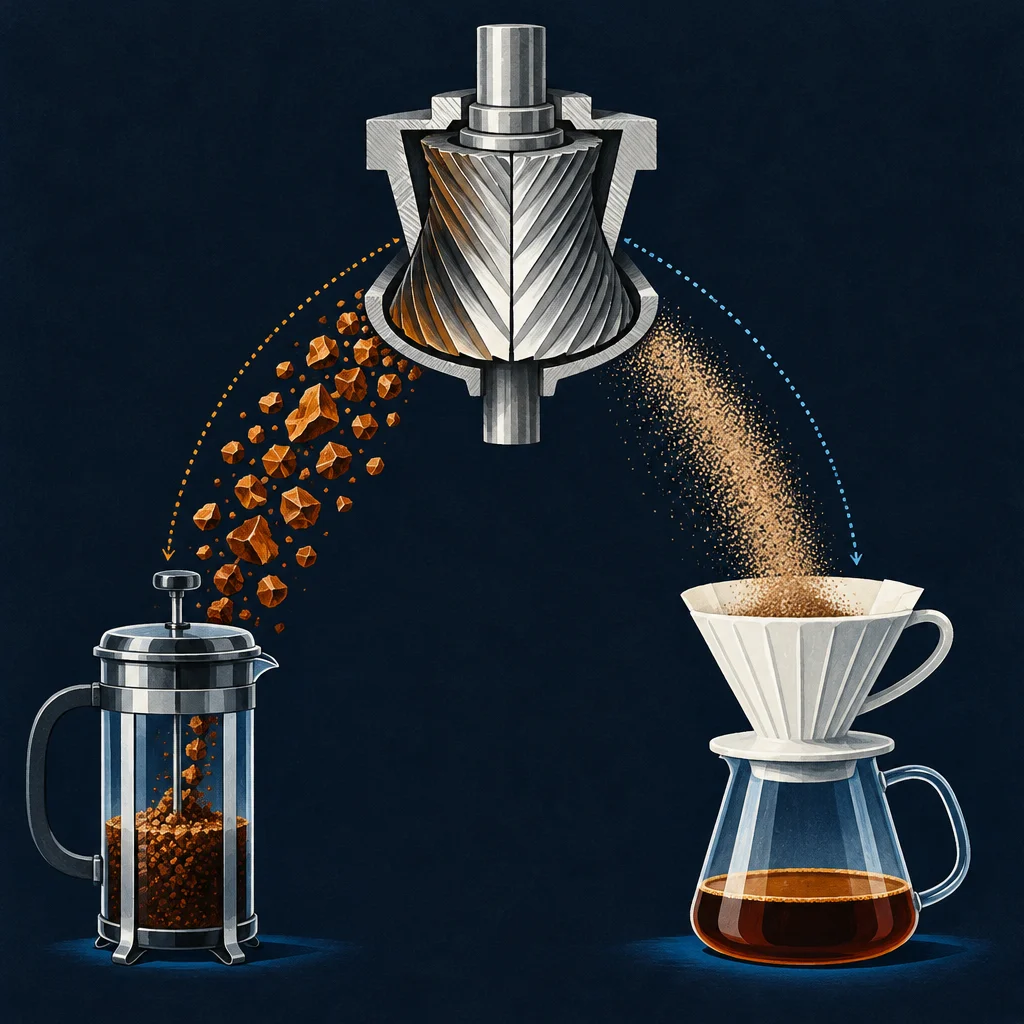
If you own a pour-over and a French press, or a drip machine and an AeroPress, you have probably hit a moment where you are not sure which grind setting to use this morning. The beans are the same. The grinder is the same. But the method is different, and the cup you got yesterday on a coarser setting tasted thin when you tried it in the pour-over today.
This is a genuinely common situation, and it has a straightforward solution once you understand what is actually happening.
Why grind size is not universal
Every brew method moves water through coffee at a different pace and for a different total contact time. A French press keeps water and grounds together for three to four minutes with no filter restricting flow. A pour-over passes water through grounds in two to three minutes, but a paper filter slows it slightly and also absorbs some oils. An AeroPress can finish in under two minutes depending on how you use it. A drip machine might take five or six minutes depending on the model.
Grind size controls how quickly water can extract flavor from each particle. Coarser grind means less surface area, which means extraction happens more slowly. Finer grind means more surface area, which means extraction happens faster. The pairing you are looking for is one where the speed of extraction matches the speed of the brew method, so that by the time the brew is done, the water has pulled the right amount of flavor out of the grounds.
When those two speeds are misaligned, the cup suffers. A French press grind used in a pour-over extracts too little because the water moves through too quickly relative to the coarse particles. A pour-over grind used in a French press extracts too much because the water has too much contact time with very fine particles, and you also end up with silt in the cup.
The practical starting point for each method
Rather than memorizing a specific number on your grinder (which will vary by grinder model), it helps to think in relative terms.
French press and other full-immersion methods generally want a coarser grind, somewhere in the range of coarse sea salt in texture. The long steep time does the work, so you do not need fine particles.
Pour-over methods generally want a medium to medium-fine grind, closer to table salt or slightly finer. The filter and the controlled pour govern how long water is in contact, and a mid-range grind keeps extraction balanced across that window.
AeroPress is flexible, and that is part of its appeal. A medium grind used with a one-to-two minute brew time is a reasonable starting point. If you go finer, shorten your brew time or use cooler water. If you go coarser, extend the steep slightly.
Drip machines vary more than most people realize, so the safest starting point is medium grind and then adjusting from there based on whether the cup tastes under-extracted (sour, thin, watery) or over-extracted (bitter, dry, harsh).
How to manage one bag across two methods
The simplest approach is to decide which method you are using before you grind, and then grind specifically for that method. This sounds obvious, but many home brewers grind a few days' worth at once, which removes this flexibility entirely. If you are grinding fresh each morning, switching methods just means dialing your grinder to the right range for today's brew.
If you do grind ahead or if resetting your grinder each day feels like too much friction, consider assigning specific days or mornings to each method rather than switching freely. Brew pour-over on weekdays when you want something precise and clean, and use the French press on weekends when the pace is slower. This reduces how often you are adjusting settings and also lets you dial in each method more reliably over time.
Another option is to keep a small sticky note or a piece of tape on your grinder with the number or position you use for each method. If your grinder has numbered or lettered settings, something as simple as "FP: 7, PO: 4" written somewhere visible removes the guesswork entirely and takes about thirty seconds to set up.
When the same beans taste surprisingly different across methods
This is worth noticing rather than worrying about. The same bag of beans can taste bright and floral in a pour-over and rounder and heavier in a French press. Neither is wrong. The filter, the grind, and the contact time each bring out different qualities in the same coffee.
If you taste something in one method that you like and do not get in the other, that is useful information. It might mean the beans are genuinely a better fit for one brew style. Some coffees with a lot of delicate fruit notes shine more clearly through a paper filter. Some beans with richer, chocolate-forward flavors taste more satisfying with the full oils that a French press or metal filter preserves.
Noticing this does not require you to do anything differently. It just helps you decide which method to reach for when you want a certain kind of cup.
The one adjustment that matters most
If you only make one change when switching methods, make it grind size. Ratio, water temperature, and pour technique all matter, but grind size is the variable with the most impact on how the cup will taste when the contact time and brew method are fixed.
Start with the right grind range for your method, brew a cup, and taste it before adjusting anything else. If it tastes sour or weak, go finer by one or two steps. If it tastes bitter or dry, go coarser by one or two steps. Most method switches only need a small correction once you have a reasonable starting point.
One grinder and one bag is not a limitation. It is a pretty good setup for learning how grind size actually works, because you get to taste the same beans through different variables and build a feel for how each one affects the cup.