How to Brew Coffee When You're Grinding at Home but Your Kitchen Is Much Hotter or Colder Than Usual
Ambient temperature changes how your grinder performs and how quickly extraction happens, and two small adjustments keep your cup consistent through seasonal swings.
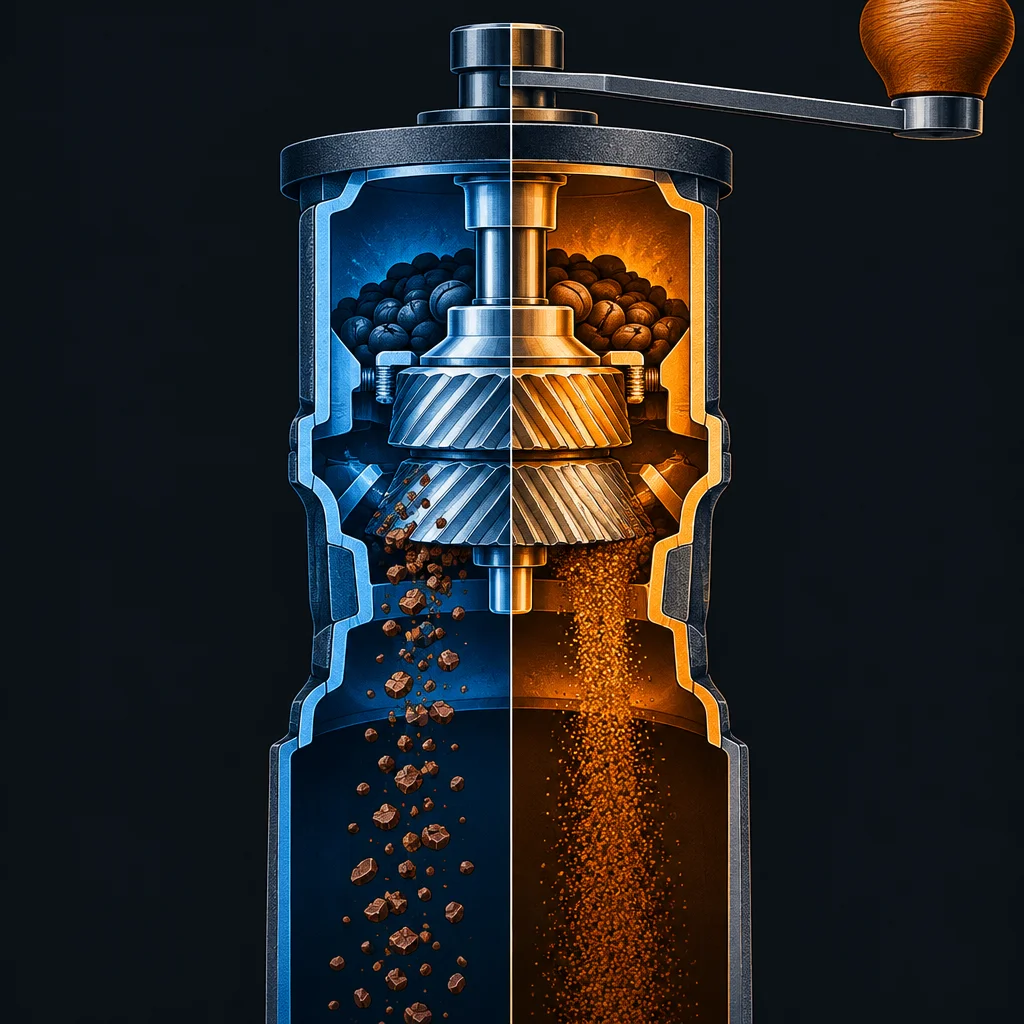
Most home brewers assume their grinder is a fixed thing. You set it once, dial it in over a few sessions, and trust it. That assumption works reasonably well until the weather changes, the heat comes on, or you move your setup from a warm kitchen counter to a cold garage or basement. Then the same grind setting starts producing cups that taste different, and it is not obvious why.
Temperature affects your coffee in a few quiet ways, and once you understand what is actually happening, the fix becomes straightforward.
What heat and cold are actually doing
Grinders generate friction. Burrs spinning against hard beans create heat, and that heat has always been part of the equation. What changes in a hot kitchen versus a cold one is the starting temperature of the beans themselves.
Cold beans are denser and more brittle. They fracture differently than beans at room temperature, and many grinders produce a slightly wider range of particle sizes when grinding cold beans compared to beans that have been sitting in a warm room for an hour. That wider range matters because fine particles over-extract and coarse ones under-extract, which can push your cup toward a muddled or uneven flavor even when nothing else changed.
On the other end, a very warm kitchen softens beans slightly before grinding. The oils in the bean become more fluid, which can cause ground coffee to clump together more aggressively and also affects how evenly the bed saturates when water hits it.
Your water is also affected. If your kettle sits on a cold counter, it loses heat faster than usual between heating and pouring. If your brewing vessel is cold, it pulls heat from the water the moment contact begins. These are small losses, but in extraction terms, even a few degrees makes a noticeable difference.
The first adjustment: bring your beans closer to room temperature
This is the simplest and most reliable thing you can do. If your beans live in a cool spot or your kitchen runs cold in winter, take them out about twenty minutes before you plan to brew. You are not trying to warm them aggressively. You just want them closer to the ambient temperature of your brewing space before they go into the grinder.
This matters most if you store beans somewhere genuinely cold, like a cool pantry or a room that drops significantly overnight. A bag that has been sitting at 55 degrees will grind differently than one at 70 degrees, and the difference will show up in the cup as sourness or muddiness depending on your method.
In a hot kitchen, the concern is less about temperature and more about the clumping and oil behavior mentioned above. If you notice your ground coffee sticking together more in summer, that is a sign the warmth is affecting the oils. In that case, grinding into a slightly cooler vessel or giving the grounds a gentle stir before they hit the filter can help distribute them more evenly.
The second adjustment: account for how temperature affects your brewer's thermal performance
Your brewing vessel, whether that is a ceramic pour-over dripper, a glass carafe, or a stainless steel brewer, absorbs heat from the water during brewing. In cold conditions, that absorption is faster and more significant.
A simple habit addresses this: rinse your brewer and your cup with hot water from the kettle before you begin brewing, then discard the water. This pre-warming step raises the surface temperature of everything water will touch, which means less heat is lost to the vessel during the actual brew. Most experienced home brewers do this automatically, but if you have been skipping it in warmer months, it matters more in winter.
If you use a thermometer or a kettle with temperature control, consider bumping your target by a few degrees in cold conditions rather than relying on the same number year-round. The goal is water that arrives at the grounds at the right temperature, and in a cold kitchen, more heat is leaving the system between the kettle and the coffee than you might expect.
Grind adjustment as a last resort
If you make both of those changes and the cup still tastes off, your grind setting itself may need a small nudge. This is worth noting because many brewers instinctively start here, but it is usually more effective to stabilize the other variables first.
If the cup tastes sour or thin after a cold morning, going slightly finer (a small adjustment, not a dramatic one) gives the water more surface area to work with and can compensate for extraction that is running slightly fast or incomplete. If the cup tastes harsh or over-extracted in a hot spell and you have ruled out water temperature as the cause, a small step coarser can help.
Make one change at a time and brew again before making another adjustment. Grind size, water temperature, and bean temperature all interact, so chasing multiple variables at once makes it hard to know what actually helped.
A note on consistency
One of the underrated habits in home brewing is trying to brew in roughly the same conditions each time. That sounds more demanding than it is. It mostly just means: keep beans somewhere with a stable temperature, pre-warm your brewer consistently, and notice when your environment has changed significantly before assuming your recipe broke.
A cup that suddenly tastes different when nothing on paper changed is often a cup where the environment shifted. Cold snap, heat wave, different room, beans that just came in from a cold car. These are solvable problems once you know to look for them.
Good coffee at home does not require a climate-controlled room. It just requires a little awareness that your kitchen is part of the recipe.