How to Brew Coffee When You're Grinding Correctly but Using the Wrong Grinder Setting for Your Brew Time
Grind size and brew time are linked, and learning to read one tells you exactly how to adjust the other before your next cup.
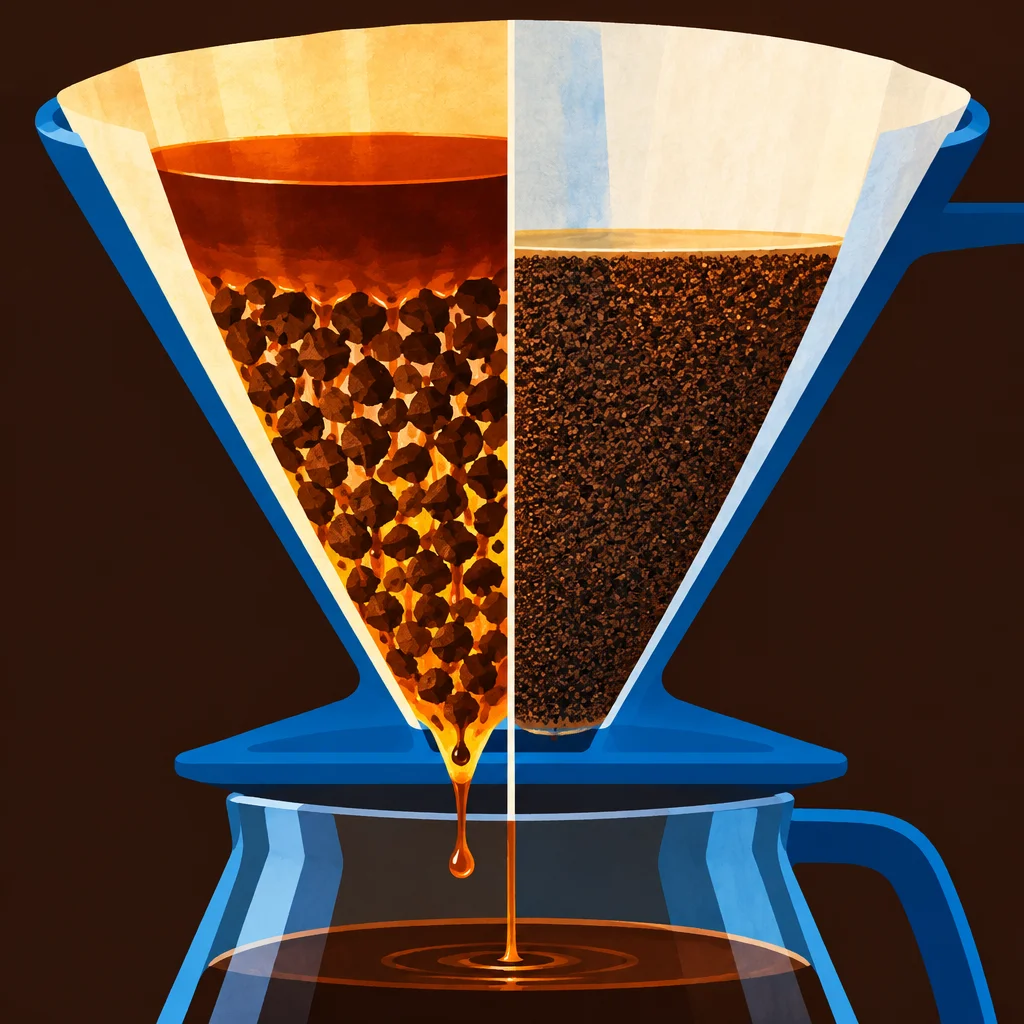
Most home brewers learn grind size as a fixed rule: coarse for French press, medium for drip, fine for espresso. That framing is a useful starting point, but it leaves out something important. Grind size does not exist in isolation. It works in a relationship with time, and when that relationship is off, your cup tells you in ways that are easy to misread.
Here is the core idea. Water extracts flavor from coffee grounds over time. Finer grounds give water more surface area to work with, so extraction happens faster. Coarser grounds offer less surface area, so extraction takes longer. When your grind size and your brew time are matched well, water has enough contact to pull out the balanced, interesting flavors without pushing into the harsh or hollow ones. When they are mismatched, you end up over- or under-extracted even if you did everything else right.
This matters for home brewers because brew time is not always something you set deliberately. It is often a consequence of your equipment, your pour technique, or your grind. Understanding the relationship puts you in a position to fix problems without buying anything new.
What brew time actually means for your method
For a pour-over, brew time is typically how long it takes from your first pour to the moment the dripper stops dripping. For a French press, it is your steep time before the plunge. For a standard drip machine, it is roughly the full cycle time. These numbers vary by method, but each method has a range that tends to produce good results.
A useful general range for a pour-over is around three to four minutes for a standard single-cup size. French press often lands around four minutes. Your drip machine runs on its own schedule, but the resulting cup still reflects whether your grind matched the speed water moved through.
If your brew is finishing significantly faster or slower than the typical range for your method, that is worth paying attention to before you assume anything else is wrong.
Reading your cup as a timing signal
If your brew runs short and the cup tastes sour, thin, or sharp in an unpleasant way, the water moved through too quickly. That usually means your grounds are too coarse. The water did not have enough contact time to extract the full range of flavors, so you are tasting the early-stage acids without the sweetness and body that develop later in extraction. The fix is to grind finer, which slows the flow and gives water more surface area to work with.
If your brew runs long and the cup tastes harsh, dry, or bitterly astringent in a way that lingers unpleasantly, the water moved through too slowly. That usually means your grounds are too fine. The water had so much contact time that it pulled out compounds that are better left behind. The fix is to grind coarser, which speeds the flow and shortens the contact window.
This is not a complicated diagnostic. Time your brew once. Taste the result. The flavor and the time together point in the same direction.
When technique affects timing, not just grind
For pour-over brewers, it is worth knowing that your pour itself affects how quickly water moves through the grounds. If you pour aggressively in one continuous stream, you create more turbulence and the bed drains faster. If you pour slowly in small pulses, the bed stays saturated longer and drains more slowly. Both approaches can produce good coffee, but if your brew time is off, consider whether your pour pattern changed before you adjust your grind.
A suggestion: pick one pouring rhythm and stick with it long enough to see what your grind needs. Changing both variables at once makes it hard to know what fixed the problem.
Practical steps for dialing in the relationship
Start by keeping a simple note for each bag of beans you open. Write down your grind setting, your dose, your water amount, your brew time, and a one-sentence flavor note. You do not need a formal system. Even a note on your phone works.
After two or three brews with a new bag, you will have enough information to see a pattern. If your time is consistently short and the cup is consistently sour, you know to go finer. If the time is long and the cup is bitter, go coarser. Adjust by one small increment at a time, then brew again before adjusting further.
One increment on most home grinders is roughly one number or one click on the adjustment ring. Moving two or three increments at once is usually too much and makes it harder to find the sweet spot.
A note on bean density and roast level
Different beans grind to different particle sizes even at the same grinder setting, which affects flow rate. Denser, lightly roasted beans tend to grind into harder particles that pack slightly differently than softer, darker roasted beans at the same setting. If you switch from a medium roast to a light roast and suddenly your brew runs faster and tastes thin, the grind setting that worked before may now be effectively too coarse for the denser bean. Going a step finer is a reasonable place to start.
This is not a reason to overcomplicate things. It is just a reminder that your grinder setting is a starting point, and brew time is one of the clearest signals you have that the starting point needs a small correction.
The practical habit that ties it together
Timing your brew takes about fifteen seconds of attention. Tasting your cup with the time in mind takes no extra time at all. Together, they give you a feedback loop that most home brewers skip entirely because nobody told them it was useful.
You do not need to chase perfection on every cup. But when a cup tastes wrong and you are not sure why, checking your brew time first narrows the possibilities quickly. Grind size and time are connected. Once you feel that connection in a couple of brews, it becomes second nature.