How to Brew Coffee When You're Making Two Cups at Once and One Always Tastes Weaker
Brewing two cups simultaneously changes how water moves through your grounds, and one ratio adjustment closes the gap between them reliably.
Most home brew guides assume you're making one cup. The ratios, the timing, the bloom instructions, all of it is usually written for a single serving. So when you start brewing for two people, you scale up the coffee and water and expect the results to scale with them. Sometimes they do. Often, at least one of the two cups comes out noticeably thinner, paler, or less flavorful than the other.
This isn't bad luck. It's a predictable result of how water behaves differently when you ask it to move through a larger bed of grounds.
Why Two Cups Is a Different Problem Than One Cup Scaled Up
When you brew a single cup using a pour-over or a single-serve drip, the water has a short distance to travel and a relatively thin, evenly saturated layer of coffee to pass through. The contact time between water and grounds is fairly consistent from the first pour to the last.
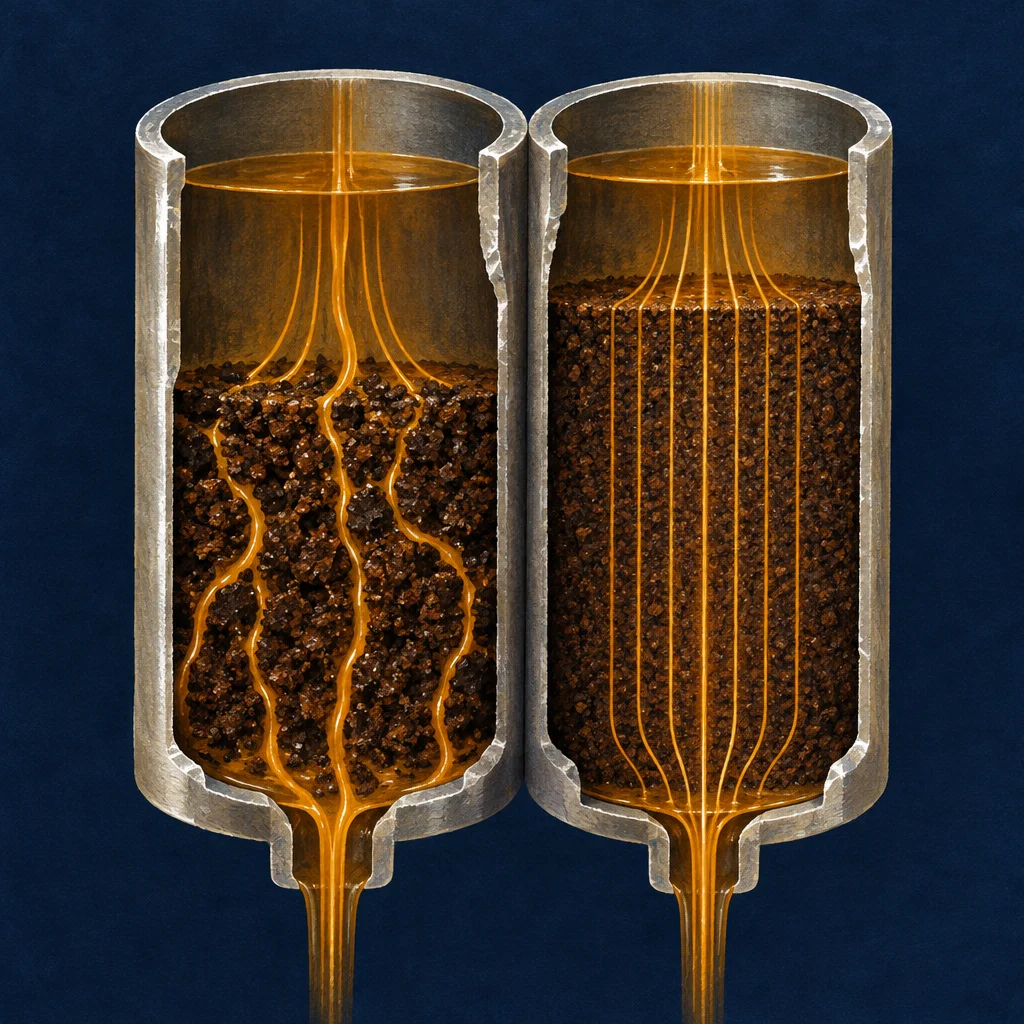
Double the dose and the water bed gets taller and denser. Water poured at the center has to travel farther. If your pouring isn't even, some grounds get saturated earlier and some later. The grounds at the edges of your dripper or basket may sit in water longer than the grounds at the center, or the reverse. The result is uneven extraction across the whole bed, and that unevenness ends up in your cups.
The second cup, poured from the bottom of the carafe or brewed from the later part of your pour, often gets the more diluted or over-extracted portion depending on your setup. This is why one cup regularly tastes off while the other seems fine.
The Adjustment That Actually Helps
The most reliable fix is not to grind finer or add more coffee, though both of those are intuitive guesses. The actual adjustment is to grind slightly coarser when doubling your batch.
A coarser grind opens up the coffee bed, which lets water flow more evenly through a larger volume of grounds. The water distributes more consistently from center to edge, which means both portions of the brew extract at a more similar rate. You will need to compensate for the coarser grind by brewing a touch hotter or slowing your pour a little, but the core change is the grind size.
As a starting suggestion, if you normally brew one cup at a setting of, say, 15 on your grinder, try stepping up to 17 or 18 when doubling. Adjust from there based on taste.
Pouring Technique Matters More at Larger Volumes
With a single cup, a slightly uneven pour is usually forgiving enough that the result is still good. At double volume, the same uneven pour causes more obvious problems because you have more surface area and more grounds that need to be wetted consistently.
A few things that help when pouring for two:
Start with a longer bloom. Give your grounds an extra 10 to 15 seconds during the bloom phase when doubling your batch. A larger bed of coffee releases more gas and needs a bit more time before it's ready to extract evenly.
Pour in concentric circles. Moving your pour in slow, consistent circles from center to edge and back wets the entire bed rather than saturating the middle and leaving the edges dry. This is always a good habit, but it matters more with larger volumes.
Split your water into more pours. Instead of two or three pours for a single cup, try four or five for a double. Smaller pours give the bed time to drain slightly between additions, which keeps the grounds from sitting in standing water and extracting unevenly.
Batch Brewing on a Drip Machine
If you use an automatic drip machine, you have less control over pour pattern, but you still have options. The most important one is to make sure your coffee bed is level before you start the machine. When you grind directly into a flat-bottomed basket, the grounds often pile unevenly. A quick, gentle shake of the basket or a small finger swipe to level the surface makes a real difference in how evenly the water distributes.
For drip machines specifically, using a medium grind rather than fine is also a good default when making a full pot. Fine grinds in a large basket can create a dense, slow-draining bed that causes channeling, where water finds one path through the grounds and leaves the rest under-extracted.
Splitting the Result Evenly
One last thing worth doing: stir your carafe or server gently before pouring two cups. Even when extraction goes well, the first liquid through the grounds is always more concentrated than the last. A quick stir blends the brew so both cups are drawing from the same thing rather than one person getting the stronger early extraction and the other getting the weaker end.
This is a small step and an easy one to skip, but it closes the gap between cups without requiring any changes to your grind or technique.
A Simple Starting Point
If you want a practical place to begin, try this the next time you brew for two:
- Step your grind one or two notches coarser than your usual single-cup setting
- Level your coffee bed before brewing
- Use a slower, more deliberate pour in circles if you're doing it by hand
- Add 15 seconds to your bloom
- Stir before splitting into cups
Taste both cups and compare. If both taste a little weak, grind slightly finer or add a touch more coffee. If one still tastes stronger, focus on making your pour or drip distribution more even.
Brewing for two is genuinely a different task than brewing for one, not harder, just different. Once you adjust for it, both cups start tasting like you meant to make them that way.