How to Brew Coffee When You're Sharing a Grinder With Someone Who Uses Completely Different Settings
A shared grinder that gets reset between users introduces subtle inconsistency, and two habits let both people brew well without conflict.
Sharing a grinder is one of those low-key household negotiations that nobody really prepares for. One person drinks espresso; the other makes pour-over. Or you both do drip but you like a slightly coarser grind and your partner disagrees. Whatever the split looks like, the result is usually the same: the grinder gets adjusted back and forth, neither person actually lands where they want to be, and the cups are quietly worse than they should be.
This is a real and solvable problem. It just requires treating the grinder like a shared tool with a known starting position rather than a device one person sets and the other disrupts.
Why resetting a grinder is harder than it looks
Burr grinders do not have a universal numbering system. A "4" on one grinder is not a "4" on another brand, and even on the same grinder, the numbers are really just reference points relative to where the burrs physically touch. When two people share a grinder and each one dials back to their preferred number, they are assuming the burrs are always in the same starting position. That assumption is usually close but not exact, especially as the grinder ages or as burrs shift slightly over time.
The result is that your "usual setting" drifts in small, invisible ways. Your grind gets slightly finer one day, slightly coarser the next, depending on how the other person left it. This is probably not the main reason your cup varies day to day, but it is a real contributor, and it is easy to eliminate.
Habit one: write down your actual setting as a physical landmark, not just a number
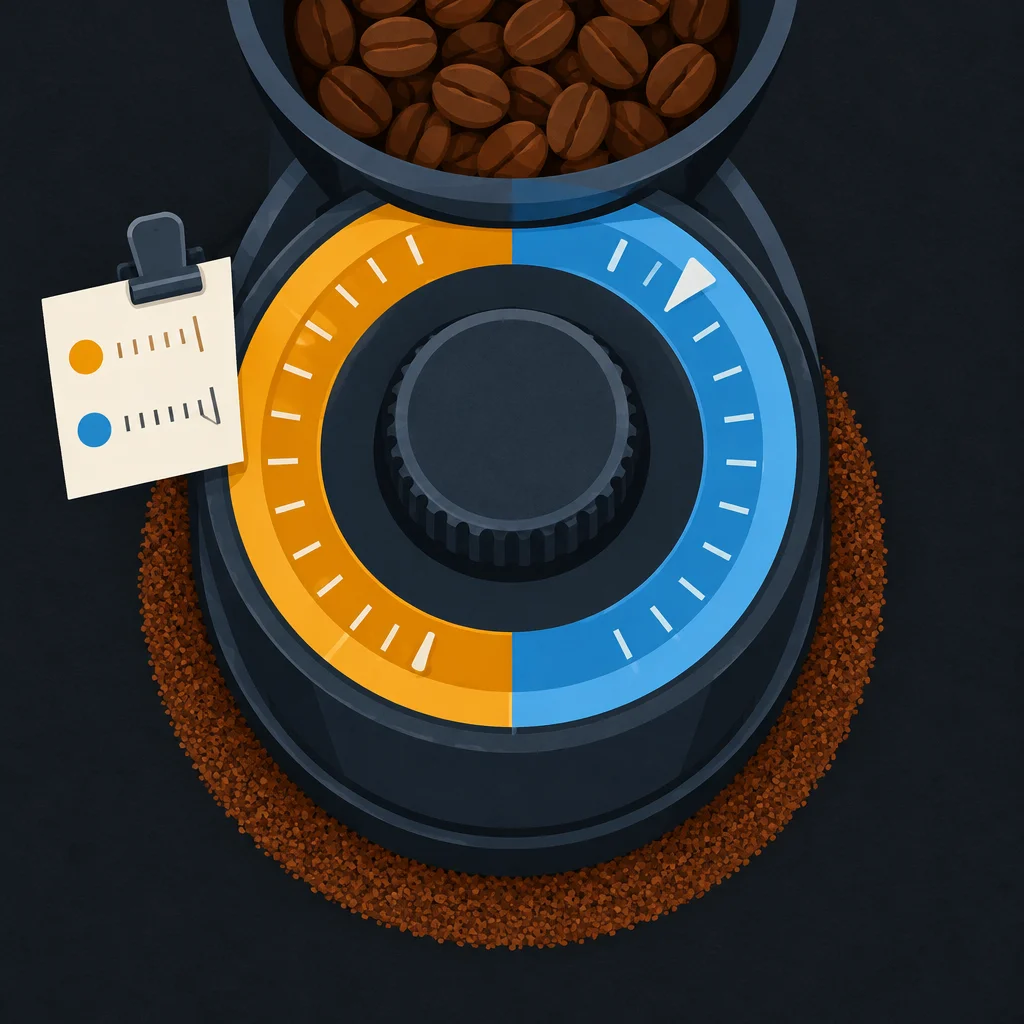
Numbers on a grinder are useful, but they are more useful when you also record what position looks like. Take a moment when your grind is dialed in and your cup tastes the way you want it. Note the number, then also note something physical about where the adjustment ring or collar sits. Does it align with a particular mark on the body of the grinder? Does a certain number sit at roughly the two-o-clock position? Write that down somewhere low-stakes, like a sticky note on the inside of a cabinet door.
Do the same for the other person in the household. Now both of you have a reference that is grounded in the physical position of the grinder, not just a number you are trusting from memory.
This matters most when you are moving between very different grind sizes, like espresso and pour-over, because those settings are far apart and it is easy to overshoot. If you are both doing drip or pour-over with only slight differences between you, the stakes are lower, but the habit still helps.
Habit two: grind a small purge dose after every reset
When you adjust a grinder to a new setting and immediately grind your actual dose, the first few seconds of output tend to reflect the old setting. The burrs take a moment to stabilize at the new position, and any grounds sitting in the grinding chamber from the previous session will come out first.
A simple fix is to grind a small amount of coffee, maybe three to five grams depending on your grinder, and discard it before grinding your real dose. This purges leftover grounds from the previous setting and lets the burrs settle. If you are switching between very different settings, a slightly larger purge is reasonable. If you are only nudging the grind by a small amount, a shorter purge works fine.
This step costs a small amount of coffee. Over a month it adds up to maybe a few grams. It is worth it.
A note on who adjusts and when
In some households it makes sense for the person who brews first in the morning to set the grinder, and the second person adjusts when they brew. In others, whoever is more particular about their grind sets it last the night before. Neither approach is wrong, but agreeing on the system out loud removes a surprising amount of low-grade friction.
If one person consistently finds their grind is slightly off when they get to the grinder, that is usually a sign the purge step is being skipped or the reference notes are not precise enough. A quick recalibration session, where both people brew at the same time and compare results, can help set better baseline notes for both settings.
When the grinder only has one burr set and you need two very different grind sizes
If your household genuinely needs both espresso and coarser grinds, a single grinder will work but the wear of frequent large adjustments adds up over time. It is not catastrophic, but it is worth knowing. Some people in this situation choose to pre-grind and store one person's coffee for the week, keeping the grinder parked at one setting most of the time. Pre-grinding does cost some freshness, so this is a trade-off rather than a perfect solution. If pre-grinding is the path, store the grounds in an airtight container, keep it away from light and heat, and plan to use them within four or five days at most before the difference in cup quality becomes noticeable.
Another option, if the budget eventually allows, is a second inexpensive hand grinder dedicated to one brew method. Hand grinders at the entry level have improved considerably, and parking one at espresso-fine while the electric grinder stays at pour-over territory is a practical way to sidestep the reset problem entirely. That said, this is a nice-to-have, not a requirement. The habits above work well without it.
The bigger idea
Sharing a grinder does not have to mean compromising on your cup. It mostly means being a little more deliberate about a step most people do automatically. Write down where your setting actually lands, purge a few grams when you switch, and agree on the order of operations with whoever else uses the machine. Those three things, done consistently, are enough to make a shared grinder behave like it belongs to both of you rather than neither of you.