How to Brew Coffee When You're Working With a Bag You Opened Weeks Ago and Everything Tastes Muted
Older open bags don't need to be thrown out, but they do need a different approach than fresh beans to taste good again.
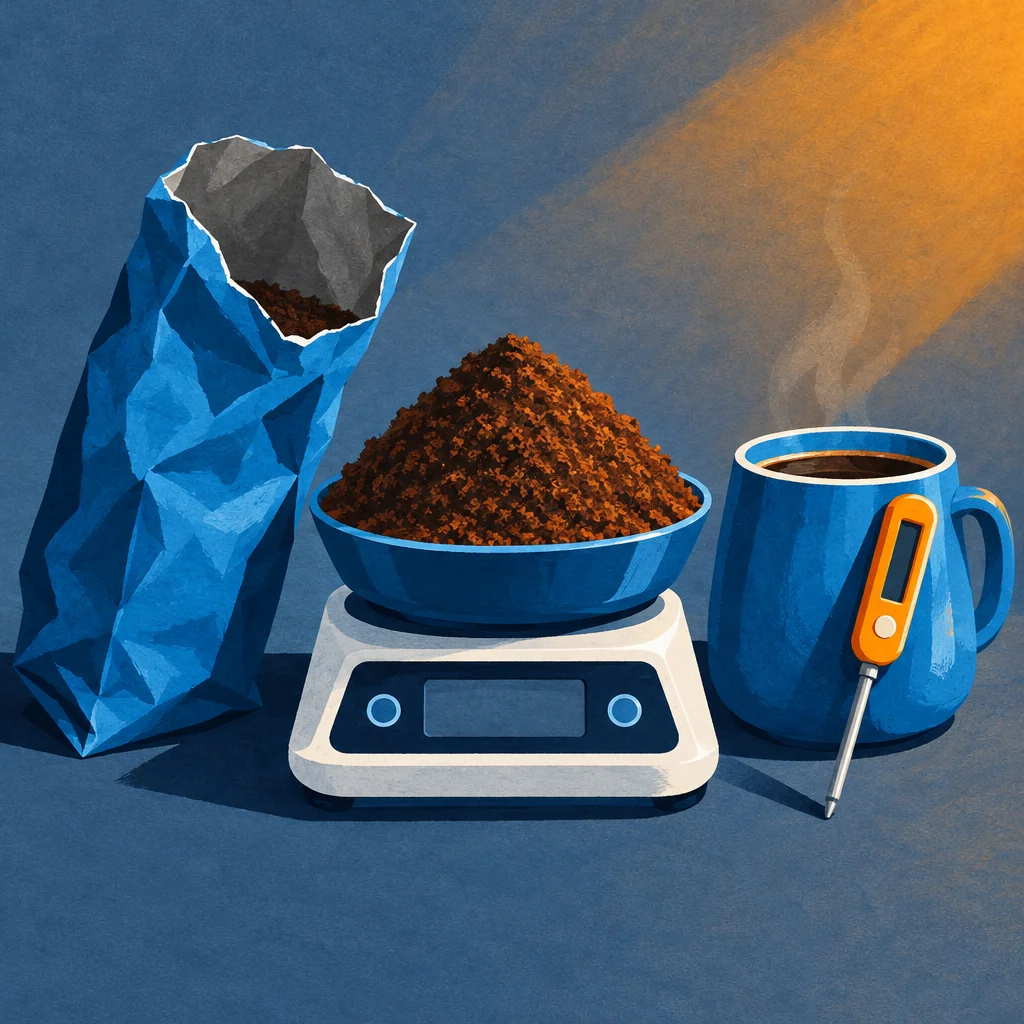
Most coffee advice assumes you're working with beans at peak freshness, opened recently, still smelling bright and alive when you crack the bag. That's a reasonable baseline, but it's not the situation most home brewers are actually in on a Tuesday morning. You've got half a bag that's been open for three weeks, the aroma is quieter than it used to be, and the cup tastes flat no matter what you try. This is a solvable problem, and it doesn't require throwing the beans away.
What's Actually Happening to Older Beans
When roasted coffee is exposed to air, it slowly loses the volatile compounds responsible for its aroma and brighter flavors. The beans also absorb a little ambient moisture over time, which changes how their cell structure behaves during grinding and brewing. The result is a dose that extracts differently than it did fresh: the water moves through it at a slightly different rate, and the flavors that do extract tend to skew toward the flat, papery, or muted end of the spectrum.
This isn't a defect in the beans. It's just chemistry, and it's manageable once you understand what direction things have shifted.
Why Your Current Recipe Stops Working
The recipe you dialed in when the bag was fresh was calibrated to beans behaving a certain way. As the beans age, two things typically change that affect your cup directly.
First, older beans grind a little differently. Fresh beans are denser and more brittle, which means your grinder produces a fairly uniform particle distribution. Older beans, especially in humid environments, can be slightly softer or more variable in texture. This tends to produce a wider range of particle sizes from the same grinder setting, which makes extraction less even.
Second, older beans have already off-gassed most of their CO2. That gas, while it can cause problems in very fresh beans, also plays a small role in creating resistance during brewing. With less gas present, water moves through your grounds a little faster than it did when the bag was new. If your brew method is a pour-over, that can mean a faster drawdown than you're used to, which often correlates with under-extraction.
The Two Adjustments Worth Making
Go slightly finer on your grind. This is the more impactful of the two changes. A slightly finer grind slows the water down and increases the surface area available for extraction, which compensates for some of what the beans have lost in soluble flavor compounds. How much finer? This depends on your grinder, but one or two small clicks or notches from your current setting is a reasonable starting point. You're not trying to make the grind dramatically finer, just nudging it enough to extend contact time slightly.
If you're using a French press, the same logic applies. Going a little finer helps extract more from beans that are offering less than they used to.
Increase your water temperature slightly. Hotter water extracts more efficiently. If you've been brewing around 90 to 93 degrees Celsius, moving toward the upper end of that range, or even just below boiling, can help pull more from beans that have faded. This isn't a dramatic change, and it won't fix everything, but it does work in the same direction as your grind adjustment: both changes encourage your water to extract more from what the beans still have to offer.
If you don't use a thermometer, letting your kettle come fully to a boil and then waiting about fifteen seconds before pouring gets you close to the high end of the useful temperature range for most home brewing.
What Probably Won't Help
Using more coffee is the intuitive move, and it's not wrong exactly, but it doesn't address the underlying issue. Adding more grounds can make the cup taste stronger, but if the extraction is still running fast and uneven, you mostly get a larger volume of the same flat result. It's worth trying if the other adjustments feel like too much to change at once, but on its own it tends to be a partial fix.
Changing your water or your brew vessel won't do much here either. The issue is in the beans and how they're behaving, not in those surrounding variables.
A Note on the Bloom
If you're doing a pour-over and you've been starting with a bloom pour, you might notice that older beans bloom much less dramatically than fresh ones. That's the CO2 situation described earlier. This is actually useful information: a weak or absent bloom is one of the clearest signals that your beans have aged out of the range where your original recipe works well. When you see this, treat it as a prompt to make the adjustments above rather than a sign that something is wrong with your technique.
With older beans, there's also less reason to hold back during the bloom. The standard advice to let fresh beans off-gas for thirty to forty-five seconds before continuing applies less here. You can move through your pours a little more deliberately without worrying about disrupting gas release.
Managing the Last of the Bag
As you get toward the bottom of an aging bag, the beans have usually been exposed to the most air, often the same air cycling through the bag each time you opened it. At this point, pushing your grind adjustment a little further and keeping your water temperature on the higher side is worth it. The goal shifts from trying to restore what the beans used to taste like toward getting the best possible cup from what they currently are.
If the cup still tastes thin or flat after both adjustments, a small increase in your coffee-to-water ratio, something like adding two or three grams more coffee to your usual dose, can round out the result without overcorrecting.
Older beans deserve a little more care in how you approach them, not dramatically more effort. A few small adjustments and you'll get a genuinely good cup out of a bag that might otherwise end up feeling like a waste.