How to Brew Coffee When You're Working With Beans You Can't Identify Because the Bag Has No Information
Unlabeled or vaguely labeled beans leave you guessing on grind and temperature, but two observable clues point you toward a useful starting recipe.
Most coffee advice starts with the assumption that you know what's in the bag. You know the roast level, the origin, maybe even the processing method. Then someone hands you a bag from a neighbor's trip, or you grab the unmarked house blend from a local shop, or you pull out a bag from the back of the pantry with a label that just says "Coffee." No roast date. No origin. Roast level listed only as "medium," which could mean almost anything.
This happens more than brewing guides acknowledge. The good news is that you're not stuck guessing completely blind. The beans themselves will give you two useful pieces of information before you brew a single drop, and those two clues are enough to build a sensible starting recipe.
Look at the Bean Before You Touch the Grinder
The color and surface of the bean tells you roughly where it sits on the roast spectrum, and roast level is the single most useful piece of information for setting your starting grind size and water temperature.
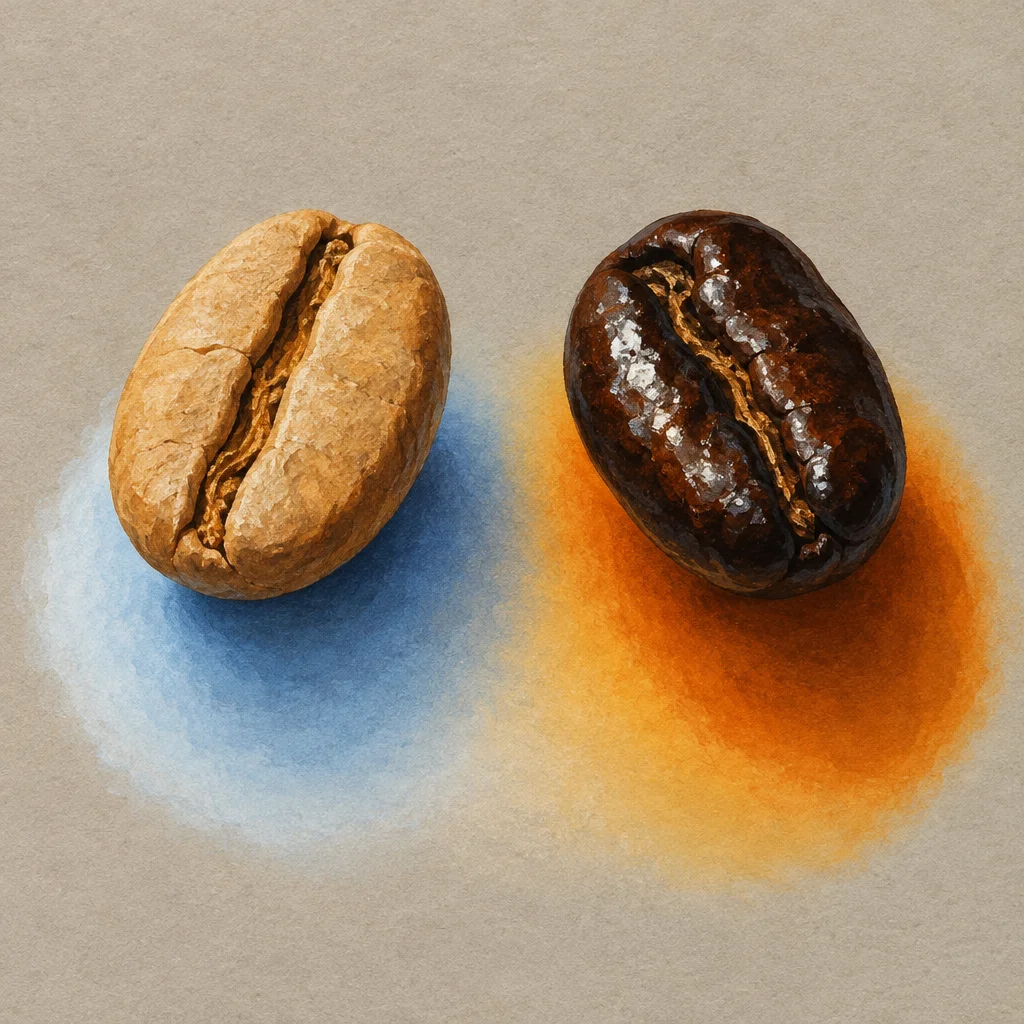
Hold a few beans in your palm near a window or a decent light source. You're looking at two things: color and oil.
Color runs from pale tan through medium brown to dark brown and nearly black. Lighter beans were pulled from the roaster earlier, which means more acidity, more origin character, and sugars that haven't fully caramelized. Darker beans spent more time in heat, which develops bitterness, reduces acidity, and produces roasty, smoky flavors. A true medium sits somewhere in the middle, genuinely reddish-brown rather than pale or dark.
Oil is the second signal. If the bean surface looks matte and dry, the roast is lighter. If it's visibly shiny or you can feel a slight slickness when you roll the bean between your fingers, the roast is darker. Oil migrates to the surface as roasting progresses, so a greasy bean is almost certainly a dark roast regardless of what the bag says.
Using those two signals together, you can land your beans in one of three rough categories: lighter roast, medium roast, or darker roast. You don't need precision here. You need a starting point.
Translate What You See Into a Starting Recipe
Once you have a rough read on roast level, you can set two variables that matter most: grind size and water temperature.
For lighter-looking, matte beans: Start with a slightly finer grind than you'd use for a typical bag. Light roasts are denser and resist extraction a little more, so a finer grind gives water more surface area to work with. Use hotter water, in the range of 200 to 205 degrees Fahrenheit if you have a thermometer, or water that has just come off a full boil if you don't. If you let boiling water sit for only about fifteen seconds before pouring, that's close enough.
For medium-looking beans with little or no surface oil: This is your most forgiving starting point. Use your standard grind setting and water around 195 to 200 degrees Fahrenheit, which is water that has been off the boil for about thirty to forty-five seconds. Your usual recipe is a reasonable place to begin.
For darker, oily-surfaced beans: Go slightly coarser than your usual setting. Dark roasts extract more quickly, and a finer grind risks pulling out the harsh, bitter compounds before the more pleasant ones. Use water that has cooled a bit more, around 190 to 195 degrees Fahrenheit, or water off the boil for roughly a minute. The cooler temperature slows extraction just enough to keep bitterness from dominating.
For all three, a starting ratio of one gram of coffee to fifteen or sixteen grams of water is a reasonable place to land while you're still figuring out what you're working with.
Taste Once and Adjust Once
The first cup from an unknown bag is diagnostic, not necessarily the best cup you'll pull from it. After you taste it, you're looking for one clear signal.
If the cup tastes sour, sharp, or hollow, extraction was probably too low. Try a finer grind or slightly hotter water for the next brew, but change only one thing at a time.
If the cup tastes bitter, harsh, or flat in an ashy way, extraction ran too high. Try a coarser grind or slightly cooler water.
If the cup tastes weak or watery but not sour, the ratio might need adjustment. Try using a little more coffee rather than immediately changing grind size, especially if the flavor profile itself seems reasonably pleasant.
Most unlabeled or vaguely labeled beans respond well within one or two adjustments. The starting recipe you built from the visual read is usually close enough that you're correcting a single variable rather than rebuilding the whole approach from scratch.
One More Thing Worth Checking
Smell the dry grounds before you brew. This doesn't replace the visual read, but it adds useful information. Fresh beans, even from an old bag, have a pleasant, complex aroma when ground. If the grounds smell papery, like cardboard, or almost like nothing at all, the beans are likely quite stale. Stale beans tend to under-extract, and you may need a slightly finer grind to compensate regardless of roast level. You won't get the same complexity you'd get from fresh beans, but you can still pull a decent cup.
If the grounds smell noticeably musty or off in a way that goes beyond flat, that's a different problem. Beans stored in conditions with significant moisture exposure can develop off flavors that no recipe adjustment will fix.
The Practical Takeaway
Working with unlabeled or mystery beans is less about giving up and more about reading the information that's already in front of you. Bean color and surface oil get you to a usable starting recipe. One tasting session with a deliberate single adjustment gets you to a cup worth drinking. You don't need the bag to tell you everything. The beans usually will, if you look before you grind.